Abolish discriminatory inheritance laws now
Inheritance is fundamentally a sequential process of transferring the assets of a deceased person. Inheritance law was developed to govern this process of transferring the property of a preceding generation — along with its liabilities — to the next generation. Inheritance is recognised as a fundamental human right. However, inheritance laws vary across gender, religion, country, and era. These variations are among the key causes of discrimination in establishing women's human rights. Ownership of property is a foundational element in creating a balance of power within society. The only way to build an equitable balance of power in society and the state is through laws that guarantee equal property rights for all citizens. In the case of Bangladesh, we see that Article 27 of the Constitution states: "All citizens are equal before the law and are entitled to equal protection of the law." Under this constitutional provision, the state is obligated to ensure equal rights for all citizens. Yet, as citizens of Bangladesh, the equal rights of women as guaranteed by the Constitution have still not been realised in practice. Women's rights continue to be neglected when it comes to accessing their fundamental civil rights in matters of inheritance.
Women's property rights
The issue of inheritance is critically important to women's empowerment — particularly their economic empowerment. Inherited assets are among the primary sources of property ownership. If women are not equal partners under inheritance law, one of their key sources of wealth is directly undermined. This disrupts the balance of power between men and women, and creates barriers to women's economic empowerment. In Bangladesh, the inconsistencies between women's property rights and inheritance law stand as a major obstacle to establishing women's civil rights as equal citizens, and continue to disturb the balance of power within society.
The family laws currently in force in Bangladesh are primarily religion-based, which is inconsistent with Article 27 of the Constitution. For the Muslim population of Bangladesh, the Muslim Personal Law governs family matters. Likewise, Hindu, Christian, and other religious communities follow their own respective religious laws. In this way, society as a whole is divided along religious lines, and women are deprived of their property rights. Under Muslim law, a daughter inherits only half the share of a son from her father's or mother's estate. Under Hindu law, daughters are not entitled to any inheritance at all. Buddhists follow the same provisions as Hindu law. Under Christian law, however, sons and daughters inherit equal shares of property.
Reforming these laws is a demand of the times, in the interest of establishing equal fundamental civil rights for women. Family law can never be allowed to stand in contradiction to civil law — especially given that Article 26 of the Constitution stipulates that any existing law or newly enacted law that is inconsistent with fundamental rights shall, to the extent of such inconsistency, be considered void and unenforceable. It is therefore the constitutional responsibility of the state to harmonise existing family laws with the fundamental civil rights guaranteed by the Constitution.
Taking all of these constitutional provisions into consideration, Bangladesh Mahila Parishad began the process of drafting a proposal for a Uniform Family Law in 1989. Eminent legal minds of the time assisted in preparing this proposal, including Dr. Kamal Hossain, Justice Kamaluddin Hossain, Justice Debesh Bhattacharya, and Barrister Salma Sobhan. Leaders and organisers of the women's movement, guided by the counsel of these legal experts, finalised the draft in its complete form in 1993 and presented it to the then Speaker, Mirza Golam Hafiz.
It is also worth noting that the Convention on the Elimination of All Forms of Discrimination Against Women (CEDAW), adopted by the United Nations in 1979, similarly enshrines: (1) the principle of equality, (2) the principle of non-discrimination, and (3) the principle of state accountability for signatory nations. It calls upon states to enact and enforce laws aimed at achieving dignity, rights, and freedom in all spheres — family, political, economic, and social — and at realising genuine equality between women and men. The enactment of a Uniform Family Law would significantly accelerate the implementation of the CEDAW commitments.
Five laws proposed under the Uniform Family Law to protect women's human rights
- A Uniform Inheritance Law — to ensure equality in property inheritance for all citizens of Bangladesh, regardless of religion, ethnicity, or gender. 2. A Uniform Marriage and Divorce Law. 3. A Uniform Maintenance Law. 4. A Uniform Guardianship and Custody Law. 5. A Uniform Adoption Law.
The five proposals comprising the Uniform Family Law have been drafted with the aim of protecting women's personal rights, which are an inseparable part of their civil rights. It is only through the implementation of these provisions that women's social and economic rights can be meaningfully secured.
In recent times, the Women's Reform Commission has also recommended the implementation of a Uniform Family Law, even if on an optional basis. Reforming inheritance law — particularly on the basis of the Uniform Family Law proposals — to establish women's property rights is now an urgent demand of the time. Women constitute 80% of the workforce that built and sustains the garments industry, the cornerstone of Bangladesh's economic development. Women also make up 70 to 72 percent of the agricultural labour force, another major pillar of Bangladesh's economy — yet women hold no ownership over agricultural land. Women's labour in rearing chickens, goats, and cattle to meet the country's protein and nutritional needs deserves full recognition. Women's innate leadership in addressing the climate crisis, and their knowledge in the use of safe fuels, are equally deserving of acknowledgment. In today's society, women are the agents of social development and progress. The prospect of societal advancement while keeping women outside the mainstream of development is simply unrealistic. It is therefore crucial to enact laws that ensure women receive their rightful share in all spheres — including inheritance and property.

At the same time, it is urgent to identify and eliminate the barriers that stand in the way of establishing women's inheritance and property rights. Beyond the inconsistencies in existing law, there are numerous other causes of women's unequal property rights, including: 1. The lack of adequate awareness among women and society at large about inheritance; 2. Social customs, cultural norms, and narrow interpretations of religious doctrine; 3. Ignorance of property law and the complexities of its implementation; 4. The pervasive influence of patriarchy within society; and 5. The lack of access to education for women, child marriage, and the curse of polygamy. All of these factors collectively nurture a misogynistic cultural mindset within society. To change this anti-woman culture, what is needed is a broad social movement — one that brings together a conscious civil society — to establish women's property rights and achieve equality in inheritance law. The Uniform Family Law proposal can serve as a guiding framework for this very movement.
The movement for women's human rights is a global social and political struggle aimed at eliminating gender discrimination and ensuring equality in education, employment, voting rights, and legal standing. In Bangladesh, this movement took root through the path of the anti-British political struggle. Around the same period, Begum Rokeya Sakhawat Hossain in East Bengal inspired women to break free from the veil of seclusion and dream of spreading their wings across a boundless horizon. In the aftermath of independence, a newly awakened women's society was born through the crucible of the Liberation War. In post-independence Bangladesh, alongside many hard-won achievements, women continue to face enormous obstacles — most visibly manifested through violence against women. Across the global movement for women's human rights, violence against women looms like an insurmountable mountain; its cruelty, severity, and scale continuing to grow with each passing day. The more visible women become in social, economic, and political spheres, the more alarming the picture of violence against them becomes.
This reality is evidence of women's subordination within society. The anti-women customs and culture deeply embedded in society — which serve as the very vehicles of patriarchy — create formidable resistance against breaking this subordination. A society built on patriarchal foundations maintains its discriminatory social structure in order to preserve an unequal balance of power. At the very centre of this power imbalance lie discriminatory inheritance laws and women's limited rights over property. In recent times, Tunisia, Egypt, and Algeria have paved the way for women's economic empowerment through landmark reforms to property rights laws. In our country as well, women's property rights must be guaranteed, safeguarded, and brought in line with the demands of the modern age. Towards this end, the women's movement and the broader citizens' movement must advance with a multifaceted programme — encompassing dialogue, research, and sustained advocacy. The movement for the establishment of women's human rights must be transformed into a full-fledged social movement.
Fauzia Moslem is the President of Bangladesh Mahila Parishad (BMP)
Send your articles for Slow Reads to slowreads@thedailystar.net. Check out our submission guidelines for details.
International Women's Day / Beyond the celebration

Unequal homes

Abolish discriminatory inheritance laws now
Land, lineage, and the fight for Indigenous women’s rights

Online abuse is now a national crisis: Time to act

Why sexual harassment laws fail in practice

Women as non-citizens in Bangladesh — and why the future must be feminist
Public lands, patriarchal rules

Break barriers to women’s economic power

Editor's Note

Justice that lets every woman and girl live free from fear
Confronting gender inequality in Bangladesh’s labour laws
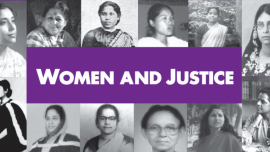
Women in justice and justice for women