


Can sand-filling help coastal households adapt to salinity?

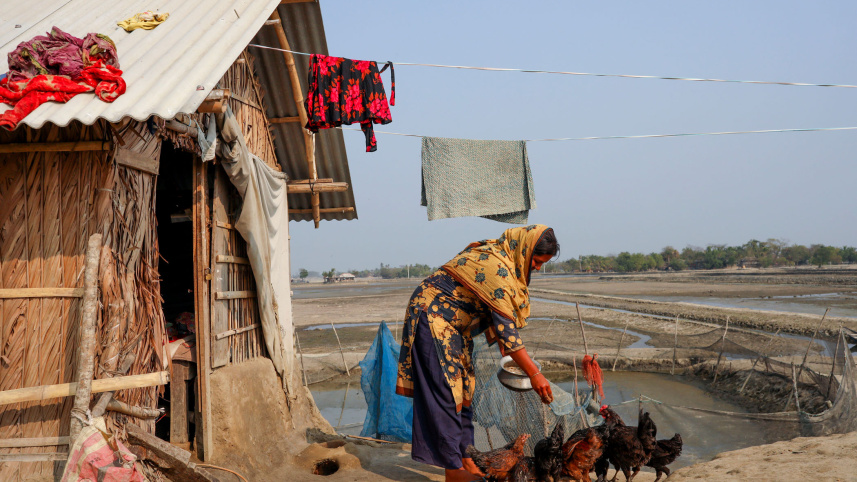
In May 2025, during a focus group discussion in Sonailtala of Mongla upazila, Bagerhat, I learned how the people living in this salinity-affected coastal area have been adapting to changing environmental conditions in ways that are rarely captured in formal research or policy discussions. One such practice is raising homestead land with sand. Some residents told us that they had brought sand and raised their homestead land around a decade ago. Their initial intention was not to improve agricultural production or grow fruit trees. They simply wanted to raise their homesteads above the surrounding land and reduce their exposure to saline water.
But something unexpected happened over time. On some of these raised homesteads, residents are now able to grow fruit trees, including mango trees. Residents said that before raising the land, growing such trees was difficult because of salinity and the associated environmental conditions. After several years, the raised land appears to have created a more favourable environment for vegetation.

This does not prove that sand-filling is a solution to soil salinity. There are still too many unanswered questions. We do not yet know how much the salinity level changed, whether the improvement is primarily owing to the additional soil depth, improved drainage, changes in groundwater movement, or other factors. Nor do we know how long such an effect could be sustained.
But these observations raise an important research question: can raising homestead land with suitable soil or sand help coastal households cope with salinity? The question is particularly relevant for coastal Bangladesh, where salinity is a growing concern. Affected communities are already spending their own money to adapt, often without technical guidance or government support. Their experiences should not automatically be dismissed simply because their ideas do not originate in laboratories or within development projects.
At the same time, there is a critical issue with this practice. Extracting sand from natural sources is restricted or prohibited in many circumstances because uncontrolled sand extraction can damage rivers, agricultural land, and ecosystems. Therefore, promoting indiscriminate sand extraction as a salinity adaptation strategy would create another environmental problem.
There is also an equity issue. Raising a homestead with a substantial amount of sand requires money. Poor households may not be able to afford it, while relatively wealthy families can. If sand-based land raising proves useful, it cannot become an adaptation strategy available only to those who can pay for it.
Another major limitation is that using sand to raise homesteads is not necessarily a permanent solution. Sand may raise the elevation of a homestead, but it cannot remove salt from the wider landscape. Salinity can return through tidal flooding, groundwater, surface-water intrusion, and poor drainage. In other words, piling on sand does not mean that the underlying salinity problem of the area will be solved.
Interestingly, residents in Sonailtala also suggested another possible application. They argued that embankments could be constructed using a sand-filled core, with reinforced sides, to provide greater protection against saline water entering agricultural and homestead areas. This idea also requires careful scientific assessment. The stability of an embankment depends on its design, materials used, slope, drainage ability, foundational conditions, and exposure to water and erosion. A sand-filled core cannot simply be assumed to make an embankment more durable. Still, the local suggestion is worth exploring, particularly because the people living behind these embankments understand their failures in ways that may not always be visible from an engineering office.
This is also why Bangladesh’s adaptation research needs to change direction. We often approach vulnerable communities with a list of technologies that experts believe they need. But communities are already experimenting with their own solutions. Some may be ineffective or even environmentally harmful. But some may contain an idea that deserves further investigation.
The practice of raising homestead land is one such example. Instead of immediately promoting or dismissing land raising, researchers should scientifically compare raised and non-raised homesteads. We need to analyse soil salinity at various depths, evaluate groundwater conditions, measure vegetation health, and track the costs of raising land against long-term benefits, especially for low-income households.
Crucially, future research must identify sustainable filling alternatives. Dredged river sediment, locally available non-saline soil, or other environmentally safe materials could be assessed based on their physical and chemical characteristics.
The lesson from Sonailtala union is, therefore, not that “sand can solve salinity”, but rather the lesson that local adaptation deserves to become a starting point for scientific inquiry. Coastal Bangladesh has extensive experience of dealing with floods, cyclones, river erosion, and salinity. Communities along this belt have therefore developed countless small-scale adaptation mechanisms, many of which remain undocumented. If researchers, engineers, and policymakers systematically document these practices and test them scientifically, some of these could contribute to more practical and locally appropriate adaptation strategies.
The people of Sonailtala did not set out to conduct an experiment. They raised their homesteads because they needed to live there. A decade later, the mango trees growing on the raised land may be telling us something, but it is up to us to figure out exactly what it is.
Md Ayatullah Khan is doctoral researcher in Department of Geography at Hong Kong Baptist University, Kowloon Tong, Hong Kong.
Views expressed in this article are the author's own.
Follow The Daily Star Opinion on Facebook for the latest opinions, commentaries, and analyses by experts and professionals. To contribute your article or letter to The Daily Star Opinion, see our guidelines for submission.
 For all latest news, follow The Daily Star's Google News channel.
Comments