


Taxing microsavings risks undermining financial inclusion for the poor

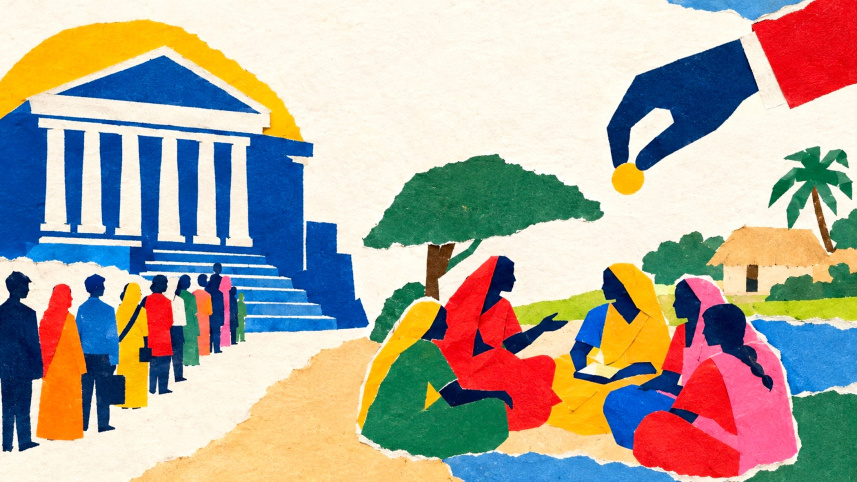
“Financial inclusion” is the buzzword that has been used to increase the number of banks in Bangladesh. It was argued that many people, primarily the poor, still don’t have bank accounts and so the number of banks should be increased. At present, 62 scheduled banks operate in Bangladesh. But only 28.3 percent of the population aged 15 years and older have accounts with banks or other financial institutions, according to the Bangladesh Sample Vital Statistics 2023. This is indeed a paradox. Although state-owned banks and a handful of private banks operate in both rural and urban areas, the poor have less access to their services. Foreign banks don’t operate in rural areas, let alone offer any services to the poor. Not many banks have customised services for the poor, either.
Conventional banks fail to reach the poor because their lending approach is too conservative. They sanction loans with collateral, but lower-income families rarely have assets to provide as collateral. Furthermore, banks generally follow some defined criteria for lending, with which most of the poor fail to comply. They prefer large loans to minimise operating costs, but the poor seek small loans which these banks avoid due to high operating costs. Moreover, the cost of monitoring numerous small borrowers is high for traditional banks because the rural poor live in remote areas, and most of the urban poor are mobile and lack permanent addresses. The poor also frequently use loans in unproductive sectors. Hence, lending to the poor following traditional methods is deemed risky.

Conventional banks also have to deal with asymmetric information—a situation where one party has more information than the other—while selecting low-income borrowers. The poor often lack a formal credit history, which may lead to adverse selection—selecting the wrong borrowers at the cost of the right ones. Wrong borrowers, if selected, tend to divert loans to unproductive sectors, leading to moral hazards. Therefore, banks prefer collateral-backed lending to the poor.
Banks are private firms with a public purpose; bound to provide banking services to all. But banks in Bangladesh fail to provide financial services to the poor, and especially poor women. This is not done on purpose but because banks follow a faulty loan production system where the poor remain excluded. By serving the rich and non-poor customers, our banking sector has ended up with a non-performing loan (NPL) rate of 32.78 percent—the highest globally. Although moneylenders in the informal credit market provide loans to the poor without collateral, a limited number of professional moneylenders, with inadequate funds, cannot reach all the poor. On top of that, their interest rates are abnormally high.
In this setting, microfinance institutions (MFIs) have been able to grant collateral-free loans to the poor, reducing the asymmetric information problem through self-selection of groups and joint liability. They leave the responsibility of borrower selection to the poor. Generally, in microcredit, a group of five to ten members is formed. Although a loan is sanctioned to one borrower, all group members remain liable for its repayment. Every member has an incentive to monitor the loan performance. They ensure that the loan is appropriately used and repaid on time. This form of peer pressure works as social collateral—a replacement for physical collateral. Microfinance members don’t need to visit the offices; rather, the employees reach them in their villages.
MFIs have been able to reach the poor, nearly 91 percent of whom are women. MFIs supplement credit with microsavings. Microcredit is often linked to savings—that is, the higher the savings of a borrower, the larger the size of a loan. Microsavings aid capital formation and provide a safety net for families facing risks of illness, natural disasters, crop failure, and income loss. MFIs also provide interest on savings like banks. However, a recent move by the National Board of Revenue (NBR) to collect tax on interest earned from microsavings has raised serious concerns among microfinance operators.
Statistically speaking, the amount of microsavings is low, and so is the profit on them. The interest rates vary between 6 and 12 percent. The Microcredit Regulatory Authority (MRA) data shows that, as of June 2026, the amount of savings of the country’s 633 licensed MFIs was Tk 95,720 crore. If the average interest rate on these savings is considered 8 percent, the sum of interest payment was about Tk 7,658 crore. A 10-percent tax on this profit will result in revenue of nearly Tk 766 crore. This amount will certainly finance the budget deficit, but at what cost? This figure is minuscule for the government but significant for the poor. If the poor feel discouraged from saving, the low saving rate will lead to higher dependency on credit, thus increasing their indebtedness. This will also reduce their financial backing for mitigating risks.
Whereas the poor should be encouraged and incentivised to join microfinance programmes to improve their livelihood, the government has imposed a tax on microsaving profits. These microsavers are low-income people; their earnings are well below the taxable income threshold. If the profits of their savings at MFIs are taxed at the same rate as that of deposits at banks, it would be imbalanced. The main objective of microfinance is to fight poverty by increasing the financial inclusion of unserved communities. Even though traditional banks receive deposits from the poor, they have reservations about granting them loans. They transfer funds from the poor to the rich, creating financial inequality. But microfinance operators reinvest deposits from disadvantaged communities back into those communities.
MFIs have been successful in reducing the presence of moneylenders. The poor get loans at a maximum of 24 percent, instead of abnormally high interest rates. Considering the high operating costs of microcredit, this rate is not irrational. But one research study found that the poor paid as much as 250-percent interest on a loan taken from the informal credit market. As a result of granting small loans from small deposits, the risk of maturity mismatch is low. Microcredit has low default risk and outstanding repayment performance—95 percent loans are repaid.
We must remember that microfinance emerged because the traditional banks failed to reach the poor. Conventional banks claimed the poor were not bankable. But MFIs proved that the poor can be successfully served with financial services to reduce poverty.
Instead of supporting the microfinance sector, the government is now intending to collect taxes from the poor. Through this change, despite having an income below the taxable income threshold, low-income populations will be unfairly included in the direct tax system. If the poor turn away from saving up, it may prove to be catastrophic. The government should revert this decision.
Dr Md Main Uddin is professor and former chairman of the Department of Banking and Insurance at Dhaka University. He can be reached at mainuddin@du.ac.bd.
Views expressed in this article are the author's own.
Follow The Daily Star Opinion on Facebook for the latest opinions, commentaries, and analyses by experts and professionals. To contribute your article or letter to The Daily Star Opinion, see our guidelines for submission.
 For all latest news, follow The Daily Star's Google News channel.
Comments