


Bangladesh’s child marriage paradox
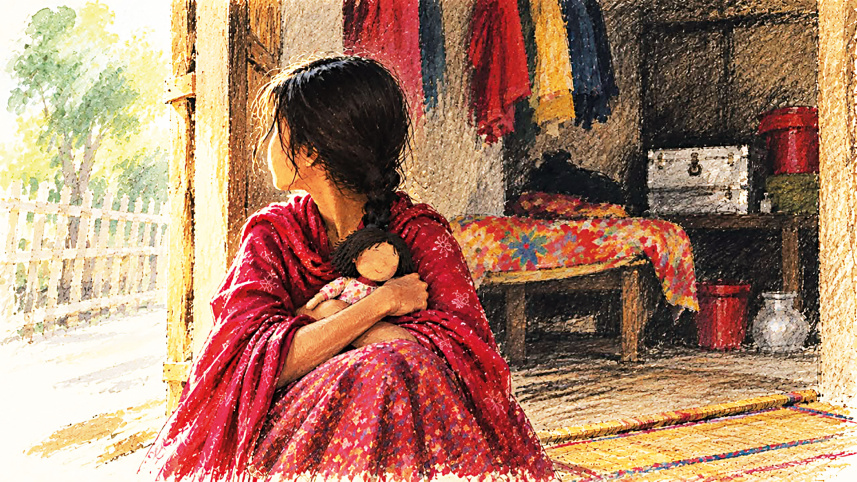
Zimbabwean human rights activist and lawyer Nyaradzayi Gumbonzvanda once said, “I call child marriage child rape”. The words are stark because the reality is. Across Bangladesh, too many girls still see their childhoods narrowed by poverty, violence, the cost of staying in school, social expectations that arrive with puberty and, ultimately, marriage before adulthood. This International Day of the Girl Child, we ask what pushes girls towards early marriage, what prevents them from staying in school, why the systems meant to protect them from violence fail, and why growing up in a patriarchal society so often means growing less free. Ending child marriage means protecting childhood itself. The mission is unequivocal: keep girls safe, keep them in school, protect their right to choose their own futures — and end child marriage, for every girl, everywhere.
Over the past 25 years, Bangladesh has sharply reduced maternal and newborn deaths, expanded education and employment, and cut poverty. Yet child marriage remains a striking exception.

Despite industrialisation, urbanisation and rising wealth, progress has been slow.
The 1993-94 Bangladesh Demographic and Health Survey (BDHS) found 73 percent of women aged 20-24 married before 18. By 2022, this fell to 51 percent, a decline of just 22 percentage points in nearly three decades, averaging 0.7 points annually, far slower than in India, Pakistan, Nepal and the Maldives.
Education and wealth, strong global predictors of child marriage, have been less effective here. The Multiple Indicator Cluster Survey (MICS) 2025 found that 25 percent of women aged 20-24 with higher secondary education married before 18.
Even among the wealthiest households, nearly one in three — 31.5 percent — married before they were 18. The urban-rural gap was also narrow, at 42.5 percent and 49.4 percent.
WHERE SHE LIVES SHAPES WHEN SHE MARRIES
A 2024 Bangladesh Bureau of Statistics (BBS) small-area estimate puts child marriage prevalence among women aged 20-24 at that time at 38.3-65.7 percent across 541 upazilas.
Khulna and Rajshahi have the highest rates. All 64 upazilas in Khulna exceed 60 percent (60.1-64.0), as do 69 of Rajshahi’s 70, except Matihar.
Chapainawabganj Sadar tops the country at 65.7 percent, with other high-prevalence areas in Bogura, Joypurhat and Sirajganj.
Most areas of Barishal, Chattogram, Mymensingh, Rangpur and Dhaka divisions record 48-53 percent. Within Dhaka, Shahbag records 39 percent, the lowest, and Mirpur 60 percent, the highest.
In contrast, every Sylhet upazila remains below 43 percent (38.3-42.8). Sunamganj has the lowest district-level prevalence, while Sunamganj’s Jagannathpur upazila records the national minimum of 38.3 percent.
MARRIED YOUNG, WISHING THEY HAD WAITED
Women in Khulna, Rajshahi and Rangpur divisions marry younger than women in any other parts of the country, and they are also the most likely to say that they would have preferred to marry later, according to Bangladesh Demographic and Health Survey (BDHS) 2022.
In these three divisions, the median age at first marriage among women aged 20-49 is 16, the lowest in the country. This means, half of the women there were married by 16 or younger.
These divisions also have the most married women who say they would have preferred to marry later: 47 percent in Rajshahi, 42 percent in Khulna and 37.8 percent in Rangpur.
Sylhet division sits at the opposite. It is the only division in Bangladesh where the median age of first marriage exceeds 18, standing at 18.8 years.
Just 16.6 percent of women in Sylhet said they would have preferred to marry later. Women in Rajshahi and Khulna are three times more likely to say that.
 For all latest news, follow The Daily Star's Google News channel.
 While the survey does not explore causal mechanisms, research on effects of child marriage sheds light on why these attitudes differ across divisions.
Research links child marriage to lower education, reduced status within husbands’ families, less reproductive autonomy and higher maternal mortality risks. A study analyzing data across 34 countries, including Bangladesh, also found that women who married as children faced a substantially higher risk of physical or sexual violence from an intimate partner compared with those who married as adults.

THE SYLHET PUZZLE
Conventional indicators suggest Sylhet should have high child marriage prevalence.
It has the lowest proportion of women aged 15-49 with secondary education or higher, the highest without education, and the lowest female employment: 18.8 percent against 32 percent nationally, according to BDHS 2022.
Wealth offers little explanation. Noakhali and Dhaka have among the lowest poverty rates, at 6.1 and 6.8 percent, yet child marriage averages around 52 percent across their upazilas.
In Meherpur, Khulna, Sirajganj and Bogura, also among the 10 lowest-poverty districts, over six in ten women married before 18.
A 2020 Iris Group report likewise found Sylhet lagging in socioeconomic and health indicators despite its lowest child marriage prevalence.
Iris Group is a women-led international development consulting firm.
To investigate, The Daily Star visited Jagannathpur, speaking to teachers, officials, students, politicians and residents across Sunamganj.
Jagannathpur Upazila Nirbahi Officer Md Islam Uddin attributed later marriages partly to men seeking to establish themselves abroad.
“Compared to the rest of Bangladesh, young men in Sylhet marry at an older age. This is also a diaspora-heavy region, and most aim to go abroad. Moving abroad and getting established takes time.”
The 2022 census shows 37.77 percent of Sylhet residents unmarried, against 28.65 percent nationally. In Jagannathpur, the figures are 49.96 percent for men and 36.28 percent for women.
About one in four Jagannathpur households receives remittances, according to the census district report. Locals say most migrants live in the UK.
Shitangshu Shekhar Dhar, former vice-chairman of neighbouring Shantiganj upazila, cited European influence: “Locals here look up to those based in the UK or Europe.”
Yet even Sunamganj upazilas with relatively few UK or European migrants have lower prevalence than almost anywhere else.
A.K.M. Azad Mia, acting headmaster of Government Jubilee School, said historical and cultural factors might be at play. As evidence, he pointed to his own mother, who married in 1965 at the age of 24.
HIGHEST IN C’NAWABGANJ SADAR
Ashraful Alam runs a tea stall with his son in Noyagola village, outside Chapainawabganj municipality. Marrying off his daughters before 18 had “unburdened” him, he said.
He had intended to wait until one daughter turned 18 but accepted a dowry-free proposal, fearing delay could bring dowry demands and jeopardise her safety.
“This is also in line with Shariah,” he said, arguing that legal marriage ages of 18 for women and 21 for men disregard mental and physical maturity.
Chapainawabganj Sadar has the country’s highest upazila-level prevalence: 65.7 percent of women aged 18-49, according to the 2024 BBS estimate.
Yet enforcement figures barely reflect the scale. Only 18 child marriages were prevented districtwide in the first six months of 2026, and another 41 during 2023-25.
Government officials, civil society representatives, politicians, students and residents cited limited women’s employment, religious conservatism, poverty, safety concerns, weak enforcement and scant political attention.
Shahida Akhter, assistant director of the Chapainawabganj Department of Women Affairs, identified scarce jobs as a major driver.
“Women hardly go outside the district for work, and there is nothing for them here.”
The 2022 census district report shows 58.67 percent of women aged 15-24 in Chapainawabganj Sadar are not in education, employment or training. Nearly half of girls aged 15-19 neither study nor work.
Dr Sultana Papia, a medical officer at the district Civil Surgeon’s Office, said she had never witnessed such widespread child marriage elsewhere she had lived or worked. The northwestern district has over 18 lakh residents.
“They marry off children at 12-13, and every child is conditioned to believe early marriage is normal. To them, marriage is like playing with dolls.”
Blaming poverty and “religious fanaticism”, she recalled health workers being denied entry to some madrasas to administer cervical cancer vaccines to girls.
“We even sent religious figures and approached local political leaders, but these clerics would not allow it. This kind of superstition is particularly prevalent in this district.”
Md Joynal Abedin, secondary education officer of Chapainawabganj Sadar upazila, called religious conservatism the “driving force”, alleging clerics even blamed girls for sexual violence that girls themselves face.
Atikul Islam, a student of Exim Bank Agricultural University, cited widespread sexual harassment of girls. “Parents concerned about their daughters’ safety marry them off at 16-17.”
Residents and government officials also alleged marriage registrars, or kazis, facilitated child marriages.
“They charge more than triple their usual fee to handle a child marriage,” said a district education office official, requesting anonymity.
Together, these accounts show how economic insecurity, social pressures and weak enforcement continue to sustain child marriage, even as the country progresses on other fronts.
Comments