


Should period put a period on childhood?

I got my first period when I was 11.
I remember being young enough to find it bewildering, but old enough to understand that something significant had happened. Today, 11 hardly seems exceptionally early.

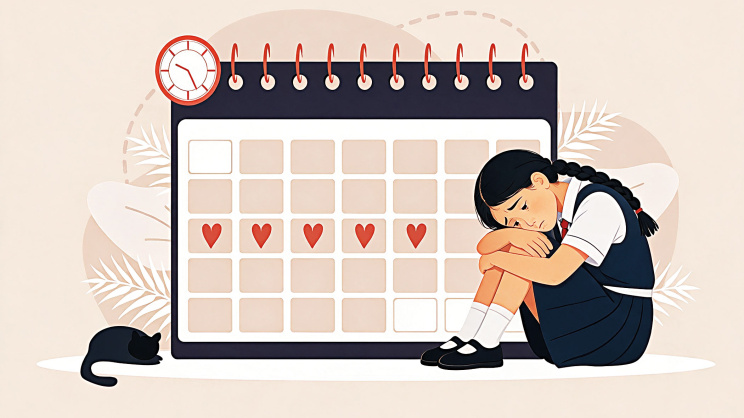
Girls now begin puberty as early as eight. A 2024 Harvard TH Chan School of Public Health-led study of over 71,000 US participants found that the average age of first menstruation fell from 12.5 years among those born in 1950-1969 to 11.9 among those born in 2000-2005. Menstruation before age nine more than doubled, from 0.6 to 1.4 percent.
Eight. That number alone should make us reconsider how we talk about puberty.
In Bangladesh, when a girl begins menstruating or developing breasts, she often hears: “Boro hoye gechho” (You have grown up).
But an eight-year-old has not grown up. Neither has an 11-year-old.
What changes beyond her biology is how society perceives her. Menstruation becomes synonymous with “becoming a woman”, bringing new expectations.
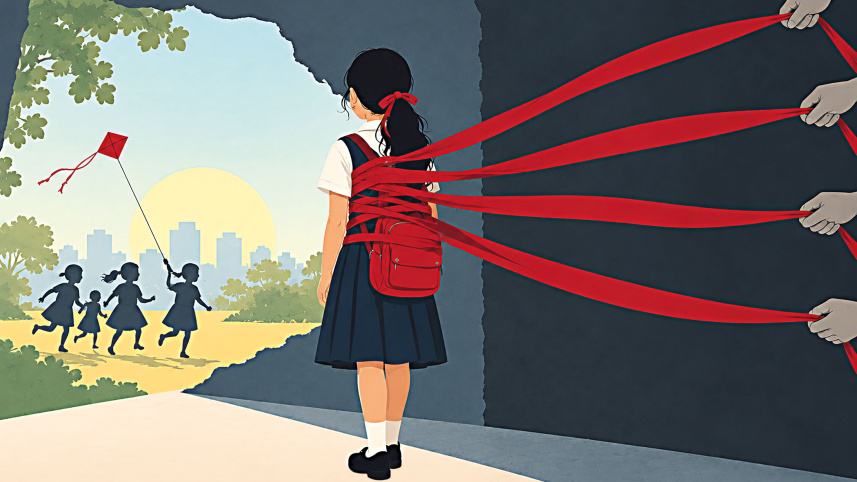
Sit properly. Cover your chest. Don’t play with boys. Don’t go out alone. Come home before dark. Watch how loudly you laugh.
Be careful, above all, of being seen.
Here lies one of girlhood’s cruellest paradoxes: just when a child should be discovering the world, it begins closing in around her.
For boys, growing up often means greater independence. For girls, puberty can mean an expanding list of restrictions.
In Bangladesh, when a girl begins menstruating or developing breasts, she often hears: “Boro hoye gechho” (You have grown up). But an eight-year-old has not grown up. Neither has an 11-year-old. What changes beyond her biology is how society perceives her.
We call it protection, and the fear is not irrational. Girls face sexual harassment and violence, even as toddlers.
A Daily Star analysis of Ain o Salish Kendra data found that among girl children reported raped during January-August 2025, 20 percent were six or younger and another 39 percent were aged seven to 12. Reported rapes of girl children rose 83 percent in the first nine months, from 195 in 2024 to 357 in 2025.
The danger persists. In August this year alone, the Human Rights Support Society recorded 79 rape victims, including 46 children, and 93 women and girls subjected to sexual harassment, including 38 children.
Clearly, puberty is not what suddenly makes girls vulnerable.
So, what changes?
Too often, we begin transferring responsibility for navigating danger onto the girl herself. Previously, she needed protection. Now she receives instructions for protecting herself.
The threat is not new. Our expectations of her are.
 For all latest news, follow The Daily Star's Google News channel.
 Men may stare, so she must cover herself. Men may harass her, so she must stay indoors. Men may sexualise her body, so she must monitor it.
An astonishing burden for someone who may be eight.
Puberty should prompt conversations about menstruation, changing bodies, consent, boundaries, sexuality and safety, not teach girls that developing breasts makes them responsible for someone else’s gaze.
Menstruation signals reproductive development, not emotional maturity. Girls deserve friendships with boys without adults sexualising those relationships, and public spaces without scrutiny.
Our conversations with boys must change too. Imagine investing as much energy in teaching boys that harassing girls is wrong as we invest in teaching girls to avoid male attention.
Every restriction imposed for a girl’s “safety” raises questions: Safe from whom? And why is it her problem?
Restricting her instead of confronting threatening behaviour teaches her that freedom is negotiable.
We cannot spend her adolescence shrinking her world, then demand fearlessness and independence when she becomes an adult. We cannot tell her at nine that the street is not hers and expect her at 25 to stride confidently through it.
Childhood should not have a shorter expiry date for girls. Biology may determine when menstruation begins; it should not determine when childhood freedoms end.
As a girl grows, her world should be allowed to grow with it.
Comments