


The cost of keeping girls in school
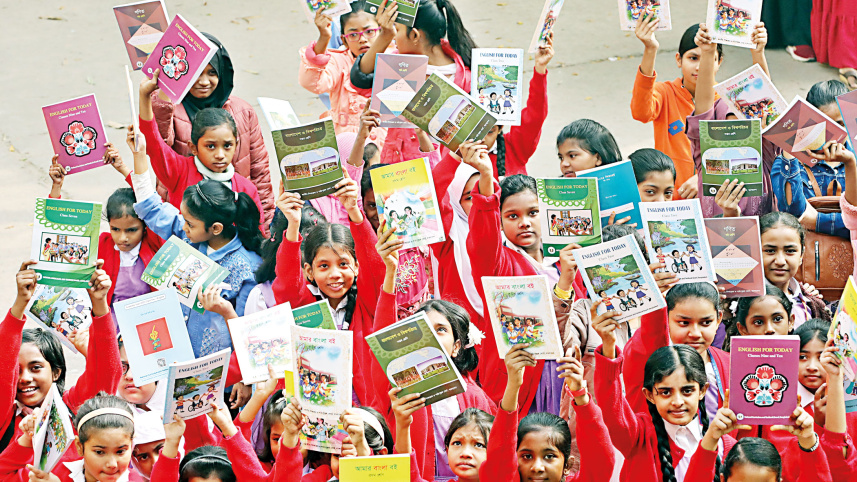
At 14, Sumi Rani should have been preparing for another year at school. Instead, marriage brought her childhood to an abrupt end.
Now 16, the girl from a remote char studied up to eighth grade. Reaching school meant walking, crossing a river by boat and travelling further. The crossing alone could take an hour.

Her mother said educating one child, including private tuition, coaching, notebooks, food and transport, cost Tk 4,000-5,000 monthly.
“Because of the distance and lack of money, we marry them off young,” she said.
The Daily Star spoke to girls who had dropped out, their parents and teachers in Satkhira, Narail, Gazipur, Kurigram, Lalmonirhat, Rangpur, Patuakhali, Rajshahi and Dhaka’s Korail, among other areas.
Their accounts point to poverty, child marriage, education and transport costs, distant schools, safety concerns, unwanted attention, social pressure, household responsibilities, adolescent relationships and declining interest in studies. Some girls also enter domestic work, factories and other low-wage jobs to support their families.
A BRAC project on out-of-school children identifies similar barriers, including inadequate school infrastructure, limited parental education and engagement, child labour, migration and environmental challenges. It warns that official dropout figures may overlook enrolled children effectively disengaged through irregular attendance or poor performance.
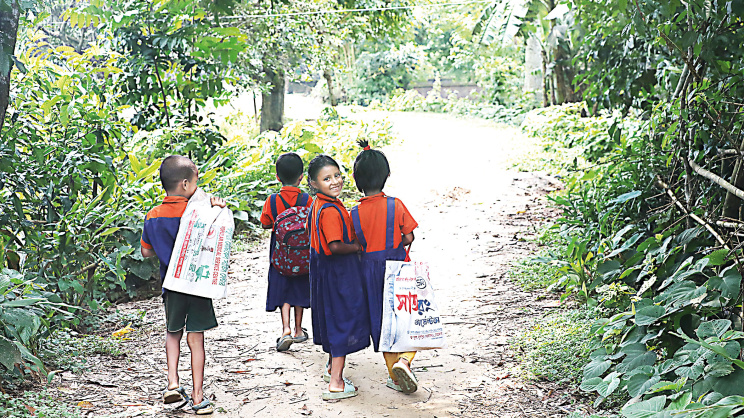
For Ayesha Akhter, now 16, school ended after eighth grade at 13 because her union had no secondary school.
“One option was four to five kilometres away, while another was 13-14 kilometres away and required a boat journey,” said her father, Shafikul Islam.
Transport, food and other expenses cost around Tk 2,000 monthly, he said, adding that roads remained submerged for months during the monsoon.
Two years later, Ayesha was married off at 15, illustrating how dropping out can precede child marriage rather than result from it.
“When girls are not studying and just staying at home, people look at them differently,” her father said, recalling local boys repeatedly asking for her phone number.
His younger daughter, now in eighth grade, wants to continue studying. “But I am unsure whether I can make that happen.”
The BRAC project identified climate-vulnerable Kurigram, citing a 23.6 percent dropout rate from the Annual Sector Performance Report 2021. It also highlighted educational barriers in chars and other remote, climate-vulnerable areas.
CAMPE’s Education Watch 2023 found families spent an average Tk 27,340 out of pocket on secondary education in 2022, particularly on private tutoring and commercial guidebooks.
A farmer, requesting anonymity, said he spends Tk 4,500-5,000 monthly on his daughter’s SSC preparation.
“The expenses include two private tuitions, school coaching and a tutor at home. I want her to complete the SSC,” he said, adding that marriage might follow.
In Gazipur, a young labourer, also requesting anonymity, said he had four brothers and four sisters. While the brothers received some education, the sisters could not continue.
“Education costs a lot now, so my father couldn’t afford to educate them,” he said. His father, he said, has long been bedridden.
Another father, requesting anonymity, said financial hardship allowed him to educate his sons up to HSC but his daughter only up to SSC before marriage.
 For all latest news, follow The Daily Star's Google News channel.
 The BRAC project also identifies gender norms deprioritising girls’ education, alongside early marriage and child labour.
Money, however, is not the only factor.
An 18-year-old Satkhira woman completed SSC before eloping with her partner. Now raising a six-month-old child, she wants to resume studying.
“My mother wants me to study, but my in-laws don’t,” she said, requesting anonymity.
Another woman, who left school after eighth grade and married around 16-17, cited financial difficulties, declining interest in education and her wish to marry.
UNICEF found married girls in Bangladesh are more than four times as likely to be out of school than unmarried girls. BRAC also notes that dropout increases girls’ vulnerability to early marriage, while boys may enter informal employment.
Monir Hossain, principal of Mayer Doa School in Korail, said fee waivers alone cannot always prevent dropout.
“Some stay home to look after younger siblings so their mothers can work, while others take up paid work to support their families.”
Shamshul Alom, a teacher from Gazipur, said excessive mobile-phone use and adolescent relationships affected some students’ interest in education.
“Some girls were married off by their families, while others chose to marry their partners. Some later found work in factories, warehouses and hotels or as domestic workers.”
The BBS-Unicef Multiple Indicator Cluster Survey 2025 found completion rates falling from 83.7 percent at primary level to 69.3 percent at lower-secondary and 43.9 percent at upper-secondary.
It found 47.2 percent of women aged 20-24 married before 18 and 13.4 percent before 15, down from 51.4 percent and 15.5 percent in 2019, respectively. Child labour affected 9.2 percent of children aged 5-17.
Mohammad Asif Ahmed, an information officer at the Ministry of Primary and Mass Education, said government dropout-prevention measures target both sexes rather than girls specifically.
These include primary-school stipends, free textbooks and mid-day meals, with plans for free uniforms, shoes and socks.
“Improving school facilities, including multimedia classrooms, is also part of efforts to increase attendance and prevent dropout.”
Yet opportunities for those already out of school remain limited.
Devbrata Chakraborty, a director at the Bureau of Non-Formal Education, acknowledged limited government programmes for dropouts, particularly at upazila level.
The bureau offers pre-vocational training, generally for those aged 15-25, targeting at least 50 percent female participation, with 20 trainees per batch. Dropouts aged around 11-13 can take a bridge course leading to eighth-grade-equivalent certification.
According to Devbrata, early marriage complicates girls’ return to education or training because of family responsibilities.
Several names have been withheld to protect interviewees’ identities.
(Our Gazipur, Satkhira, Patuakhali, Rangpur and Rajshahi correspondents contributed to this report)
Comments