


Export growth picks up as garment rebounds

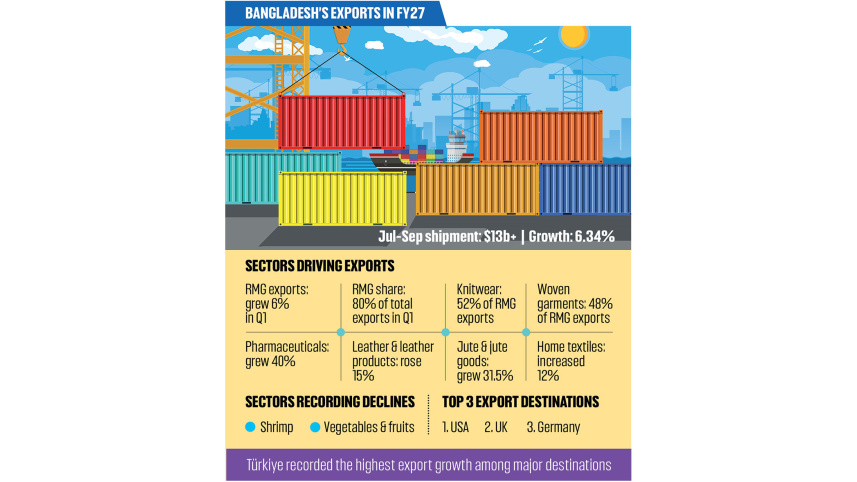
The country’s merchandise exports rose 8.54 percent year-on-year to $3.93 billion in September, helped by a gradual recovery in garment shipments, according to data from the Export Promotion Bureau (EPB) released yesterday.
However, September earnings were 11.11 percent lower than the $4.42 billion recorded in August, data showed.

In the first quarter of the current fiscal year, from July to September, merchandise exports increased 6.34 percent year-on-year to $13.09 billion, compared with the same period a year earlier.
In its statement, EPB said that Bangladesh’s merchandise exports continued to show strong resilience and competitiveness in the global market.
The readymade garment (RMG) sector, the mainstay of the country’s export earnings, maintained its leading position and achieved encouraging growth during the period, according to the EPB.
During the July-September quarter of fiscal year 2026-27, RMG exports increased by 6.10 percent to $10.57 billion, from $9.97 billion in the same period a year earlier.
In September alone, RMG exports rose 8.56 percent year-on-year to $3.08 billion, from $2.83 billion.
Within the sector, knitwear exports grew 6.88 percent in the first quarter to $5.63 billion, from $5.58 billion, while woven garment exports rose 5.11 percent to $4.61 billion, from $4.39 billion.
In September, knitwear and woven garment exports grew 8.58 percent and 8.54 percent respectively from a year earlier.
Several major non-RMG sectors also performed strongly during the period.
Leather and leather products exports grew 14.74 percent in the first quarter of FY27 and 20.19 percent year-on-year in September, reflecting rising global demand and improved market penetration.
Jute and jute goods exports increased by 31.55 percent in the first quarter and 22.72 per cent year-on-year in September. This growth reflects the growing global preference for sustainable and environmentally friendly products.
Light engineering exports grew 16.51 percent in the first quarter of current fiscal year, while September exports rose 3.76 percent.
Home textile exports increased 11.94 percent in the first quarter and 13.52 percent year-on-year in September, supported by steady demand in key international markets.
Pharmaceutical exports recorded the strongest growth among the major sectors, rising 40.39 percent in the first quarter and 64.33 percent year-on-year in September.
Agricultural products and frozen and live fish recorded negative growth during the period. But strong performances by major manufacturing and value-added sectors helped drive overall export growth.
The United States remained Bangladesh’s largest export market in July-September quarter, with exports rising 11.34 percent to $2.59 billion from $2.32 billion a year earlier.
The United Kingdom remained the second-largest export destination, with exports worth $1.37 billion, followed by Germany with $1.21 billion.
Bangladesh also recorded strong growth in several emerging markets. Exports to Türkiye posted the highest growth among major destinations, more than doubling to $210.54 million from $105.21 million, an increase of 100.11 percent.
India and Japan remained important export markets, ranking sixth and ninth, respectively, among Bangladesh’s major destinations, with both recording positive growth, the EPB said.
 For all latest news, follow The Daily Star's Google News channel.
 Some sectors, including frozen fish, agricultural products such as vegetables, tea and fruits, tableware, kitchenware, rubber, cotton and cotton products, man-made filament, terry towels and ceramics, recorded negative growth in the first quarter of the current fiscal year, according to EPB data.
Mohammad Hatem, president of the Bangladesh Knitwear Manufacturers and Exporters Association (BKMEA), said garment exports increased in value but not in volume.
He also said exports in September last year were weak, which helped drive the higher earnings recorded in September this year.
“Higher yarn prices also pushed up the unit price of exported garments, contributing to the rise in overall export earnings in September,” he said.
Yarn prices were higher in September this year than in the same month last year, he added.
International clothing retailers and brands are placing work orders, but there has not yet been a full recovery in orders, he said.
Hatem said a strong rebound in apparel exports is expected as the energy supply situation gradually improves.
Comments