


BB holds policy rate on inflation risks, weak economy
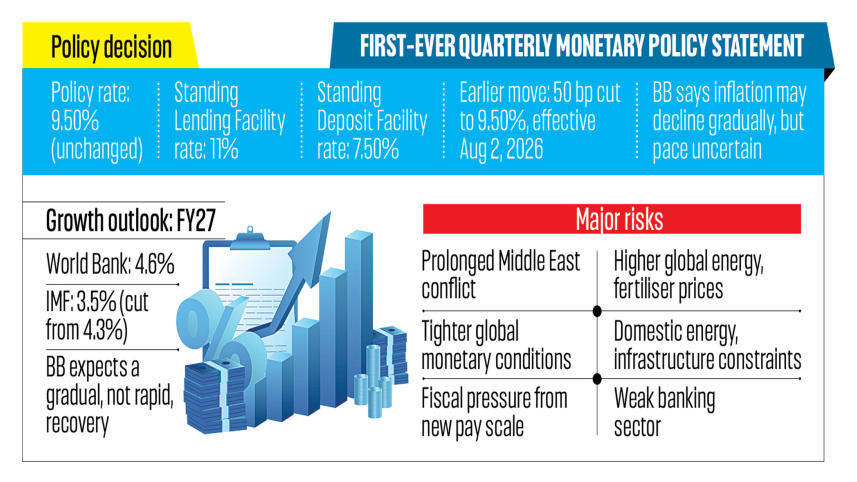
The Bangladesh Bank (BB) has kept its main interest rate unchanged at 9.5 percent for the October-December quarter, saying inflation risks ahead are still large and the economy is weak.
The risks include higher global energy prices, the ongoing conflict in the Middle East, the recent fuel price hike and partial implementation of the new pay scale for public employees.

In its monetary policy statement yesterday, the central bank said it would wait and watch before cutting rates again. The BB lowered the policy rate by half a percentage point to 9.5 percent on August 2.
The Standing Lending Facility (SLF) rate stays at 11 percent, while the Standing Deposit Facility (SDF) rate stands at 7.5 percent, as per the monetary policy statement.
This was the BB’s first quarterly policy statement. Previously, the central bank announced its monetary policy statement for six months at a time.
While announcing the statement at a press conference at BB headquarters, Deputy Governor Md Habibur Rahman said inflation slowed to 8.26 percent in August, the lowest in 10 months, from 9.16 percent in June.
Food prices drove the decline, with food inflation at 7.02 percent. Prices of other goods and services remained elevated at 9.32 percent.
Habibur said the recent moderation in headline inflation does not yet provide sufficient evidence of durable disinflation.
The central bank listed several threats, including higher global energy prices, the prolonged conflict in the Middle East, shipping trouble in the Strait of Hormuz, the latest fuel price hike in the third week of September and the new pay scale for public employees.
“The monetary policy committee decided to observe the impact of these developments for another one or two months before taking a fresh decision on the policy rate,” said the deputy governor.
He said the BB considers its monetary policy stance somewhat tight because the rate is high compared with those in other countries and with inflation.
GROWTH
The Bangladesh Bureau of Statistics (BBS) put growth for the fiscal year 2025-26 at 4.14 percent. However, the central bank said the figure may hide underlying weakness.
Growth in the third quarter of FY26 was only 2.2 percent, while factory output fell 0.28 percent. Recent data point to a small pickup in the July-September quarter, according to the monetary policy statement.
To stimulate economic activity, the BB announced a Tk 60,000 crore loan package, comprising a Tk 41,000 crore refinancing fund and Tk 19,000 crore from its own funds.
Of the total, Tk 20,000 crore is earmarked for reopening closed factories. The rest will go to farming, small businesses and export growth. The central bank expects the plan to create about 25 lakh jobs, restore export momentum and boost farm output.
Private-sector credit grew by just 4.75 percent in August, well below the central bank’s 6.8 percent target through December.
This means banks have plenty of cash, but demand for loans is weak. Interbank rates and yields on government bonds have fallen, yet the lower rates have not reached borrowers.
18-MONTH PLAN FOR BAD LOANS
In June, bad loans accounted for 32.78 percent of all loans in the country’s banking sector.
 For all latest news, follow The Daily Star's Google News channel.
 At the press conference, Habibur admitted that the central bank’s earlier steps to deal with bad loans were slow.
He said the BB and the government are now preparing an 18-month plan to tackle the problem and roll out the stimulus package.
“It will be shared with stakeholders soon,” he said, adding that it should bring a clear improvement.
EXTERNAL SECTOR & OUTLOOK
Habibur said the external sector had provided some relief. The country ran a surplus of $6.6 billion in FY26, helped by strong remittance inflows from Bangladeshis living abroad.
He said this helped keep the taka steady and lift foreign exchange reserves. The BB bought more than $6 billion from the local market over the past year.
The picture changed in the first two months of the new fiscal year, when the balance moved into deficit. Remittances still rose 18.9 percent during the period.
The deputy governor said the central bank expected a gradual rather than rapid recovery.
The World Bank forecasts growth of 4.6 percent for FY27. The International Monetary Fund (IMF) cut its forecast to 3.5 percent from 4.3 percent.
The BB said it would maintain a data-driven approach, with an emphasis on targeted credit support, structural reforms, financial-sector strengthening and orderly exchange-rate flexibility.
Comments