


Can government and fishers work together to restore hilsa abundance?

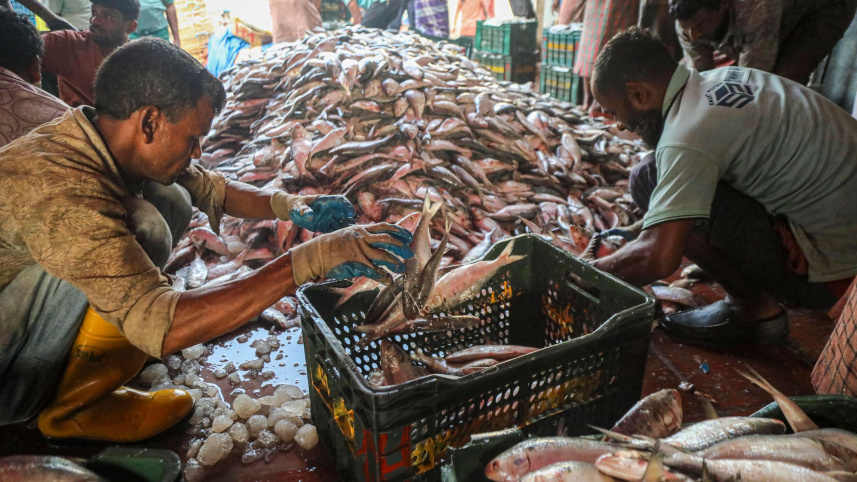
For years, the government has been enforcing an annual ban on hilsa fishing in October, which falls in the fish’s peak breeding season, so that brood fish can spawn in peace. For two decades, this move worked: hilsa production saw a steady rise. However, over the last few years, hilsa production has been in decline. In 2007-08, Bangladesh produced about 295,000 tonnes of hilsa. Fifteen years of conservation nearly doubled that figure to a record 5.71 lakh tonnes in 2022-23. Then the trend reversed: production fell to about 5.29 lakh tonnes in 2023-24 and to around five lakh tonnes in 2024-25—a loss of roughly 71,000 tonnes in just two years. The sea tells an even harsher story: hilsa catch dropped from about 3.22 lakh tonnes in 2021-22 to about 2.51 lakh tonnes in 2024-25—a decline of nearly 22 percent. Much of this decline unfolded while a Tk 229 crore hilsa development project, launched in July 2021, was underway.
What went wrong? The answer lies in a partnership that once worked and is now fraying: the partnership between the government and the fishers who live by the rivers.

The annual ban of catching brood hilsa began in 2008 as an 11-day closure around the full moon in the month of Ashwin in Bangla calendar. When researchers found that hilsa also spawn around the new moon, the ban was extended to 22 days. The impact was dramatic: in 2008-09, only 17.62 percent of brood hilsa managed to spawn, but by 2017-18, spawning success rose to 47.74 percent. That season, around 7.28 lakh kg of hilsa eggs was released, adding an estimated 36,000 crore juveniles—“jatka”—to the population. Spawning success reached a record 52.5 percent in 2023. These gains did not come from the ban alone. They came because the government set the rules and offered support, while fishers stayed off the water.
Community co-management offers further proof. Between 2014 and 2019, the ECOFISH project, jointly run by the Department of Fisheries and WorldFish, brought co-management to 136 fishing villages around hilsa sanctuaries. It formed 575 hilsa conservation groups, set up co-management committees in the six sanctuaries of the Padma-Meghna system, and trained around 400 community fish guards. Those years saw four consecutive seasons of bumper hilsa production. Feeling ownership of the resource, fishers themselves became the hilsa’s most reliable guardians.
Sadly, the partnership is breaking down at three points. The first is support: during last year’s ban, more than 6.2 lakh fishing households in 165 upazilas of 37 districts received 25 kg of rice each under the government’s VGF programme. For a family facing three weeks without income, that is far from enough. Furthermore, officials acknowledged that not every fisher received even this support last year. They promised to cover everyone this time and to raise the allocation in the future. Whether that promise is kept on the ground is going to be the first test of this season’s drive.
The second is fairness in enforcement. During the 2024 ban, in Barishal division alone, authorities conducted 3,212 drives, seized more than 1.3 crore metres of illegal nets and jailed 630 fishers. Such figures show official effort, but they also reveal who bears the punishment. Those caught are mostly poor, young and indebted fishers. The factories that produce current nets, the wholesalers who sell them, and the moneylenders whose advance loans, known as “dadon”, push fishers into the rivers largely escape. Every year, crores of metres of nets are burnt, and every year new nets appear. As long as the source stays open, burning nets will hardly make any difference.
The third, and most neglected, point is jatka-catching. The fry born during the October spawning drift into coastal rivers and estuaries from November. Because of this reason, catching, transporting or selling hilsa smaller than 25 cm is banned from November 1 to June 30. Violations carry up to two years’ rigorous imprisonment or a fine of up to Tk 5 lakh. But this eight-month jatka ban receives far less attention than the 22-day brood ban. Food support for the fishers doesn’t cover the entire ban period. Jatka is still sold openly in many markets. Putting so much effort into protecting the mother hilsa and then allowing the jatka to be caught is like sowing a crop and cutting the seedlings before they can grow. The mother hilsa doesn’t always get spared either. After this year’s 22-day ban came into effect on October 8, several incidents of fishers being caught illegally catching brood hilsa have already been reported.
It all comes down to restoring the partnership between the government and the fishers, which demands action from both sides. First, the government must treat support during bans as compensation, not charity. Rice should be supplemented with cash, delivered before each ban begins and extended across the full jatka season. Second, fisher lists must be updated and made transparent, displayed at union parishads and verified in front of the community, so that genuine fishers are not left out and fake names do not slip in. Third, every landing ghat should have government-recognised fisher conservation groups to guard remote chars and channels at night, where patrol boats rarely reach, backed by a hotline that protects the identity of informants. Fourth, enforcement must move upstream to the factories, warehouses and traders of illegal nets, while the navy, coast guard and River Police should strengthen night patrols across the roughly 7,000 sq-km of core spawning grounds, which the Department of Fisheries has already sought. And lastly, the government must publish spawning success, jatka abundance and enforcement data every year, so that the public can see what works and where gaps remain.
Fishers, too, carry responsibility. A brood hilsa is a fisher’s capital. The fish that spawns safely this October will return as many fish next season. A fisher who casts an illegal net during the ban is stealing from his own future income as well as his neighbours. If fisher associations, boatmen and elders take a stand against violators, that social pressure can achieve more than any drive.
In my experience, most fishers want to follow the rules. What they seek is dignity, fair support and trust. If the government treats fishers as partners, the country will find its most dedicated river guardians among them. Hence, the government must provide fairness and security, and fishers must offer restraint and cooperation. When the two stand together to protect the mother hilsa and the jatka, the country’s hilsa abundance will return.
Mir Mohammad Ali is assistant professor and former chairman of the Department of Aquaculture at Sher-e-Bangla Agricultural University. He can be reached at mir.ali@sau.edu.bd.
Views expressed in this article are the author's own.
Follow The Daily Star Opinion on Facebook for the latest opinions, commentaries, and analyses by experts and professionals. To contribute your article or letter to The Daily Star Opinion, see our guidelines for submission.
 For all latest news, follow The Daily Star's Google News channel.
Comments