


Stop attacks on campus journalists and ensure accountability

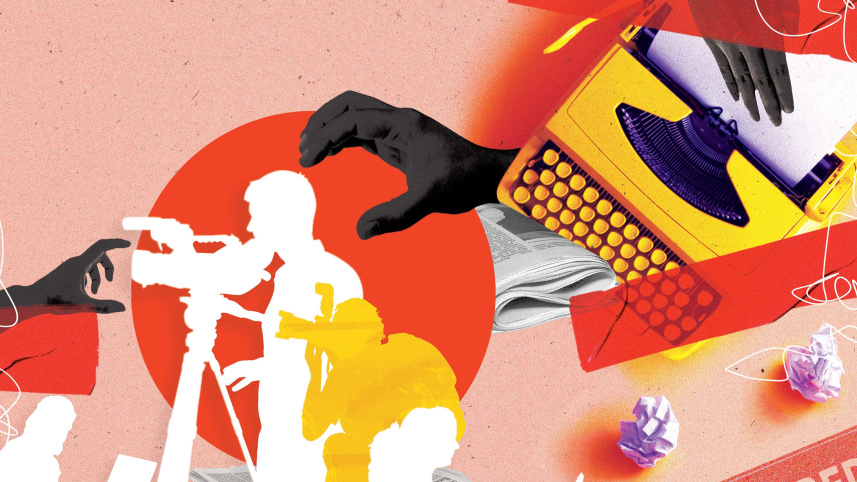
Campus journalism is often seen as a stepping stone to the profession; it is also a training ground. But it is far more than an extracurricular activity. Alongside their studies, campus journalists carry a real ethical responsibility. Campus correspondents are often the first to report what is happening around them. They ask difficult questions and give students a platform to speak about issues that might otherwise go unheard. At the same time, these young journalists are well positioned to expose long-standing malpractice. However, this job is far from easy. The occupation can come with threats, intimidation, expulsion, and even violence.
Protecting these journalists, therefore, is essential not only for their safety, but also for accountability, freedom of expression, and the free flow of information on campus. The latest heinous attack on several Rajshahi University correspondents, carried out by members of the ruling party’s student wing, Jatiyatabadi Chhatra Dal (JCD), goes far beyond threats or intimidation. Although the JCD has expelled its three leaders and The Daily Star has identified seven JCD men and published their photos, the university hall administration filed a case with Motihar Police Station against “unidentified people”. This potentially raises a broader concern about a culture in which accountability is weakened when perpetrators remain unidentified. In some cases, universities routinely respond to such incidents by forming probe committees, only for their findings to gather dust for years.

Consider the Dhaka University case, for instance. On April 23, several reporters of the Dhaka University Journalists’ Association (DUJA) were assaulted allegedly by a group of JCD leaders and activists inside Shahbagh Police Station while covering a dispute triggered by a derogatory Facebook post targeting the prime minister and his daughter. Five months on, the university administration is yet to publish an investigation report.
Universities are places to question, debate, and challenge ideas, and campus journalism is an extension of them. However, when reporting expands to cover topics like irregularities, discrimination, and misconduct, the reporters often come under fire. Asking difficult questions becomes harder when journalists fear what might happen after publication. I know this fear first-hand. When I was a campus correspondent at Jahangirnagar University five years ago, senior administration officials would often remind me, “You are a student first, then a journalist.” The remark is not entirely wrong. Student reporters must balance their academic careers with a demanding and vulnerable job. But the line also works as a warning, and sometimes, the work can jeopardise the reporter’s academic life.
I can recall two cases in the past decade in which campus reporters were suspended from their universities. One is Mohammad Iqbal Monwar, a reporter for the Bangla daily Jaijaidin at Comilla University, who was suspended over a report in 2023. The suspension order said Monwar had violated university discipline by allegedly distorting a statement by the then VC AFM Abdul Moyeen, and intentionally circulating misleading information to tarnish the university’s image. The other case involved Fatema Tuz Zinia, the university correspondent for The Daily Sun. The Gopalganj Science and Technology University suspended her over social media posts that the authorities claimed had damaged the institution’s image.
Such incidents affect far more than the journalists targeted. The immediate victim may drop a story; other journos become reluctant to investigate similar issues, while editors grow more cautious about publishing sensitive reports. Eventually, self-censorship takes root. Therefore, the safety of campus journalists, who is also the student of the university, must be treated as an institutional issue. When a journalist faces intimidation, threats, or violence because of their work, complaints must be taken seriously, investigated transparently and settled through established rules and procedures.
Too often, however, the authorities themselves are part of the problem. In 2019, when I was a leader of the Jahangirnagar University Journalists’ Association, two of my colleagues—Shoriful Islam Simanto of Bangladesh Pratidin and Maidul Islam of Prothom Alo—were assaulted when they sought comments from then vice-chancellor Farzana Islam while investigating allegations that Bangladesh Chhatra League leaders had demanded Tk 2 crore from the VC as “Eid salami,” claiming it was their “fair share”.
However, this does not mean campus journalists should be above criticism. Student journalists, like all journalists, must verify facts, avoid presenting allegations as facts, give people a fair chance to respond, and rely on evidence rather than sensationalism. They should correct their mistakes, and those who feel misrepresented have the right to seek a correction or respond. But intimidation or violence is never an acceptable response.
Student organisations also have an important role in creating this culture where people are welcome to strongly disagree with a report, may challenge information or interpretation. Such disagreement is part of a healthy campus environment. But disagreement should be expressed through argument, evidence and logic—not through threats or violence. Newsrooms, too, have a responsibility to support campus reporters, including with legal and financial assistance when necessary. Many correspondents work with limited support despite the risks involved.
Universities should be places where questions are embraced, evidence is treated with importance, and disagreements are resolved through dialogue. Protecting campus journalism means protecting young people’s space to question power. As when a campus journalist is silenced by fear, the entire campus loses an important channel of accountability.
Md Asaduz Zaman is a journalist at The Daily Star. He is also a former Jahangirnagar University correspondent. He can be reached at asaduz.zamanjubd@gmail.com.
Views expressed in this article are the author's own.
Follow The Daily Star Opinion on Facebook for the latest opinions, commentaries, and analyses by experts and professionals. To contribute your article or letter to The Daily Star Opinion, see our guidelines for submission.
 For all latest news, follow The Daily Star's Google News channel.
Comments