


The Empire and the performance of moral high ground


Power, devoid of decency, sheds the mantle of governance and reveals its coercive core.
In the modern age, no state has perfected this aesthetic more completely than the United States of America -- its methods are sophisticated, its rhetoric moralistic, its machinery bureaucratically antiseptic.

Yet beneath the procedural varnish lies something elemental and ancient -- the logic of dominance.
Under Donald Trump, this logic has become performative, almost operatic in its unapologetic assertion.
There is something faintly theatrical about the American republic’s insistence on its own innocence. It wages war while invoking peace, topples governments while invoking democracy and assassinates adversaries while invoking law.
Like a mob boss who insists his violence is merely “business”, US has refined coercion into doctrine and brute intervention into habit.
It is defined by its monopoly on force and its insistence that its force is uniquely justified.
And Iran is not where it all began
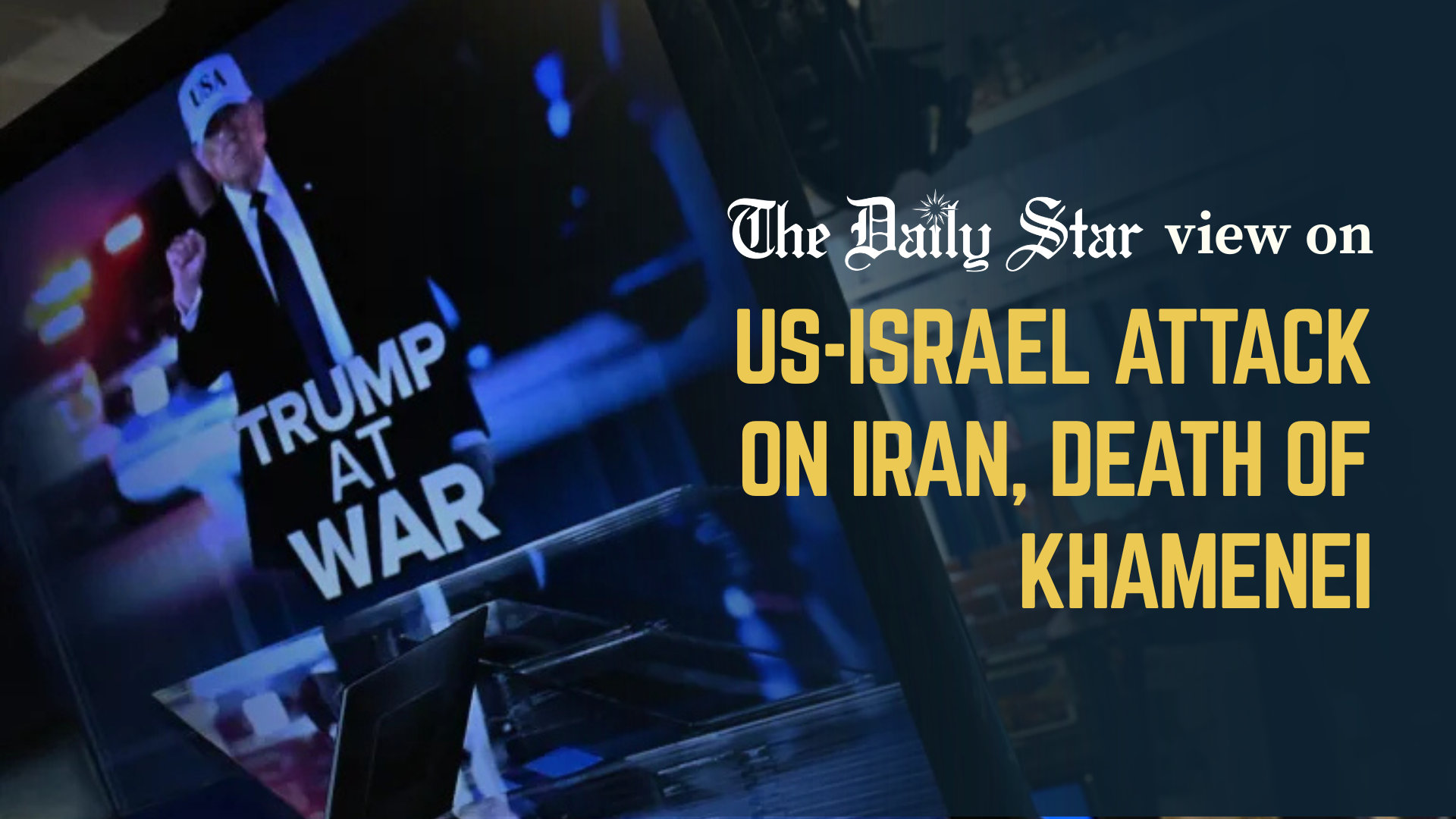
The killing of Iran’s supreme leader, Ayatollah Ali Khamenei, on February 28 was part of a coordinated US-Israeli airstrike designed explicitly to decapitate the country’s leadership structure, using intelligence provided by American agencies.
Iranian state media confirmed his death, while subsequent strikes targeted additional leadership nodes, including the residence of former president Mahmoud Ahmadinejad.
On January 3, 2026, US special forces entered Venezuela under cover of aerial bombardment, captured its sitting President Nicolás Maduro, and transported him to New York to face trial under American jurisdiction.
A sovereign leader was removed physically from his own territory and placed under the custody of a foreign power. Yet US proceeded with the serene conviction of a creditor repossessing defaulted collateral. In all fairness though, Donald Trump inherited this grammar of coercion. But, to his credit, Trump refined the theatrics.
To understand Trump’s comfort with domination, one must return to New York in the 1970s, where his career began in the tactile brutalism of the construction business.
New York real estate in that era was less a market than a contested terrain, where concrete rose through negotiations not merely with bankers and architects but with intermediaries who operated in the penumbra between legality and organised crime.
Numerous investigative reports, including those by The New York Times and other US outlets over decades, documented how developers navigated these networks as a routine cost of doing business. The ecosystem rewarded aggression. It punished hesitation.
When Trump entered politics, he scaled this paradigm. The presidency became, in effect, a larger construction project, with nations rather than boroughs as his units of negotiation.
The pattern of American military intervention in the new millennium provides the structural context for this evolution.
Following 9/11, Afghanistan became America’s longest war, stretching two decades before ending in withdrawal and Taliban restoration. The US invaded Iraq in 2003 under the pretext of trying to locate weapons of mass destruction which were never found. Libya’s regime was dismantled in 2011, leaving a fractured state in its wake. Syria became a theatre for proxy conflict, drone warfare and covert intervention.
 For all latest news, follow The Daily Star's Google News channel.
They were systemic expressions of a doctrine in which military force functioned as an extension of ambition.
The US strikes on Iranian nuclear facilities in June 2025, were framed triumphantly, with Trump declaring that the targets had been “completely and totally obliterated.” The language was hardly diplomatic. He celebrated the act.
The psychological shift was profound. Previous US presidents cloaked intervention in reluctant necessity. Trump clothed it in unapologetic assertion.
The Venezuela operation demonstrated this most vividly. It achieved, in hours, what decades of sanctions and diplomacy could not -- the removal of a sovereign leader and the restructuring of a nation’s political trajectory under American supervision.
Oil sanctions were lifted, privatisation reforms initiated and geopolitical alignment recalibrated.
Control need not always be formal to be absolute.
Strikes on Iran represent the continuation of this doctrine. The US state, of course, rejects such characterisation and prefers to think of itself as a guarantor of order and stability, a reluctant hegemon compelled by necessity.
And indeed, American policymakers often genuinely believe this narrative. Empire, after all, rarely perceives itself as empire.
Comments