


Fuel price hikes feed inflation but ease subsidy burden
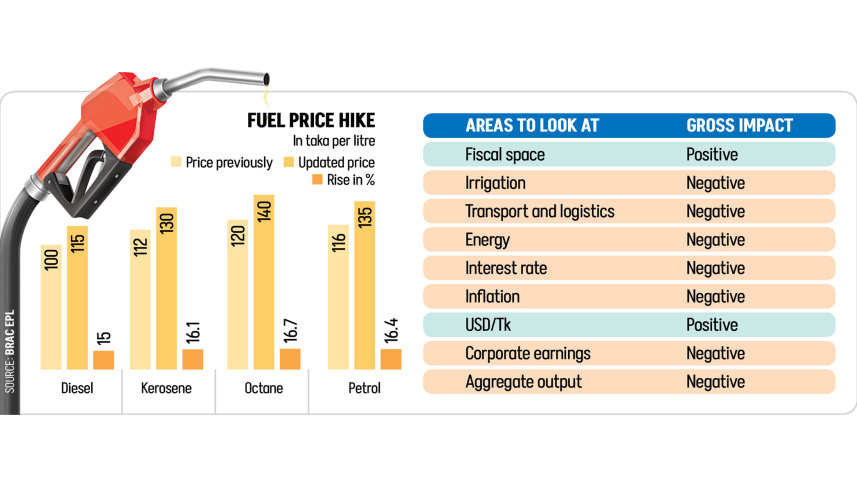
The latest fuel price increase is expected to send shockwaves through much of the economy, lifting costs for farmers, transporters and manufacturers while offering only slight relief to the government finances and the exchange rate, according to an analysis by Brac EPL Stock Brokerage Ltd.
The brokerage estimates that seven out of nine key economic indicators it reviewed will face negative pressure. Only two areas, fiscal space and the dollar-taka exchange rate, are likely to benefit.

The government on Saturday night raised the prices of four fuels with effect from midnight. Diesel now sells at Tk 115 per litre, octane at Tk 140, petrol at Tk 135 and kerosene at Tk 130.
Bangladesh introduced an automatic, market-driven fuel pricing mechanism on March 7, 2024. Under the guidelines, prices are adjusted in the first week of each month based on the Mean of Platts Arab Gulf benchmark published by S&P Global.
For months, however, prices moved within a narrow Tk 1 to Tk 2 range in line with global markets. This time, the adjustment crosses over 15 percent, reflecting global price volatility amid conflicts in the Middle East.
Brac EPL estimates that a 15 percent increase across hydrocarbons could cut the subsidy bill by about Tk 700 crore a month at current price levels. That would ease pressure on public finances at a time when weak revenue collection and high operating costs have left the government with limited room to manoeuvre.
Lower subsidy requirements could also trim government borrowing, offering some support to the external balance and the exchange rate. But the impact is not straightforward, rather layered and uneven.
The immediate burden of the fuel shock will fall on irrigation, transport and power generation. North Bengal is in the middle of the Boro season, the largest paddy cycle of the year.
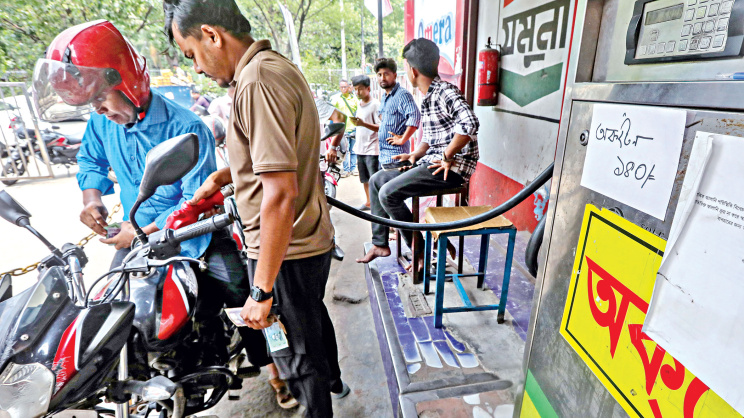
Irrigation there depends heavily on diesel and electricity. Higher diesel prices will raise cultivation costs unless offset by policy support or price adjustments.
Transport and logistics are equally exposed. Freight operators usually pass on higher fuel costs quickly, especially in goods transport. That, in turn, feeds into the prices of agricultural produce, consumer goods and manufactured items.
Although diesel-based generation accounts for less than 2 percent of total power output, its share can rise during peak demand, especially as liquified natural gas (LNG) shortages drag on. Higher generation costs may be passed on to consumers or absorbed through fresh subsidies, according to the report.
It said there could be second-round effects too. Dearer transport, irrigation and energy will add to inflationary pressures already stoked by high imported food prices.
The brokerage said that rising inflation expectations could push up yields on government securities and lift borrowing costs for companies if not carefully managed.
Higher inflation and interest rates, according to the report, would weaken demand, lower output, and leave factories running below capacity, which may ultimately translate into slower GDP growth.
While the country usually depends on long-term supply contracts, diesel, which accounts for nearly 65 percent of hydrocarbon consumption, is increasingly sourced from the volatile spot market.
Because geopolitical tensions have disrupted trade routes, with some suppliers declaring force majeure amid infrastructure damage and shipping blockade through the Strait of Hormuz.
The country’s sole crude oil refinery, Eastern Refinery Limited, has an annual capacity of 1.5 million tonnes and meets about 20 percent of domestic demand across 16 fuel products.
The refinery is currently running well below capacity because of crude shortages and is unlikely to scale up production before May this year.
Besides, existing trade agreements with the US limit Bangladesh’s ability to diversify its fuel sourcing, creating added pressure on procurement.
 For all latest news, follow The Daily Star's Google News channel.
 Brac EPL said reliance on spot purchases, low refinery utilisation and limited sourcing options could prompt further price increases, though at a slower pace.
Bangladesh is seeking an additional $2 billion in external support to cushion exposure to volatile fuel markets, ease foreign exchange pressure, and gradually reduce subsidies.
In the meantime, the country has secured a 60-day waiver from the United States to import fuel from Russia and has sourced 100,000 tonnes from Kazakhstan at around $75 a barrel.y
Comments