


Leading Bangladesh’s Climate-Resilient Future
[Promotional content]
As World Environment Day 2026 dawns, the global conversation has shifted from abstract warnings to an urgent, localised demand for climate action and resource efficiency. In Bangladesh, a nation uniquely positioned on the front lines of climate change, the challenge is multifaceted: managing a burgeoning plastic waste crisis while maintaining industrial growth. The latest research from the Environment and Social Development Organization (ESDO) paints a stark picture, revealing that between 3.15 and 3.84 billion single-use plastic bottles are produced annually within the country. However, only 21.4 percent of these materials find their way into recycling streams. Against this backdrop of environmental urgency and the impending implementation of Extended Producer Responsibility (EPR) regulations, Unilever Bangladesh Limited (UBL) has emerged as a vanguard of industrial transformation.
 For all latest news, follow The Daily Star's Google News channel.
 The company’s journey is not merely about corporate social responsibility; it is a fundamental reimagining of how a global giant operates within a local ecosystem. Unilever Bangladesh’s products currently reach nine out of every ten households in the country. This unparalleled market penetration brings with it a massive responsibility—one that the company has met by embedding sustainable development into the very architecture of its business.
From the historic factory floors of Chattogram to the retail aisles of Dhaka, Unilever is proving that environmental performance and long-term business stability are not only compatible but mutually reinforcing.
The Kalurghat Legacy: A Symbol of Industrial Evolution
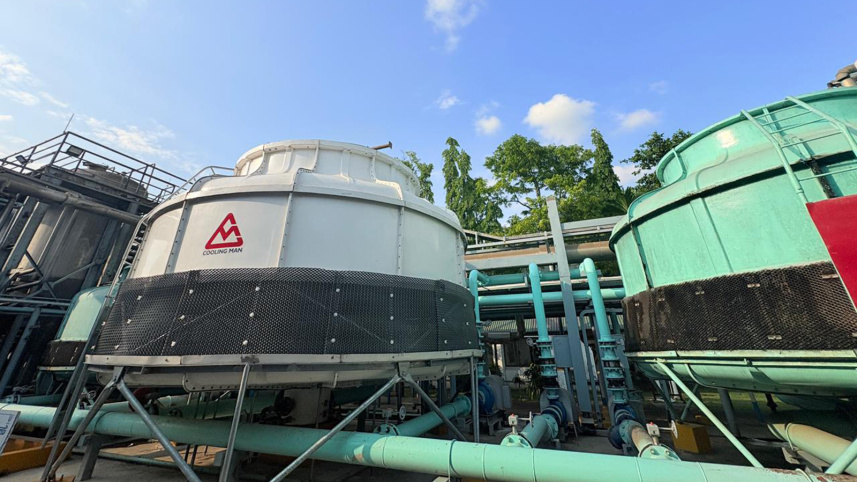
The heart of Unilever’s operations in Bangladesh is the Kalurghat Factory. Located on the western bank of the Karnaphuli River in Chattogram, this facility began its journey in 1964. Following the nation’s independence, the Government of Bangladesh became a 39.25 percent owner of Unilever Bangladesh in 1973. At that time, the factory was celebrated as a symbol of the new nation’s industrial potential. Today, it serves as a global benchmark for sustainable manufacturing.
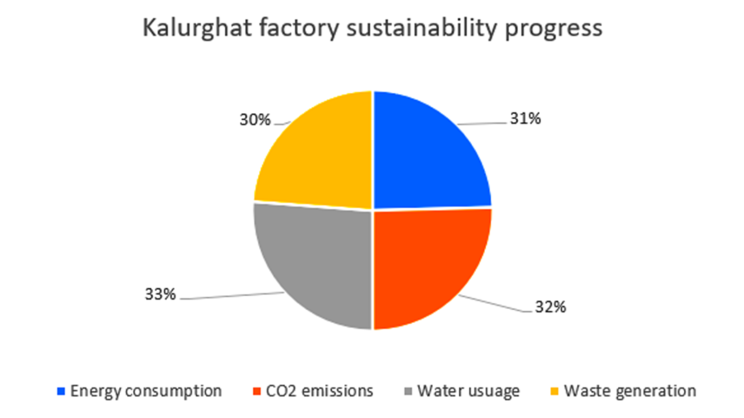
Since 2010, the Kalurghat Factory has been on a rigorous path to achieve measurable and verified progress in energy efficiency, carbon reduction, and resource conservation. This was not a change that happened overnight; it required a decade and a half of continuous analysis and the courage to overhaul traditional systems. Over the past 15 years, compared to its 2010 internal baseline, the factory has reduced energy consumption by 31 per cent, saving approximately 1.61 million gigajoules of energy. This efficiency has directly translated to a 32 per cent drop in carbon emissions, preventing the release of roughly 90,560 tons of CO2 into the atmosphere.
The factory’s approach to water management is equally transformative. In a country increasingly grappling with water scarcity, the Kalurghat facility has slashed its water usage by 33 per cent, which is equivalent to saving 2,763 million liters of water. This achievement is underpinned by a "Water Mapping Project" and a comprehensive flow metering system that tracks every drop of water entering and leaving the facility. By enhancing condensate recovery systems and expanding rainwater harvesting, the factory has moved toward a closed-loop system that minimises waste.
The commitment to a circular economy is most evident in the factory’s waste management. Since 2014, the Kalurghat Factory has maintained a "zero waste to landfill" status. All residual waste is carefully managed; for instance, non-recyclable waste is sent to cement factories to be used as alternative fuel, thereby reducing the consumption of natural gas and coal. Furthermore, since 2021, the facility has operated on 100 per cent renewable electricity under a verified and auditable system, utilizing Renewable Energy Certificates (RECs) and an expanding 1-megawatt rooftop solar installation.
R&D and the Science of Sustainable Packaging
While the factory optimises production, Unilever’s Research and Development (R&D) team is fundamentally rethinking the products themselves. Nabeel Siddiquee, Senior Development Manager and Head of Research & Development at Unilever Bangladesh, is at the helm of this transformation. According to Siddiquee, the company is bridging the gap between engineering and ecology.
“Unilever Bangladesh’s Oral Care category is turning packaging innovation into climate action by reducing over 50 metric tonnes of plastic through 3D-optimised, lightweight designs across tubes, bottles, and caps,” Siddiquee explains. “This lowers the carbon footprint of both manufacturing and supply chain operations by cutting material use, improving production efficiency, and reducing transport-related emissions at scale.”
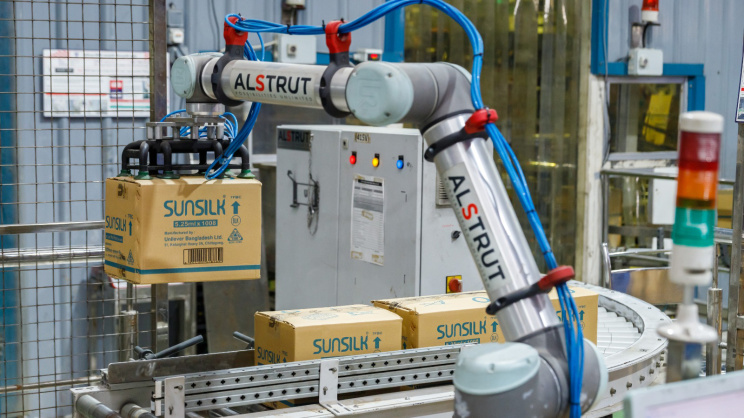
This focus on "smart design" has led to significant breakthroughs. In 2025 alone, the Oral Care division removed over 50 metric tonnes of plastic from the environment. Using advanced 3D modeling, the team reduced the thickness of toothpaste tubes by 11 per cent and the weight of toothpowder bottles by 17 per cent. Even the smallest components, such as bottle caps, were redesigned into a "flower-pot" shape, saving 16 tonnes of plastic without compromising the integrity of the product.
However, Siddiquee emphasises that the goal is not just to use less plastic, but to rethink the entire relationship between the product and the planet. He notes, “Unilever’s R&D team is rethinking the entire product lifecycle—from smarter design and lighter packaging to refill models and circular solutions—to reduce plastic use without compromising product performance or affordability. By embedding sustainability into innovation, Unilever is helping make high-quality products more accessible while advancing its ambition toward a plastic-neutral future.”
U-Refill: Resurrecting Tradition through Technology
Perhaps the most visible sign of Unilever’s shift toward a circular economy is the U-Refill initiative. This project addresses the "single-use" dilemma by encouraging consumers to reuse their existing plastic containers. Consumers bring their clean, empty bottles to digital refill machines located in retail shops and fill them with trusted brands like Sunsilk, Dove, Vim Liquid, or Lifebuoy.
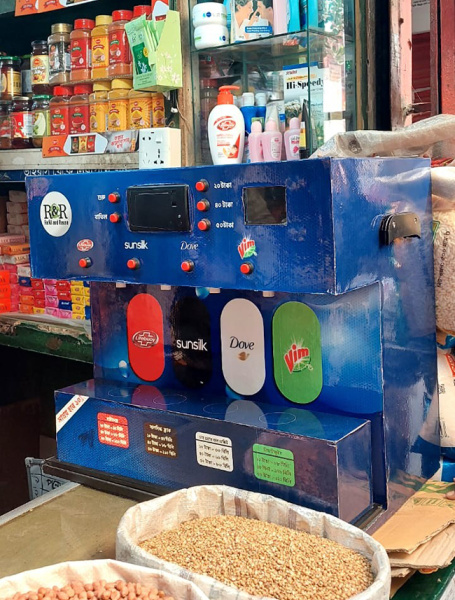
This model is a modern echo of a long-standing Bangladeshi tradition where people once carried their own jars to local grocers for oil or kerosene. By digitizing this process, Unilever has made it safe, precise, and scalable. Since its pilot launch in June 2022 and the subsequent introduction of "U-Refill 2.0" in November 2025, the system has already reached 20,000 consumers and prevented over 72 kilograms of plastic waste from entering the environment.
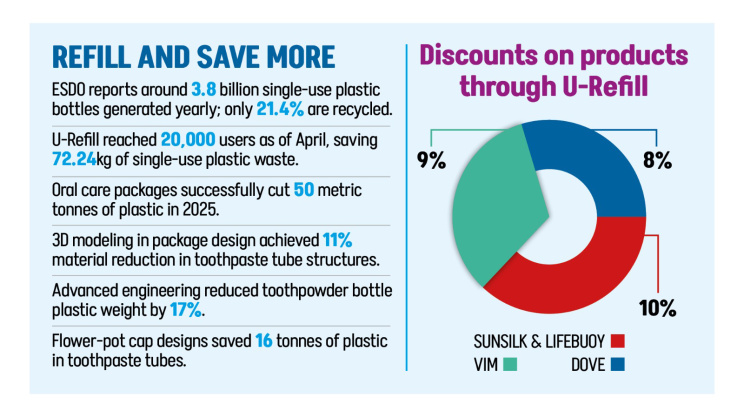
The ambition for U-Refill is vast. From a pilot of 50 shops, the company aims to reach 1,500 locations by the end of 2026, with a long-term goal of 10,000 outlets nationwide. As Nabeel Siddiquee describes it, this is a cornerstone of the company’s future business model. “U-Refill is helping Unilever Bangladesh turn everyday shopping into a more circular model by enabling consumers to reuse bottles instead of discarding them after a single use. Already active in 50 outlets and targeting up to 10,000, the initiative combines refill technology, affordability, and behaviour change to reduce plastic waste and make sustainable consumption more accessible at scale.”
Crucially, the refill system is designed to be economically attractive. By eliminating the cost of new packaging, Unilever passes direct savings to the consumer. Shoppers can save up to 10 per cent on Sunsilk and Lifebuoy handwash, 9 per cent on Dove shampoo, and 8 per cent on Vim liquid. This aligns with the project’s slogan: “The more you buy, the more you save.” Furthermore, the initiative supports the local economy. Participating retailers are targeted to earn at least BDT 15,000 per month from refill sales, with profit margins of up to 20 per cent. The project also champions social inclusion, with more than half of the workers, including 18 brand promoters being women.
A Holistic Approach to Community Waste
Unilever’s responsibility extends beyond its own products and into the communities where those products are consumed. In Chattogram, a city where approximately one-fourth of waste remains uncollected often leading to clogged drains and devastating waterlogging. Unilever has partnered with the Chattogram City Corporation and Young Power in Social Action (YPSA).
Since June 2022, this integrated plastic waste management initiative has operated across all 41 wards of the city. By April 2026, the project successfully collected over 32,000 tons of plastic waste, with an additional 8,000-ton target set for the remainder of the year. This initiative is not just about collection; it is about human dignity and formalising the informal waste sector.
Approximately 3,000 waste workers have been trained in health, safety, and waste management. To ensure their long-term well-being, 1,827 participants were brought under a group health insurance scheme in 2025, providing a safety net for accidents, disability, and death. Furthermore, the project has helped 50 per cent of participating scrap buyers obtain trade licenses and ensured that 100 percent have active bank accounts, effectively pulling them into the formal economy.
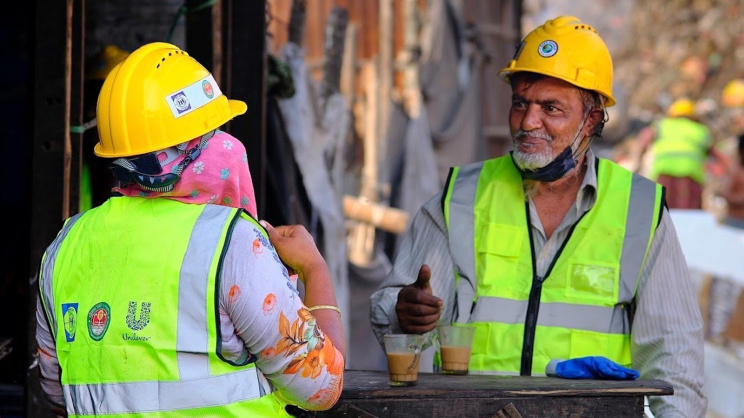
Community engagement is the final piece of the puzzle. Through awareness campaigns reaching 25,000 families, the project has achieved a 40 per cent waste segregation rate at the household level. Schools and residential colonies have been equipped with "three-bin" systems, and a network of 410 youth volunteers has been mobilized to ensure that the next generation of Bangladeshis views waste as a resource rather than a burden.
The progress documented at the Kalurghat Factory and through the U-Refill and community waste initiatives proves that the transition to a sustainable industrial model is possible, even in a complex, climate-vulnerable market like Bangladesh. Unilever’s experience demonstrates that operational efficiency, reducing energy, water, and waste is a business necessity that lowers operational costs and mitigates the risks of fuel price volatility and resource scarcity.
However, the company remains vocal about the fact that private sector action alone is not enough. To truly scale these successes, Bangladesh requires robust policy support, infrastructural development for recycling, and continued international commitment. The internal frameworks Unilever has built, such as independent monthly "Data Integrity Audits" and inter-departmental accountability committees, provide a roadmap for other industries to follow.
As Unilever Bangladesh eyes its target of 10,000 refill outlets and continues to push the boundaries of plastic-neutral manufacturing, the message is clear: the journey toward sustainability is an ongoing process of innovation and accountability. In the context of Bangladesh’s unique environmental challenges, this journey is more critical now than ever before. By integrating the R&D vision of experts with the industrial might of the Kalurghat Factory and the grassroots power of community waste workers, Unilever is not just preparing for the future, but is actively building it. Every lighter bottle cap, every reused jar, and every gigajoule of energy saved represents a step toward a cleaner, more resilient Bangladesh for all.
Comments