


When mobile journalism crosses the line into public shaming

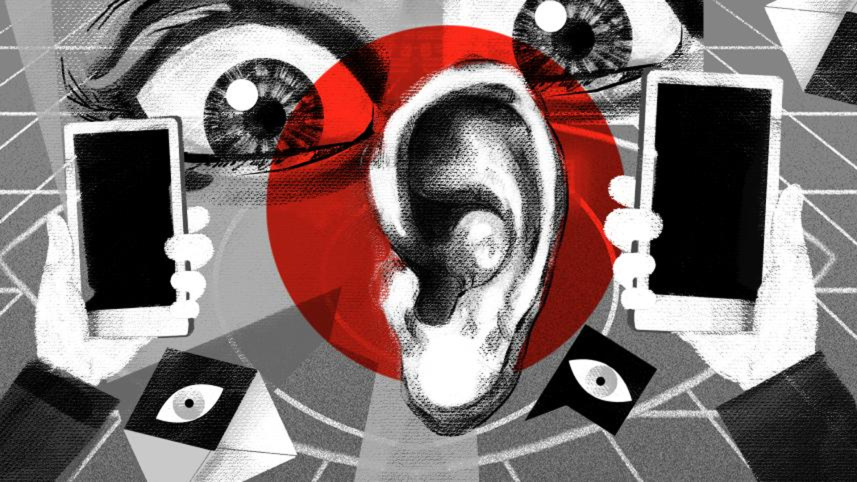
Journalism is meant to hold power to account, and mobile journalism, using smartphones for reporting and storytelling, should have ideally taken that mission to new heights. In too many corners of Bangladesh, however, we are witnessing a rather disturbing reality where mobile journalism is used as a tool for moral policing and public shaming of the vulnerable members of our community, especially women.
For example, imagine a woman attending a public event; she takes a moment to adjust her saree, stands in a crowd, or walks down the road. There is a good chance that somewhere nearby, a phone camera has already decided that she—not the event—is the focal point. The result? A barrage of clickbait content that exposes moral degradation masquerading as public-interest journalism.

There was a time when mobile journalism felt like a democratic breakthrough. A phone in a reporter’s hand meant speed and reach. Stories could be told from places where professional cameras did not have access. It was supposed to expand the boundaries of reporting, but somewhere down the line, that idea was lost. However, the problem here is not the cameras. Journalists must film public events. Citizens, too, record public moments. The problem arises when the angle is chosen not to inform but to expose; when the selected frame does less to explain and more to embarrass; when the caption exists not to provide context but to direct the viewer’s gaze towards a woman’s body, clothing, or posture. And at that moment, the woman becomes consumable content.
Some of the key culprits here are Facebook pages, TikTok accounts, YouTube channels, and pseudo-portals trading in degradation. Even some recognised media outlets have, at times, published clips and still shots of women that had less to do with public interest and more with spectacle. Pseudo-portals operate without standards, and recognised media outlets sometimes betray the very standard it claims to uphold. In the end, the result is the same: women exploited to increase traffic. Let us not confuse this with journalism. It most certainly is not. A page attaching words such as “TV” or “news” to its name does not automatically become a credible source of news simply because it has learned how to upload humiliation.
Recently at TSC, students confronted a multimedia reporter for inappropriately filming a female activist during a protest. A video showed the woman asking him why he had taken such clips. This newspaper also came across a handwritten undertaking on the letterhead of Dhaka University Journalists’ Association stating that the reporter had been caught unnecessarily zooming in on a woman while filming. He admitted wrongdoing and was released on a bond.
The same trend exists elsewhere as well. At police checkpoints, routine checking often turns into a show, as reporters gather around with cameras or phones and continue to film long after all the public interest justification has disappeared. The same thing happens during police raids, especially in hotels, where people are recorded in vulnerable moments. Their faces are exposed without consent, whether or not they are guilty of anything. Then the clips go online with outrageous captions, and the trial by media begins.
The damage does not stop with the sexualised framing of women. According to reports published by The Daily Star and The Business Standard, four people were assaulted by a mob in the evening of April 10 in the capital’s Shahbagh area following accusations of being members of the queer community. The victims later told The Business Standard that people identifying themselves as mobile journalists obstructed their movement, filmed them without consent, and subjected them to embarrassing, indecent, and suggestive questioning even as the violence unfolded. What is being normalised in all these incidents is not merely bad journalism but a broader instinct to treat vulnerability as content. The camera culture has digitised and monetised harassment.
It is also about law, regulation, and state responsibility. Section 509 of the Penal Code states that anyone who, intending to insult the modesty of a woman, utters any word, makes any sound or gesture, exhibits any object, or intrudes upon her privacy can face imprisonment for up to one year, or a fine, or both. Yet we rarely see that seriousness applied to media-branded actors who trade in women’s humiliation. Cyber security laws and digital enforcement mechanisms often become visible when politics is involved or when powerful interests are affected. They seem far less apparent when the dignity of women or vulnerable community members is under question. Bangladesh’s legal framework has already been criticised for failing to provide effective protection when it comes to online violence against women. If the present framework is too weak and far too easy to evade, there is no question why it should not be amended.
Here, the state’s responsibility begins with registered media houses. If the government grants registration, it cannot then pretend it has no role when that legitimacy is abused. It can issue warnings, demand explanations, impose sanctions through proper channels, and, where warranted, move towards legal action. Registration cannot become a shield for predation.
The state’s responsibility is even clearer when the offender is not a registered newsroom, but an unregistered page or portal using the word “News” in its name. Such actors do not carry the protections of a recognised media institution, yet they exploit the name of journalism to prey on people for clicks. The government should not wait for victims to speak up—many may not even know their images have gone viral. It should create a working mechanism for rapid reporting and warning issuance and takedown requests alongside strengthening platform coordination and repeat-offender tracking through law enforcement agencies.
I write this as a journalist because I know what this culture is doing not only to women, but also to the profession. Every time humiliation is packaged as content under the label of media, journalism is tainted. Every time a woman is reduced to bait beneath a news logo, the public learns to trust journalism a little less. That is also why this cannot be brushed aside as a matter of press freedom. Protecting a woman or any vulnerable member of society from predatory lenses is not a restriction on the press; it is the enforcement of a citizen’s right to dignity. And, if we continue to excuse this in the name of media, journalism might become part of the very problem it should work to expose.
Arafat Rahaman is a journalist at The Daily Star. He can be reached at arafat.mcj@yahoo.com.
Views expressed in this article are the author's own.
Follow The Daily Star Opinion on Facebook for the latest opinions, commentaries, and analyses by experts and professionals. To contribute your article or letter to The Daily Star Opinion, see our guidelines for submission.
 For all latest news, follow The Daily Star's Google News channel.
Comments