


Life of a student with bad handwriting
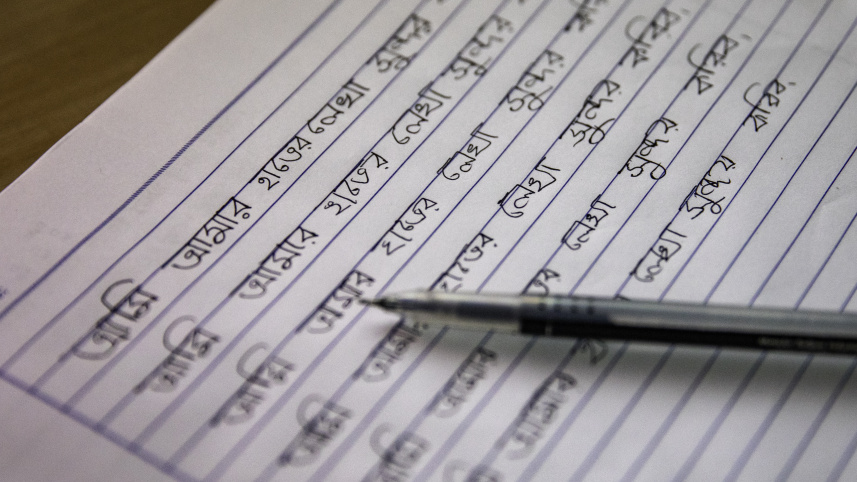
I still remember my eighth-grade test. I scored perfectly in almost every subject, except for two: Bangla and English, where I somehow managed to come away with a B and an A. I had seen my scripts. I knew I had written fairly well. Yet the marks made me wonder whether they had really read my answers line by line or whether my handwriting had already decided for me. The neater the script, the better the score seemed to be.
“Writing in a readable style increases the chances of scoring better in board exams,” my teachers said. And that is what scared me most, even more than any science subject could.

The worst part of having bad handwriting is that you begin to feel as though you cannot write anywhere in public. Not on the classroom board, not on gift wrappers, and certainly not on your own application to school. With handwriting like mine, you know your application is going to get rejected. I used to get mine written by my friends. The problem is not that my handwriting is unreadable. It is good enough, just not neat. The real problem is the assumptions people make once they see it. They look at the script and instantly consider me a bad student, which I can live with. But that is not the end. They start to see me as a doomed student.
I still remember handing my exam scripts to my mother with a beaming smile because I had gotten full marks. The first thing that would come out of her mouth was, “Why did your teacher even give you marks for this ghastly writing?” And if that ghastly handwriting came with poor marks, all hell would break loose.

The attempts to improve my handwriting were not few. My mother used to take my notebook and make invisible lines by pressing a finished ink pen onto the page to keep my lines straight. She also had peculiar names for some of my exclusive fonts. She would refer to my “জ” as “কাকের ঠ্যাং” and my “r” as a “malnourished child".
The campaign to fix my handwriting eventually reached a new level. I was enrolled in a handwriting school in class eight. I entered and realised I was not the only one. Even college students were there. They were like giants in a sea of children. My instructor started from the very basics: drawing straight lines, one page at a time, then curved lines, then circles with a pencil. How to hold my pencil and when to sharpen it—all things I had supposedly learned when I was five. We started with those margin-lined copies children use to write English and Bangla. I didn’t see them since class two. For a while, it actually worked. My handwriting improved.
Unfortunately, the improvement did not last very long. As I continued writing, I slowly plunged back into my old handwriting style: hurried lines, crooked lines and strikethrough sentences that looked as though the words themselves were trying to escape.
I know what the people with good handwriting are thinking right now. Do not mock us. The handwriting we have is not something we are particularly proud of either. You cannot change your writing overnight, just as you cannot grow one inch taller overnight. I have made peace with all of this. So far, I am okay with it. What I am not absolutely okay with, however, is the bias in script checking, as I said at the start.
The only explanation left for my poor marks in English and Bangla was “bad handwriting". While the toppers wrote with three different coloured pens and words that looked as though they had been typed directly onto the page, mine was completely different: hurried, disorganised and apparently a crime against the examiner’s eyes. I understand that handwriting needs to be readable. But there is a difference between unreadable handwriting and handwriting that is simply untidy.
Over the years, I have tried everything: special notebooks, invisible lines, handwriting schools, different pens, different grips, and whatever else people recommend when they discover you write like you are escaping from a fire.
So yes, I have bad handwriting. I have accepted it. My teachers have accepted it. My mother has accepted it, mostly. And now that I am in university, handwriting does not matter quite as much as it did during my school years. Here, what you know and what you write matters more than how neatly you write it. For most of my school life, though, I was made to feel that my handwriting was something I had to fix before I could be taken seriously as a student. Maybe that is the strangest part of it all. We are taught to believe that neat handwriting means discipline, intelligence and effort. My handwriting is still bad, probably still capable of confusing an examiner or two. But somewhere along the way, I stopped being embarrassed by it. After all, it may not be neat, but it is readable. And it is mine.
Irfan spends his time writing, travelling, doomscrolling — and occasionally attending class for a degree he believes will be useful someday. Send him cat reels at: irfan.ink63@gmail.com.
 For all latest news, follow The Daily Star's Google News channel.
Comments