


Stakeholders call for collective action to eliminate child labour in Bangladesh by 2030
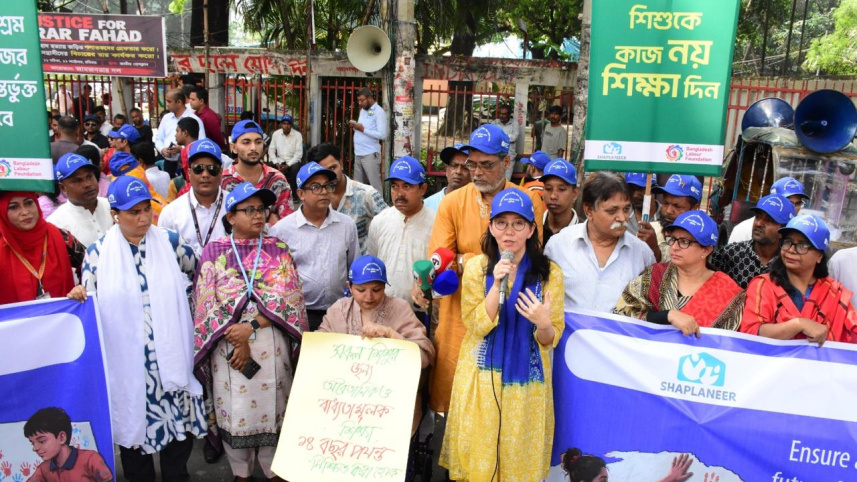
Trade union leaders, employers’ organisations and development partners yesterday called for efforts to eliminate child labour in Bangladesh by 2030, stressing the need for stronger law enforcement, free education and social protection for vulnerable families.
The call came at a human chain and rally organised by the Bangladesh Labour Foundation (BLF), in collaboration with SHAPLA NEER, in front of the National Press Club in Dhaka to mark Child Rights Day and World Children’s Week 2026.

SHAPLA NEER Bangladesh is a non-profit organisation established in 1972 by a group of young and dedicated Japanese volunteers.
Held under the theme “Ensure a Secure Future for Children”, the programme brought together representatives of the Department of Inspection for Factories and Establishments (DIFE), the International Labour Organization (ILO), the Sramik Karmachari Oikya Parishad (SKOP), the IndustriALL Bangladesh Council (IBC), civil society and the media, according to a statement from the BLF.
The preliminary findings of the Bangladesh Multiple Indicator Cluster Survey (MICS) 2025 show that 9.2 percent of children aged 5–17 are engaged in child labour, up from 6.8 percent in 2019.
The findings also show that only 50.2 percent of children aged 7–14 have acquired foundational reading skills, while 39.2 percent have achieved foundational numeracy skills.
The figures underscore the challenges Bangladesh faces in protecting children from exploitation and ensuring access to education, speakers said.
Syeda Munira Sultana, national project coordinator at the ILO, called on the government to ensure free and compulsory education for all children up to the age of 14. She also stressed the need to remove children under 14 engaged in domestic work from child labour and bring them into education.
Biswajit Roy, representing DIFE, said the government was taking measures to rehabilitate children engaged in child labour. A five-year National Plan of Action for 2026–2030 is also being developed, he said, expressing hope that its proper implementation would strengthen rehabilitation and protection efforts.
Foyez Hossain, joint coordinator of SKOP, demanded an end to all forms of child labour, abuse and violence against children. He called for immediate steps to ensure free education and protect the health of marginalised children.
Naimul Hasan Jewel, general secretary of SKOP, urged the authorities to enforce a minimum employment age of 14 in line with ILO Convention No. 138. He also called for social protection for vulnerable families, conditional on regular school attendance, and technical and vocational training for adolescents aged 14–18.
Nurul Amin, another joint coordinator of SKOP, called for legal action against employers who engage children in prohibited work. Creating employment opportunities for parents and guardians and ensuring minimum wages, he said, would help families keep children in school.
Khadija Rahman, women’s affairs secretary of IBC, stressed the effective implementation of ILO Conventions Nos. 138 and 182, alongside decent work for parents, quality education and a safe environment for girls and boys.
Yumi Yagishita Masuda, country director of SHAPLA NEER, said protecting children and supporting their healthy development required collective responsibility from families, society and the government.
BLF and SHAPLA NEER are conducting a week-long awareness campaign from October 5 to 11 to promote child rights, education and social protection and mobilise support for Bangladesh’s commitment to eliminating all forms of child labour by 2030.
 For all latest news, follow The Daily Star's Google News channel.
Comments