Why blaming Dhaka's bus drivers misses the real problem
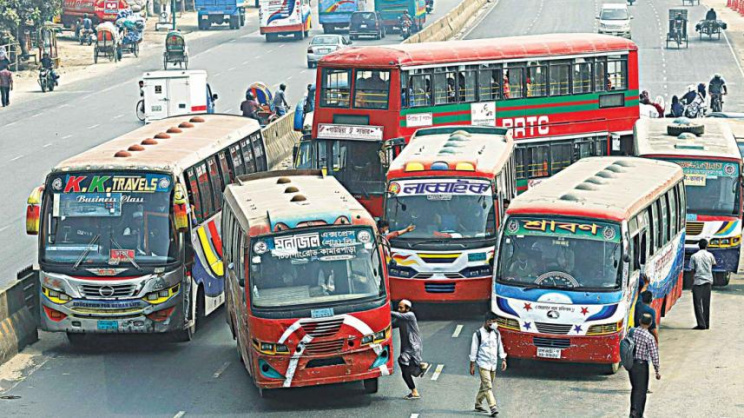
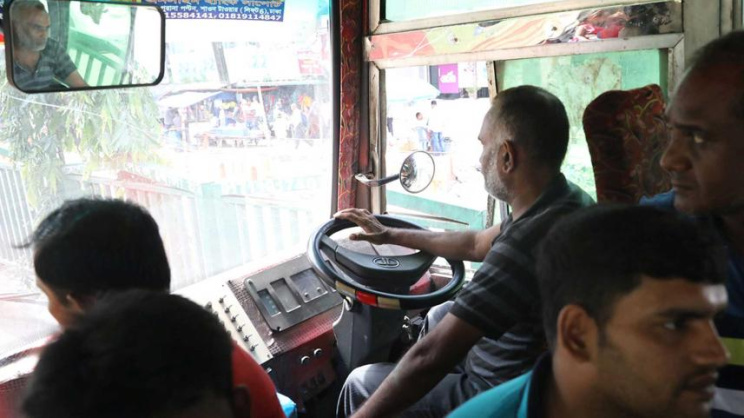
Watch a local bus pull away from almost any Dhaka intersection and you will usually notice him first: a boy or young man leaning out of the open door, one hand gripping the frame as he calls out the next stop over the noise of traffic. He is the helper, the most junior member of the crew, and he may be as young as 14. He is not hanging there simply because he is careless. He is doing the job as the system requires him to do it, on a route where functioning bus stops are often nowhere to be found.
We usually encounter these workers at their worst moments. A driver is caught on camera racing another bus for passengers. A conductor argues with a student over half fare. A crew is dragged out after a crash as an angry crowd closes in. The public sees these incidents as evidence of indiscipline, and since 2018, the law has largely treated them that way too. But the picture that emerges from reporting and research is far more troubling. This is a workforce drawn largely from some of the poorest households in the country, put on the road with little or no formal training, handed vehicles whose owners have often failed to keep them safe, and paid under a system that effectively punishes them for driving carefully. Much of what appears to be the workers' fault is shaped by conditions created by others.
Who ends up on the buses
It begins with the person who steps onto the footboard first. Dhaka's bus crews are drawn overwhelmingly from the rural-to-urban migrant poor, the same population that fills many of the city's other informal trades. For many of them, working on a bus is not a choice among jobs; it is the work available to a boy who left school early because his family needed both his labour and his earnings. Bangladesh has made significant progress in reducing child labour over the past two decades, but the problem is far from gone. UNICEF's 2024 review of Bangladesh, drawing on the country's own labour surveys, still puts roughly a million children in hazardous work and finds the country off track to meet its 2025 target for ending child labour. Children who are out of school are far more likely to be working, and informal transport work is among the forms of employment that absorb them.
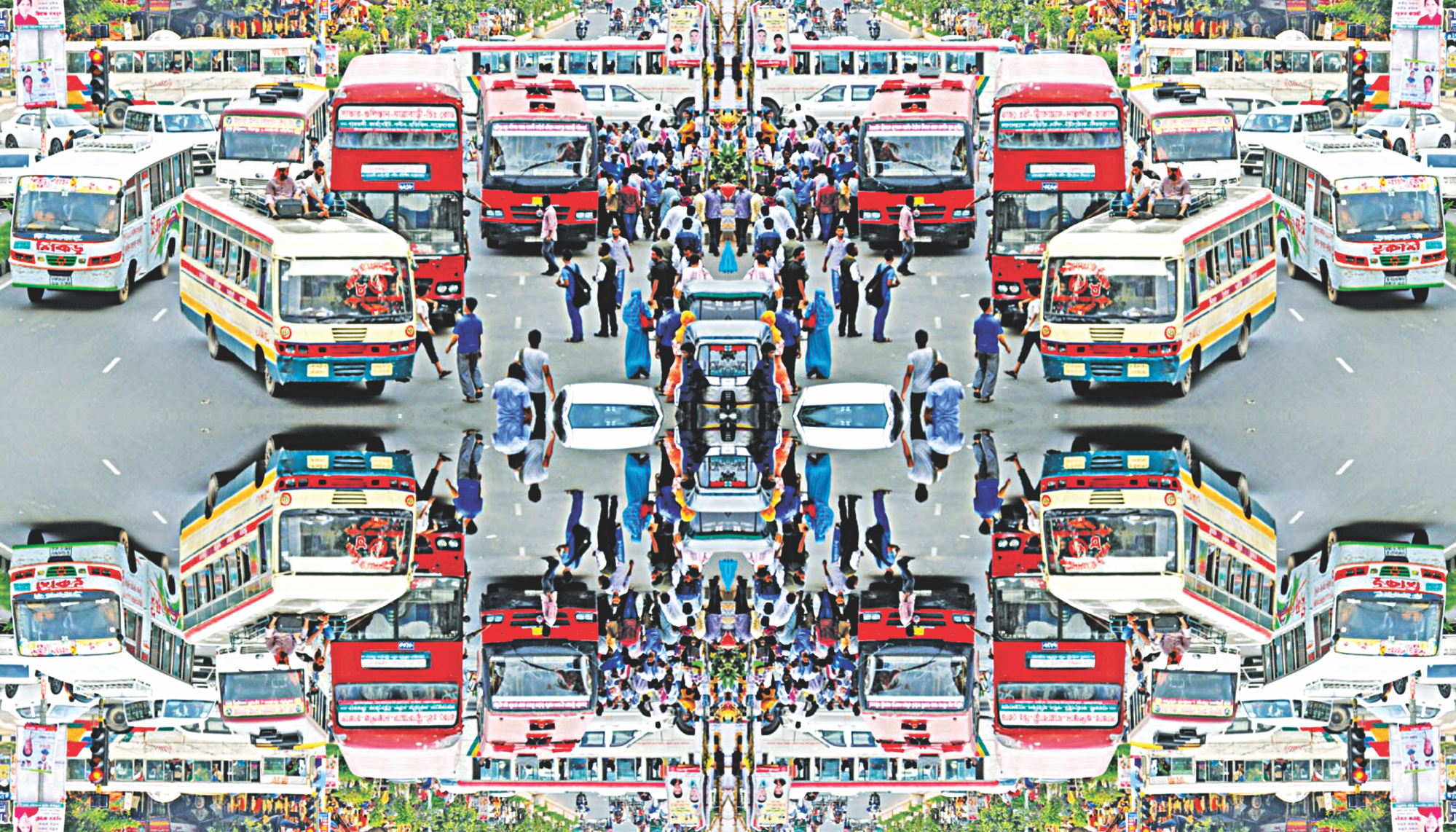
The connection is not merely an assumption. A 2021 study in Child Indicators Research of child labourers in three Dhaka neighbourhoods found that 97 percent were economically exploited, earning below the national minimum and working far beyond the limits considered appropriate for children. Among those interviewed were helpers on human-haulers, the Leguna that share Dhaka's roads with buses. They described spending their days hanging from the sides of moving vehicles and earning as little as Tk 250 for the work. Bus and human-hauler helpers are often children from similar households, doing much the same dangerous work for much the same reason: few other opportunities are open to them.
Paid to hurry, punished for a slow day
The situation does not improve much when these boys become men. Most Dhaka bus crews are not paid regular salaries. Instead, they work under a daily deposit system built around a target sum known as the zoma. The owner is guaranteed a fixed amount each day, while the crew keeps only what remains after that sum, fuel costs and various roadside payments have been covered. That arrangement shapes almost everything that happens on the road. A slow day trapped in gridlock, a breakdown, or an hour lost to rain does not reduce the owner's return; the loss comes out of the workers' earnings. Drivers in the city report gross daily takings of around Tk 3,000, an amount that shrinks sharply after deductions and before the crew is paid.
The depth of the problem became particularly visible in 2025, when workers on several intercity routes went on strike over wages that had barely changed for years. On the Rajshahi–Dhaka route, drivers were earning about Tk 1,100 per trip and helpers about Tk 400, rates that their representatives said had barely moved in close to a decade. A supervisor summed up the situation in a single line: bus workers earn barely enough to cover their daily meals. A minimum-wage structure for transport workers has existed on paper since the 2018 reforms, but in practice it is the deposit and per-trip system that determine what workers actually earn. That is why wages continue to be fought over route by route rather than guaranteed by an effective minimum floor.
What those wages buy is a precarious life. Average monthly earnings across the workforce hover around Tk 22,000, while rent in Dhaka consumes a punishing share of that income. As a result, many drivers and helpers cannot afford to keep their families in the city at all. Some sleep inside parked buses or on terminal floors between shifts, without a proper wash or a proper night's sleep, only to begin another long working day already exhausted. There is no pension waiting at the end of this working life and no meaningful compensation when an injury forces a worker off the road. A single illness can push an entire household into debt that a per-trip wage may take years to repay, if it can be repaid at all.
Never trained, handed an unfit bus
Another part of the story changes how these crashes should be understood: many of the workers behind the wheel have never received formal training. A baseline study by BRAC's Research and Evaluation Division found that close to 90 percent of commercial drivers had received no institutional training after entering the profession, while a large share did not hold a valid licence. Three in four did not know the posted speed limits, and most could correctly identify only about 40 percent of standard road signs. Where training does happen, it is largely informal. A young helper learns by watching an ostad, or senior driver, until someone decides that he is ready to take the wheel himself. There is often no formal process to determine whether that judgement is right.
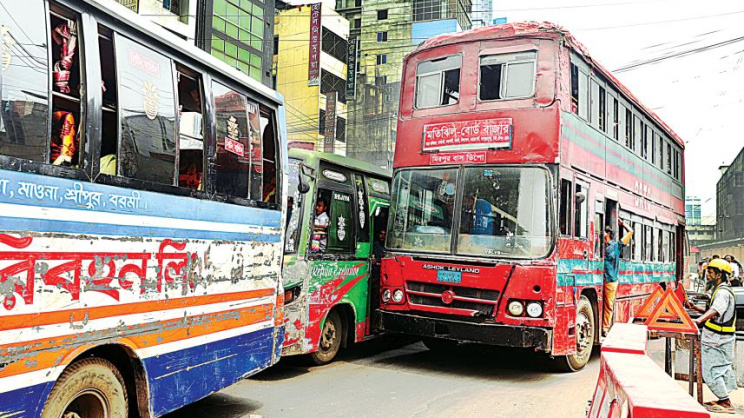
The vehicle he eventually takes control of may be no safer than the system that trained him. Bangladesh's vehicle fitness certification process has been so compromised that owners have admitted to obtaining certificates for buses that were never physically inspected, part of a broader pattern of extortion and collusion documented by Transparency International Bangladesh in a survey of hundreds of owners, workers and passengers across the country. The familiar sight of an untrained young man behind the wheel of a worn-out bus, then, should not be read simply as evidence of an irresponsible driver. It also points to an owner who failed to invest in training or properly maintain the vehicle, and to a regulatory system that allowed both an inadequately trained driver and an unfit bus onto the road.
The familiar sight of an untrained young man behind the wheel of a worn-out bus, then, should not be read simply as evidence of an irresponsible driver. It also points to an owner who failed to invest in training or properly maintain the vehicle, and to a regulatory system that allowed both an inadequately trained driver and an unfit bus onto the road.
The physical toll of these working conditions is substantial. A peer-reviewed study of professional drivers at Dhaka terminals found that approximately 34.5 percent had experienced low back pain within the previous month. The prevalence increased with age and, tellingly, was higher among lower-income drivers, suggesting that those earning the least were also among those bearing the greatest physical burden. A 2026 study of the city's drivers documented another occupational hazard: prolonged exposure to excessive noise inside vehicle cabins, often at levels capable of damaging hearing. Almost none of the drivers had access to hearing protection or appropriate care, while headaches, fatigue and elevated blood pressure were among the health problems associated with persistent noise exposure. Added to this are shifts that can stretch to 17 hours a day, several days a week. With no sick pay to fall back on, taking time off means losing a day's earnings. For many workers, resting when they are ill or exhausted is therefore a luxury they cannot afford.
A governance failure, not a driver's failure
It is easy to file all of this under “Dhaka traffic”, as though congestion were simply a condition of the city rather than the product of decisions about how its roads are governed. A major study published a decade ago offered a different way of understanding the problem. In its State of Cities 2016 report on traffic congestion, the BRAC Institute of Governance and Development (BIGD) looked beyond the honking, gridlock and disorder to ask a more fundamental question: who actually governs Dhaka's roads? Using a political economy framework, the study assessed six public agencies, including the traffic police, the two city corporations, the road transport authority, the transport coordination body and the planning authority, and surveyed 774 transport users. Its conclusion was that Dhaka's congestion is, at its core, a governance failure, characterised by overlapping responsibilities, weak planning, limited accountability and the absence of any single institution responsible for the overall outcome.
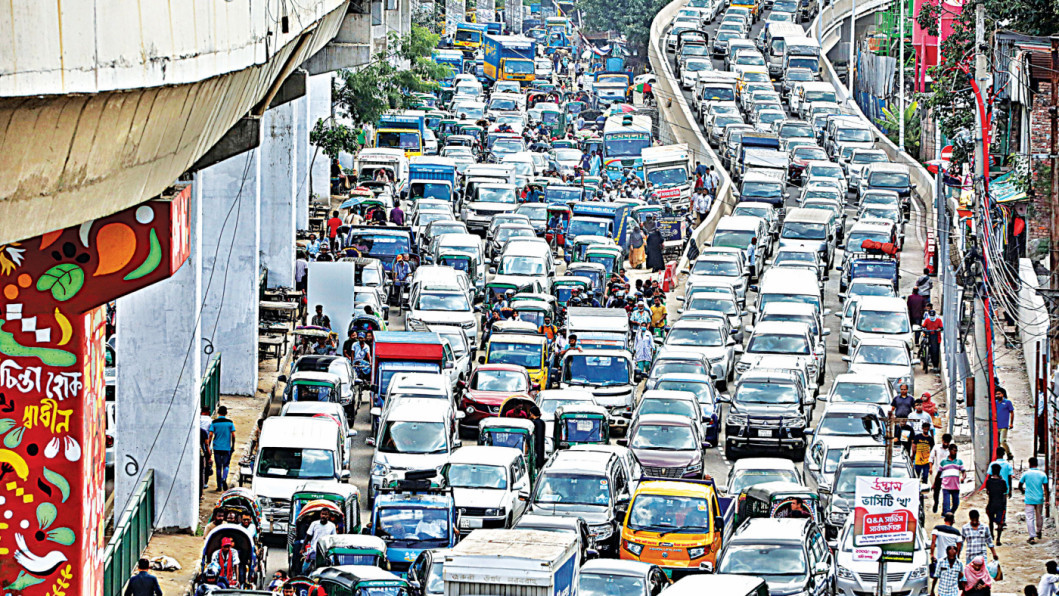
That finding is central to any honest account of the lives of transport workers because it shifts attention from what happens on the road to the conditions that produce it. Crews pick up passengers from moving traffic because functioning bus stops are often absent. An audit of one flagship route cluster found that 41.3 percent of authorised stops did not physically exist and that only a fifth were fully functional. Drivers race for passengers because the deposit system rewards additional trips and higher takings. They continue driving while exhausted because stopping means losing income. These choices do not occur in isolation. They are responses to incentives and conditions created by a transport system that workers themselves did not design and over which they have little control.
Blamed at the scene, spared at the top
Yet when that system fails, responsibility falls most visibly on the worker. After the 2018 student protests demanding safer roads, the government passed the Road Transport Act, introducing tough penalties for drivers, including heavy, non-bailable penalties for causing death. Within a year, however, pressure from transport syndicates and owners' associations, which surveys have found to be overwhelmingly connected to political parties, led the government to move towards relaxing some of those penalties. The result exposed a deeper imbalance in accountability: the man behind the wheel remained the most visible target, while responsibility became harder to trace as one moved upwards through the system.
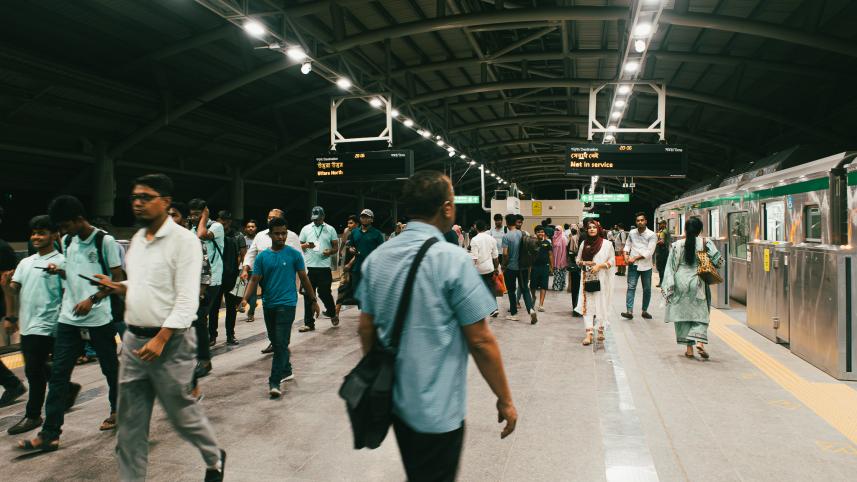
On the road, that imbalance can be even more immediate. After a crash, a driver may face an angry crowd, and even physical assault, before responsibility for the accident has been established. He begins each shift knowing that a mechanical failure, another road user's mistake, or his own exhaustion could leave him injured, arrested or even dead. The risks of the job, in other words, extend far beyond the possibility of a collision. Workers operate at the point where the failures of the entire transport system become most visible, and they are often the first to bear the consequences when something goes wrong.
Taken together, these pieces reveal a pattern that is difficult to ignore. A child from a poor family leaves school and finds work on a bus because it is one of the few opportunities available to him. He receives little or no formal training. Eventually, he may be handed a vehicle whose fitness certificate says little about whether it is actually safe to drive. He is paid only after the owner's daily deposit has been met, pushing him towards punishing hours and constant competition for passengers. Proper stops where he could pick up passengers safely are often missing. And when something finally goes wrong, it is the worker whom the law and the crowd encounter first, while the owner, the syndicate and the officials responsible for regulating the vehicle and the system remain far removed from the scene. To place responsibility entirely on the crew is to mistake the final link in a much longer chain for the chain itself.
Where the honest fix begins
The solutions are neither mysterious nor beyond reach, and most require changes to the system rather than demands for better behaviour from workers. Replace the daily deposit system with a stable salary or per-kilometre payment structure so that careful driving does not come at the cost of a worker's income. Set reasonable limits on working hours and make shifts predictable. Provide crews with basic occupational health protections, adequate seating, protection from excessive noise and regular health checks. Build and maintain the bus stops, depots and toilets that a functioning transport system requires. Make entry into professional driving dependent on proper training and a valid licence, rather than an informal apprenticeship that begins on the footboard. And after a crash, treat crew members as people whose role and responsibility must be properly investigated, and who may themselves be victims, rather than automatically presenting them as culprits to an angry public.
None of these changes requires the boy on the footboard to become a better person. Each requires the system around him to change a condition he did not create.
So, the next time a bus cuts across three lanes to reach a cluster of waiting passengers, it is worth holding two thoughts at once. The manoeuvre is dangerous and should not happen. But the fourteen-year-old leaning out of the doorway and waving passengers aboard did not design the road, devise the wage system, choose to go without training or certify the bus as fit for the road. He inherited those conditions.
If Dhaka wants safer buses, accountability cannot end with the people we see hanging from the doors or sitting behind the wheel. It must extend to the owners, regulators and institutions that determine how those people work. The boy on the footboard may be the most visible part of the problem, but he is also one of the people with the least power to change it.
Dhrubo Alam is a Deputy Transport Planner at the Dhaka Transport Coordination Authority (DTCA). He can be reached at dhrubo101@yahoo.com
Send your articles for Slow Reads to slowreads@thedailystar.net. Check out our submission guidelines for details.
Can the new strategy achieve Bangladesh’s renewable energy targets?

André Wink speaks / What we get wrong about the Indo-Islamic world
Bengali Muslims and the ghosts of India's citizenship politics

Bangladesh’s solar growth: Will the incentives be enough?

The missing link in Bangladesh's innovation economy
Dhaka’s battery rickshaw problem is economic, not just about traffic
The staircase between our mothers and care
Is Bangladesh prepared for the next food shock?
From more power to better power: Rethinking Bangladesh’s energy future