Dhaka’s battery rickshaw problem is economic, not just about traffic
Every time Dhaka’s traffic grows unbearable, the same policy reflex returns: clear the rickshaws off the main roads. The impulse is easy to understand in a city that ranks among the slowest in the world, where average traffic speeds have fallen close to walking pace, and congestion is estimated to cost the economy billions of dollars a year. Yet four decades of bans, enforcement drives and court orders have ended the same way each time. The rickshaws return within days. The reason has little to do with lane markings or signal timing. Dhaka’s rickshaw question is, at its root, an economic one, and it cannot be answered with the tools of traffic engineering.
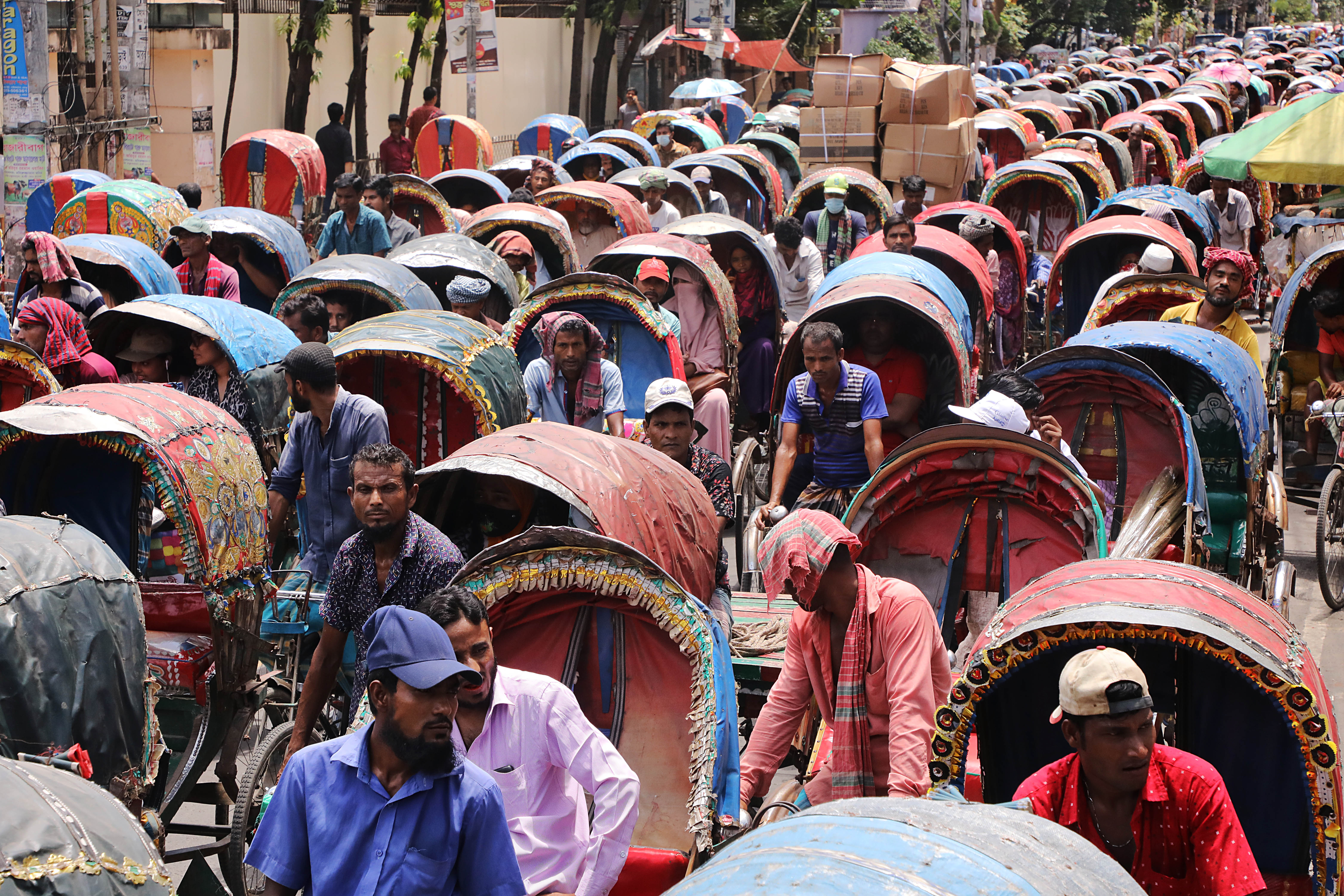
The scale alone makes that clear. Dhaka has had roughly a million rickshaws for years, and that number has barely changed. If each vehicle supports, on average, a driver and two other members of his household, close to three million people in the capital depend on the trade. Across the country, the figure may be closer to twenty million. For them, a rickshaw is more than a vehicle: it is a source of income and survival. A trade that sustains close to a tenth of the population cannot simply be treated as a traffic nuisance to be swept off the roads. Its sheer size reflects how few alternative livelihoods the formal economy has been able to create.
A trade nobody has counted
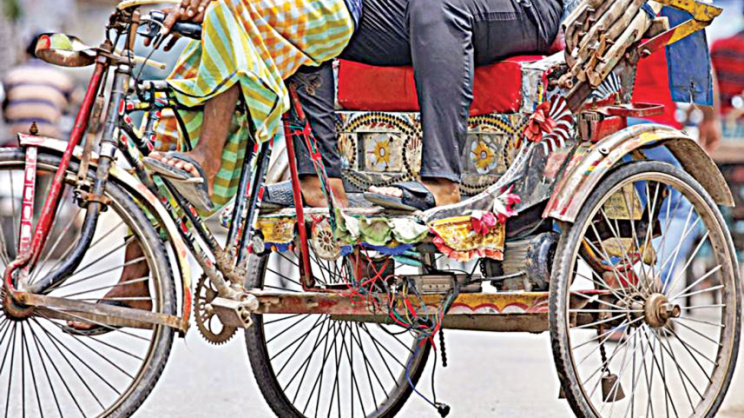
No authority in Bangladesh actually knows how many rickshaws exist. Dhaka stopped issuing new rickshaw licences in 1986, freezing the legal fleet at fewer than eighty thousand vehicles. Nearly four decades later, the two city corporations officially recognise only a couple of hundred thousand rickshaws, while every serious survey estimates that many times that number are operating on Dhaka’s roads.
Declaring battery-run rickshaws illegal did not make them disappear. It merely left their regulation in the hands of informal actors.
For battery-run rickshaws, the estimates vary even more widely: credible figures for Dhaka range from about six hundred thousand to one million, while national estimates range from four and a half to six million. Such a wide gap reveals how little the state actually knows about the sector. For four decades, the authorities largely chose not to recognise these vehicles, but declaring them illegal did not make them disappear. It merely left their regulation in the hands of informal actors.
That vacuum is filled by garage owners, local power brokers and an informal market in “thief plates”: counterfeit tin licences sold as protection against both the police and organised vehicle theft. Charging runs off the books, too. Against a few thousand approved points, the traffic police count tens of thousands of illegal connections drawing power directly from the grid. Battery rickshaws nationwide now draw an estimated three-quarters of a gigawatt to a full gigawatt, roughly five per cent of the country’s generation, a large share of it stolen. Every taka of that theft, and every taka of protection money, is a levy on the poorest workers in the city, collected by a system the law refuses to acknowledge.
The upgrade that became a debt trap
The clearest picture of these drivers’ economics comes from a field study of Dhaka’s rickshaw trade released in January 2026, which surveyed drivers, passengers and garage owners across both city corporations. Its central finding is blunt: around 97 per cent of battery rickshaws and 86 per cent of pedal rickshaws carry no registration at all. These are not fringe operators. This is the fleet.
The shift from pedal to battery power appears, at first, to be straightforward progress. A battery-rickshaw driver earns about 880 taka on a good day, compared with roughly 594 taka for a pedal-rickshaw driver, while the motor also spares him much of the physical strain. Three out of four battery-rickshaw drivers are new to the trade, many of them having arrived in the city within the previous two years. But the higher earnings conceal a more difficult reality. Most drivers borrow money to buy or rent their vehicles: the average loan associated with a battery rickshaw is close to eighty thousand taka, compared with less than nineteen thousand for a pedal rickshaw. Much of that money comes from microfinance lenders at high interest rates. After paying daily rental and charging costs, a driver who rents his vehicle can end up taking home less than a pedal-rickshaw driver. Some carry two loans at once, with the second taken out to repay the first.
Where the drivers come from
The fleet keeps growing despite repeated enforcement drives because the forces driving its expansion begin far beyond the city limits. Dhaka absorbs an estimated four to five hundred thousand new migrants a year, and by the reckoning of city officials and international agencies alike, around seventy per cent are driven by climate change: by riverbank erosion that can take away a homestead overnight, by salt seeping into once-fertile fields, and by intensifying cyclones. Roughly two thousand people a day arrive in the city’s slums. A farmer who has lost his land may reach the capital with no capital of his own, few contacts and often little formal education. Rickshaw driving is one of the few jobs that requires none of these things and can provide an income almost immediately.
The same problem extends across the wider economy. About 85 per cent of all employment in Bangladesh is informal: close to sixty million people work without contracts, safety nets or protection under labour law, with the share even higher among women and young people. The country has grown richer and better educated, but the formal economy has not created nearly enough jobs for its expanding workforce. Those who cannot find a place in the formal economy are pushed into the informal sector, of which the rickshaw trade is one of the largest and most visible parts. Clearing rickshaws from the road does not solve that problem; it simply moves it out of sight.
Why every ban fails
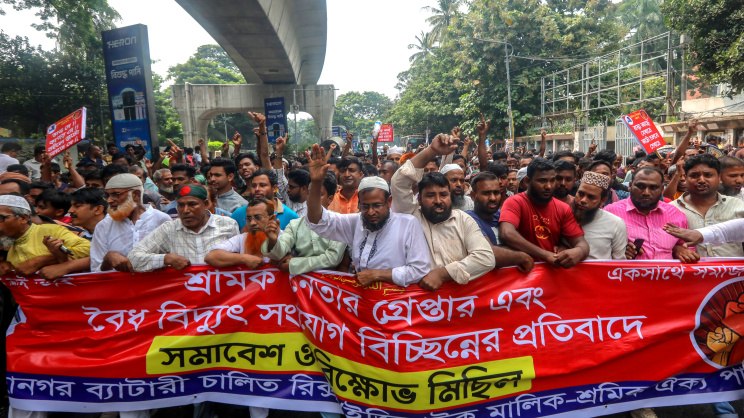
The experiment has been repeated many times, with much the same result. A 2024 order to clear battery rickshaws from the main roads was reversed within days after drivers blocked roads and neighbourhoods in protest. A subsequent High Court order to remove them within seventy-two hours instead led to pitched clashes in Jurain, a blockaded rail line and tear gas, followed by a stay from the higher court. Fresh restrictions followed in 2025. By mid-2026, the government had changed course again, drawing up an eight-zone registration scheme with QR codes, engineering certificates and mandatory solar charging; drivers’ associations are already contesting its terms.
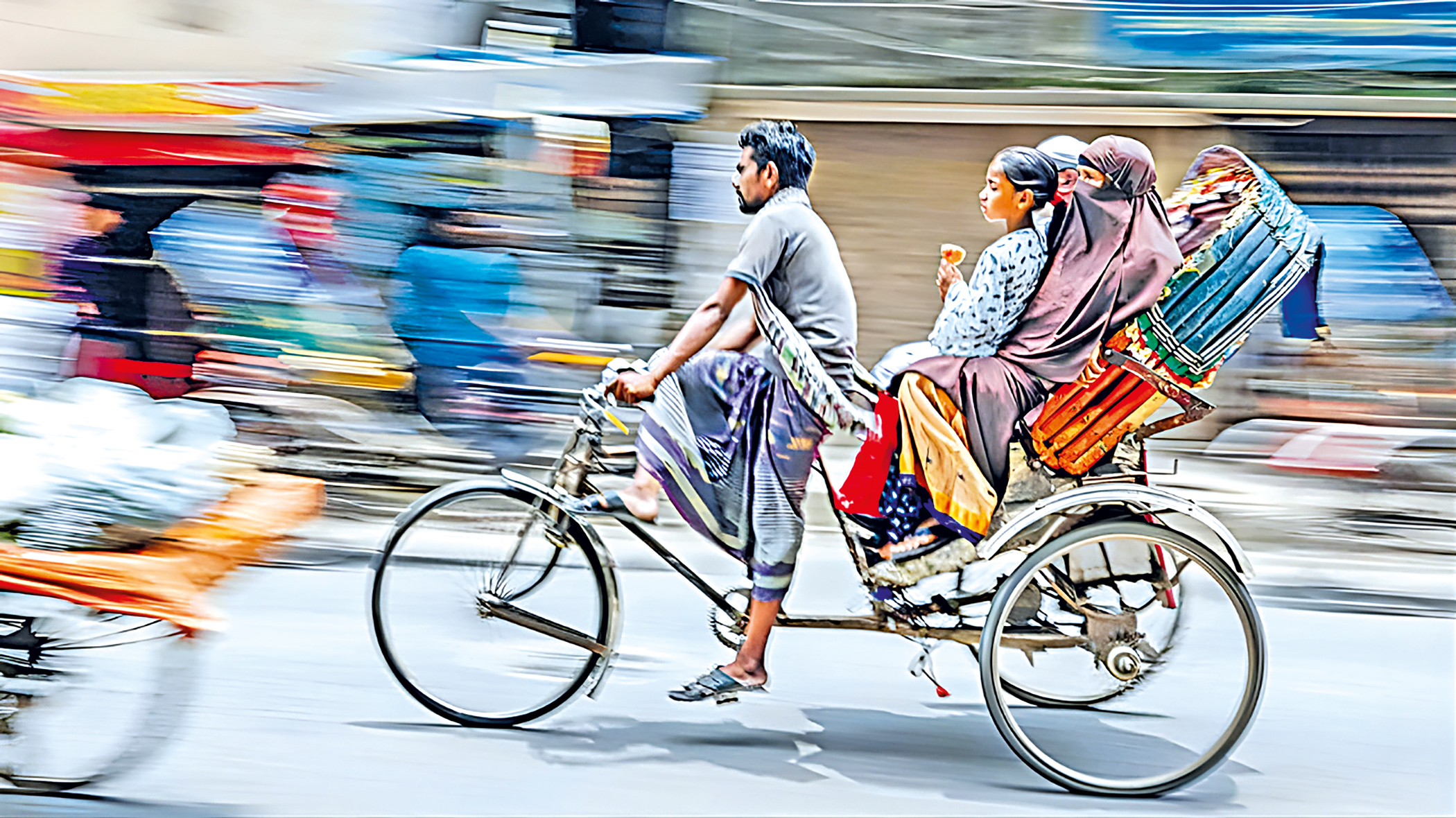
There is a simple reason for this recurring pattern. A ban assumes that the people it displaces have somewhere else to go. Most do not. As long as people who have lost their livelihoods in the countryside continue to arrive in the capital, and the city has no better first job to offer them, the rickshaws will return as soon as enforcement eases. Behind each vehicle may be a loan that still has to be repaid and a household that still has to be fed. Analysts who have tracked the sector note that successive governments have failed to regulate it for precisely this reason.
Nor is the promised public transport alternative arriving quickly enough. Bus route rationalisation, intended to bring order to Dhaka’s roads and provide commuters with a genuine alternative, has been discussed for the better part of a decade but currently operates on only a single route, with a large share of its designated stops found not to exist. Even a fully functioning system could not simply replace the livelihoods supported by a million rickshaws. In its present form, it is nowhere near doing so.
What an honest policy would look like
None of this is an argument for leaving the sector unregulated. Battery rickshaws are measurably more dangerous than their pedal-powered counterparts, with their drivers reporting significantly more serious accidents. Unregulated charging also places a real burden on the power supply and creates a serious fire hazard. The point is that the sector should be governed for what it is: one of the city’s largest informal labour markets, rather than treated simply as a traffic nuisance.
That begins with counting and registering the vehicles. Doing so could do more to dismantle the thief-plate rackets and curb electricity theft than repeated enforcement drives, while also generating municipal revenue. It also means designing roads around the journeys people actually make, many of which are short and local, and better served by a slow-moving vehicle than by a private car carrying a single passenger while occupying considerably more road space. And it means recognising rickshaw driving as work that warrants basic protections. The international framework for bringing informal workers into the formal economy has existed since 2015; Bangladesh has yet to make meaningful use of it in this sector.
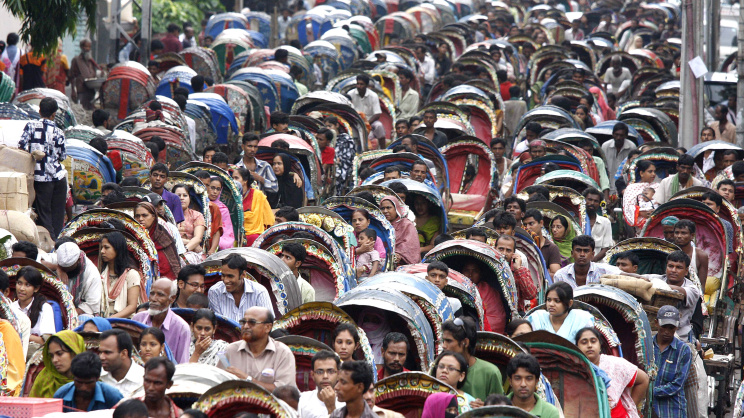
There is no quick solution, and pretending otherwise only postpones the harder choices. Dhaka’s rickshaw fleet will begin to shrink only when a farmer in Bhola or Satkhira can afford to remain on his land, or when the city he moves to can offer him a factory job, construction work or a service-sector job that provides a better living than a rented battery rickshaw and a day’s fares. That requires a generation of economic policy, not another traffic circular. Until those alternatives exist, the vehicles will keep returning. This is the dilemma at the heart of every recent debate over the sector: the roads cannot be cleared of rickshaws faster than the economy creates alternative ways for their drivers to earn a living.
Dhaka cannot ban its way out of a labour market without first building an alternative to it. Address the underlying economics, and the pressure on the roads can begin to ease. Leave those conditions unchanged, and no ban, however firm, and no transport plan, however well designed, is likely to hold.
Md. Muntasir Mamun is a Technical Consultant for the Preparation of Concept Design & Implementation Plan for Bus Route Rationalisation and Company-Based Operation of Bus Service in Dhaka at the Dhaka Transport Coordination Authority.
Dhrubo Alam is a Deputy Transport Planner at the Dhaka Transport Coordination Authority.
Send your articles for Slow Reads to slowreads@thedailystar.net. Check out our submission guidelines for details.
The staircase between our mothers and care
Is Bangladesh prepared for the next food shock?
From more power to better power: Rethinking Bangladesh’s energy future
Growing out of LDC status: Bangladesh’s real negotiation at COP31
What is holding back solar in Bangladesh’s garment industry?
Confessions of a finance professor: The danger of putting profits first
The making of a cup of tea: Plantation, empire and the pursuit of quality
Why Bangladesh’s measles outbreak should be a wake-up call
From prediction to preparedness: How AI can help us navigate climate uncertainty