Can pink buses make travels safer for women?


It’s 10:30 PM, and a young female researcher enters her home and has the following conversation with her father.
Father: “Where were you? I’ve been calling you since half past nine.”
Researcher: “Baba, the conference ran late, and then you know how the traffic is in this city.”
Father: “That’s exactly why I was calling. You could have at least sent a message. Is that so difficult?”
Researcher: “I was on the bus, and as usual, it was too crowded. I couldn’t…”
Father: “Next time, try to pick up the call or share your live location. That’s all I ask.”
Every day, similar conversations take place across millions of households in South Asian countries such as India, Bangladesh, Nepal, and Pakistan. Yet this simple conversation reflects multifaceted aspects of women’s mobility: recalculation, negotiation, permission, accountability, bodily autonomy, and anxiety. For anyone who wants to understand the complexities and nuances of mobility through a gendered lens, this is the real unit of analysis. It also intersects with what sociologists call ‘mobility of fear’ (Phadke, S., Khan, S. and Ranade, S., 2011. Why Loiter?: Women and Risk on Mumbai Streets. Penguin Books India) and what economists call ‘mobility tax’ (Kondylis, F., Legovini, A., Vyborny, K., Zwager, A.M.T. and Cardoso De Andrade, L., 2020. “Demand for Safe Spaces: Avoiding Harassment and Stigma.” World Bank Policy Research Working Paper, No. 9269), invisibly levied on women’s time, income, and professional engagement. As two doctoral researchers coming from two distinct streams of sociology and economics, we find ourselves returning to that doorway scene with a single inquisitive but comparative question: what can Delhi offer Dhaka in light of its decade-long experimentation with safer and fare-free public transport for women, and what, in turn, should Delhi take away from Dhaka’s failures before it repeats them itself?
Two capital cities with the same fault line
Capital cities are magnets for opportunities and social mobility. As the capitals of Bangladesh and India, Dhaka and Delhi share a similar historical trajectory in how they accommodate their inhabitants. Every year, about 500,000 people move to Dhaka from rural areas (Abdullah, A., 2016. “Rural-Urban Migration and Informal Sector of Dhaka City: Issues and Facts”) due to various push factors (poverty, natural disasters, etc.) and pull factors (employment opportunities, safety, higher living standards, etc.). In Delhi, the city’s migration history is closely linked to India’s independence and the transfer of a large population following Partition (Dupont, V., 2000. “Spatial and Demographic Growth of Delhi since 1947 and the Main Migration Flows.” Delhi: Urban Space and Human Destinies, pp. 229–239).
Women comprise a significant portion of the migrant population in both capitals. While the migration literature often characterises women’s migration as passive, their resettlement within urban spaces is directly or indirectly driven by formal and informal labour-market demand. Yet, in the discourse of city development, especially around public infrastructure and the built environment, much of the planning does not reflect these classed and gendered dynamics, which require recalibration. Looking particularly at the public transport systems (PTs) of both cities, even though women tend to be among their biggest users, they are subjected to gender-based violence (GBV) on a daily basis, which restricts their ability to move freely and safely, thus limiting their right to access the city. Against this backdrop, the PTs of both Delhi and Dhaka (including buses, cabs, and intermediate paratransit such as legunas, e-rickshaws, and phatphats) present an extraordinarily harassment-prone environment, leading to numerous cases of GBV. The consequence is a quiet withdrawal of women from public economic life.
In 2012, in the aftermath of the gang rape and murder of a young physiotherapy student, Delhi witnessed a massive uprising demanding justice and safety for all women in the national capital. The movement served as a catalyst, forcing India’s capital to confront what feminist scholars had long argued: that urban public space and transport infrastructure are never gender-neutral. Reading public transport infrastructure as a site of gender-based violence and linking the right to mobility with the right to safety, the Justice Verma Committee suggested amendments to laws involving sexual violence against women and called for changes within Delhi’s urban infrastructure, including its public buses. What followed was a spate of technology-enabled interventions: GPS tracking, the installation of panic buttons, CCTV cameras on buses, and the Delhi Police’s ‘Himmat’ app. Today, public buses in Delhi are equipped with surveillance systems in a way that those in Dhaka are not yet. However, sociological exploration of the past decade paints a sobering picture in which technological interventions have failed to bring about changes in how passengers, conductors, and drivers interact with women passengers on public buses. It also highlights that, while institutional responses through technological adoption have happened faster, the much harder work of realising cultural reform is yet to come.
In 2017, a particular case that became a national flashpoint in Bangladesh was the gang rape and murder of a 27-year-old female law student by a bus driver and his helpers while she was travelling on an inter-city bus from Dhaka to Mymensingh. This incident became a tipping point for the people of Bangladesh, triggering national outrage and leading to public demands for measures such as capital punishment for all perpetrators, enhanced security on public transport (such as CCTV cameras, mandatory uniforms and nameplates for drivers and helpers, a crew verification database, and reserved seats for women), and strict accountability for transport owners and operators. These reforms also marked an important juncture in the emergence of gender as a crucial category in Delhi’s and Dhaka’s transport policies and planning. In this light, what becomes important is reflecting on these existing measures and considering how they are quietly reshaping ideas about what safety means for women.
Blind spots in both cities: Migrant labour and the economics of fare-free travel
Among the public transport modes available in Dhaka and Delhi, buses remain the most affordable means of travel. Delhi’s highly subsidised bus transit serves as an extremely critical mode of transport, especially for the working population among the lower and lower-middle classes (Bhatia, T. and Jain, M., 2009. “Bus Transport in Delhi.” Centre for Civil Society). In Dhaka, buses carry around 1.9 million passenger trips on a daily basis and are the most widely available mode of public transit.
Post-Nirbhaya, for about a decade, city dwellers in Delhi experienced technology-enabled surveillance in the city’s public transport system. Towards the end of this decade, in 2019, the Aam Aadmi Party (AAP)-led government inaugurated free travel for female passengers on Delhi Transport Corporation (DTC) buses and cluster buses, popularly known as the ‘Pink Ticket Scheme’. The economic evidence for this scheme in a city like Delhi, where an estimated 45 per cent of the city’s workforce comprises migrant workers, is substantial enough to guide any city, including Dhaka, in considering similar interventions. Using data from the Time Use Survey 2019 (TUS 2019) and employing two alternative difference-in-differences (DID) strategies, an economics discussion paper published by Ashoka University shows that, following the implementation of the fare-free public transport (FFPT) scheme, employment among women, especially those from marginalised backgrounds, increased by 24 percentage points, while the time spent on paid work increased by two and a half hours (Ashoka University, Discussion Paper 105). Another research paper by the World Resources Institute (WRI) India finds that Delhi’s FFPT scheme helped about half of the women surveyed (out of 2,010 respondents) save Rs 500–1,000 per month on bus fares (World Resources Institute India, Fare-free bus travel scheme for women: Lessons from Delhi, 2025).
However, in 2026, the newly elected Bharatiya Janata Party (BJP)-led government rolled out the Saheli Smart Card, replacing the previous paper-based ‘Pink Ticket’. While the rationales provided were anti-corruption and digital efficiency, the new scheme, in essence, transformed a partially universal public good into an inherently exclusionary and conditional one, especially leaving scores of migrant women unable to access its benefits (Mukherjee, P., 2025. “Pink Tickets to Saheli Smart Cards: Gendered Mobility and Debates on Fare Free Travel.” Refugee Watch: A South Asian Journal on Forced Migration). From a sociological vantage point, the introduction of smart cards must be seen in the light of the ‘politics of othering’, in which migrants are treated as enemies of the public good (Schenk, C., 2021. “The Migrant Other: Exclusion without Nationalism?” Nationalities Papers, 49(3), pp. 397–408).
Delhi’s experience provides a cautionary tale that Dhaka should absorb before overhauling its chaotic public bus infrastructure. Dhaka has an estimated four million-plus RMG workers, predominantly women, residing in scattered areas adjacent to garment factory clusters in Jatrabari, Demra, Keraniganj, Mirpur, Savar, etc. This indicates that, unlike Delhi’s middle-class commuter base, Dhaka’s commuter base is composed mostly of what labour economists call a ‘captive’ transit population (Kabeer, N., 2000. The Power to Choose: Bangladeshi Women and Labour Market Decisions in London and Dhaka. Verso), for whom economic survival is intricately tied to commuting from the factory gate to their residences and back, regardless of safety concerns. Therefore, the question of safe mobility when drafting any transport plan for Dhaka city demands not only the creation of an enabling environment for new labour-force entry, but also the prevention of attrition among existing low-wage women workers.
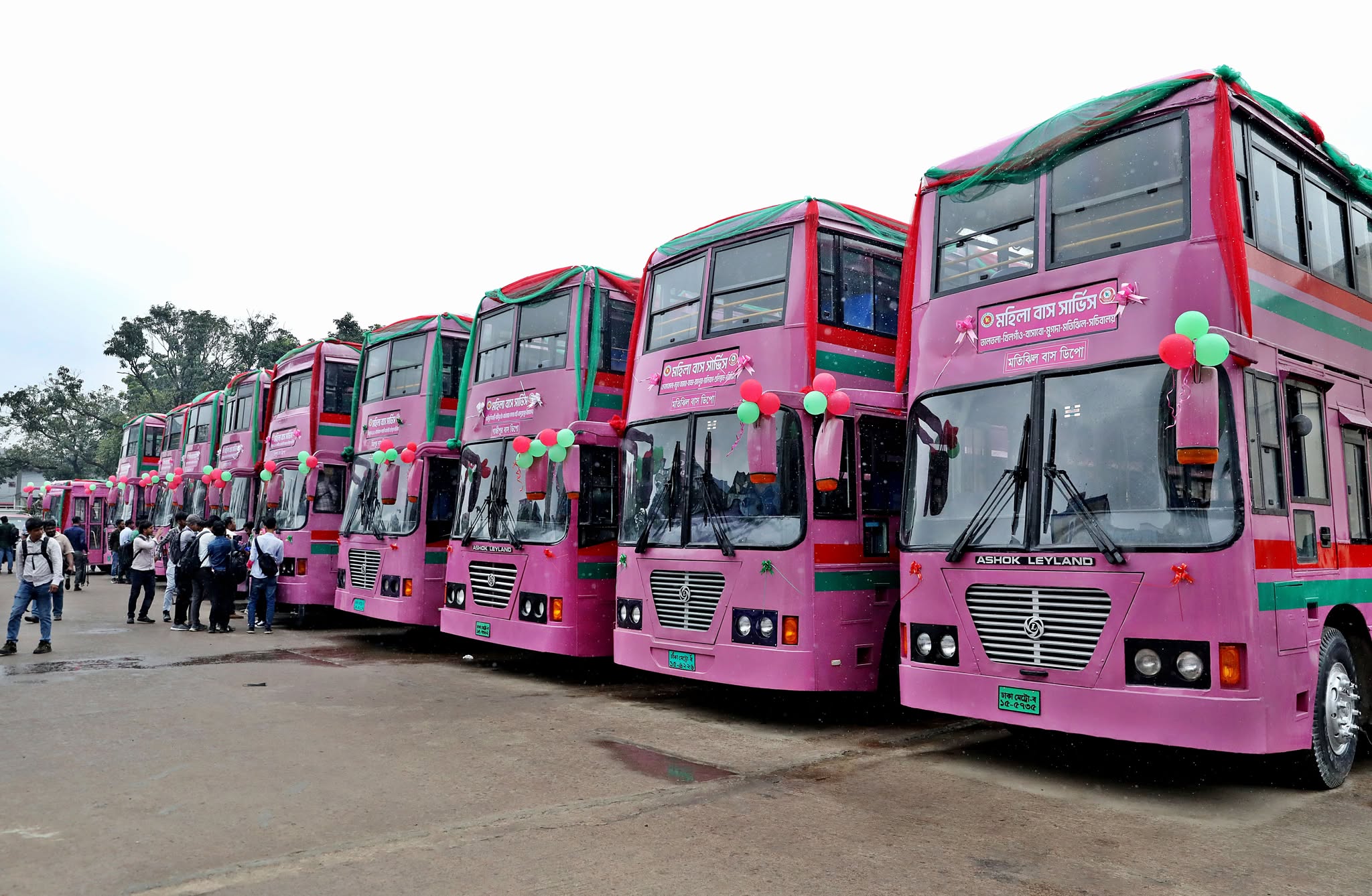
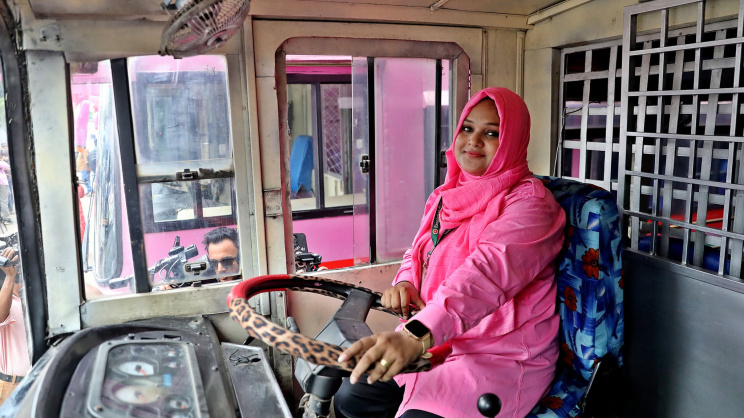
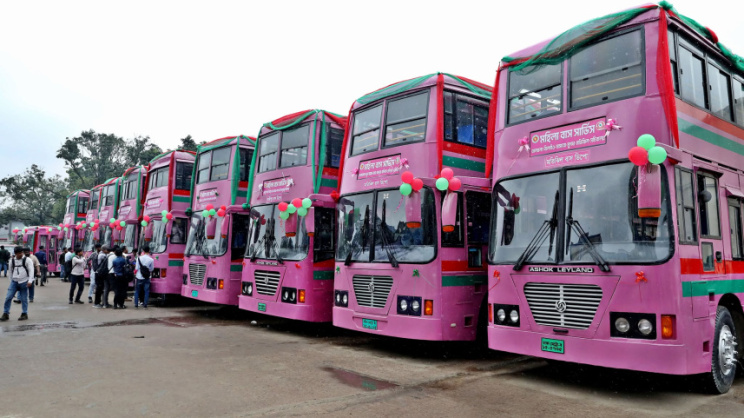
Against this backdrop, Dhaka’s most recent response to introduce women-only and women-operated Bangladesh Road Transport Corporation (BRTC) bus services, from a sociological vantage point, is reflective of a ‘segregation’ rather than an ‘integration’ model. Such reforms are not a new phenomenon, however. Over the last three decades, both the government (BRTC) and private operators have made several attempts to provide women-only bus services. These efforts have often involved buses specifically designated for women, while other initiatives have used pink branding. But due to limited route coverage and high ticket prices, such projects have failed to move beyond their limited reach.
Without comprehensive efforts to address gender-based inequalities in mobility planning, the ‘pinkification’ drive risks becoming an illusory gimmick that fails to bring about any substantial change.
Even though gender-based measures such as reserved seats for women (mostly placed beside the driver’s seat and closer to the engine) have been loosely implemented, as yet, no attempts have been made to introduce a subsidised scheme like FFPT for Dhaka’s female commuters. Without comprehensive efforts to address gender-based inequalities in mobility planning, the ‘pinkification’ drive risks becoming an illusory gimmick that fails to bring about any substantial change.
Furthermore, data from the Dhaka Transport Coordination Authority (DTCA) show that more than nine thousand buses owned by over a hundred fragmented companies operate across 291 routes in the capital. Alongside this chaotic situation, weak law enforcement, the absence of regular monitoring, a manual traffic signalling system, undefined bus stops, and a haphazard counter-ticketing system undermine the potential of any single reform agenda.
What Delhi and Dhaka can learn from each other
First, Dhaka should resist the temptation to be overly enthusiastic about merely repainting BRTC’s existing fleet pink, which would serve only as a symbolic gesture. Before indulging in any Delhi-style technological fix, Dhaka needs to prioritise the implementation of bus route rationalisation, modernisation of the traffic signalling system, as well as the expansion of bus stops within underserved but busy corridors from which a significant number of garment workers travel daily.
Secondly, Delhi must reflect on its own policies, especially on how the universality of the pink ticket system meant equal opportunities for all, rather than for Delhi residents only. In turn, Dhaka must refrain from adopting a similar policy verbatim. Instead, policymakers in Dhaka must envision any future design with sensitivities that explicitly safeguard undocumented migrant women and women working in the informal sector. It is important here to keep in mind that technological solutionism, such as digital ticketing or surveillance-based mechanisms, should not come at the cost of human agency or people’s right to movement and mobility.
Thirdly, except for BRTC’s double-decker buses, the majority of public buses have only a single entry/exit door, as opposed to Delhi’s DTC buses, making boarding and alighting a cumbersome task for Dhaka’s female commuters. Therefore, Dhaka’s transport regulator must require manufacturers to provide separate entry and exit doors on buses. Additionally, on Dhaka’s buses, the placement of reserved seats must be redesigned, keeping in mind questions of accessibility, safety, and comfort for women.
Finally, the most important lesson that both cities must consider is that institutional reforms alone cannot fix the age-old societal problem of patriarchal structures, as well as the rampant misogyny that governs women’s mobility in complex and dynamic ways. Any gender-based transport measures must therefore be grounded in considerations of women’s everyday experiences of travelling, moving beyond mere economic rationalities. As feminist scholars have repeatedly pointed out, “what makes a public space safe for women is the presence of other women” (Phadke, S., Khan, S. and Ranade, S., 2011. Why Loiter?: Women and Risk on Mumbai Streets. Penguin Books India). Bangladesh’s new Pink Bus initiative, which deploys women drivers and conductors, is an important step that can not only increase women’s visibility but also enhance their participation in the transport sector, which remains largely male-dominated. Furthermore, technical training for bus drivers and conductors should be complemented by gender-sensitisation workshops, which, in turn, can build women’s confidence to travel on buses more freely.
By the time Dhaka’s pink buses become more visible, cost-effective and accessible, and Delhi’s pink ticket reverts to universality, female citizens of both cities will continue to face the same harsh reality: the longest commute is the one that runs between their economic potential and the road they still cannot travel safely and freely.
Dr Procheta Mukherjee recently completed her PhD. She can be reached at mprocheta@gmail.com .
M. A. Shaleh Sadiq is a PhD scholar at South Asian University, New Delhi. He can be reached at mass16kh@gmail.com.
Send your articles for Slow Reads to slowreads@thedailystar.net. Check out our submission guidelines for details.
Can the new strategy achieve Bangladesh’s renewable energy targets?

André Wink speaks / What we get wrong about the Indo-Islamic world
Bengali Muslims and the ghosts of India's citizenship politics

Bangladesh’s solar growth: Will the incentives be enough?

The missing link in Bangladesh's innovation economy
Dhaka’s battery rickshaw problem is economic, not just about traffic
The staircase between our mothers and care
Is Bangladesh prepared for the next food shock?

From more power to better power: Rethinking Bangladesh’s energy future