Bangladesh and the question of indigenous peoples
Since the United Nations proclaimed 1993 the International Year of the World's Indigenous People, the question of who should be recognised as Indigenous has remained a recurring subject of debate in Bangladesh's political and public discourse. The peoples concerned have variously been called Adivasi, Indigenous peoples, ethnic minorities or, officially, small ethnic groups and tribal peoples. The discussion commonly turns to history: who came when, who preceded whom, and whether the term Indigenous has any bearing on the status of Bengalis within the nation and on the sovereignty of the state of Bangladesh. These questions have political consequences and cannot simply be wished away.
A key question concerning indigenous peoples is their relationship with the modern state. Citizenship and peoplehood are not the same: states confer citizenship, but states do not necessarily create the peoples who live within their borders. A Chakma, Marma, Mro, Tripura, Garo, Santal, Hajong or Khasi can be a citizen of Bangladesh and, at the same time, belong to a historically constituted people whose language, social memory, institutions and relationship with the land long predate the present state of Bangladesh. Recognition of this history does not diminish the sovereignty of Bangladesh; rather, it describes more accurately the society over which that sovereignty is exercised.
Canadian scholar Will Kymlicka's work on multicultural citizenship is relevant here. His core thesis is simple but significant: equal citizenship does not imply identical treatment. For national minorities and indigenous peoples, equality may require distinct rights, such as language rights, territorial autonomy and forms of self-government. This is partly because state institutions frequently reflect the language, history and habits of the majority. Therefore, treating everyone identically within such institutions may perpetuate, rather than alleviate, historical inequality.
The main point, then, is simple: equal citizenship does not require cultural uniformity.
The main point, then, is simple: equal citizenship does not require cultural uniformity.
Indigeneity, in this sense, concerns more than the question of who occupied a place first. This takes us to a question rarely posed in contemporary public discussion: when does a people cease to exist?
Consider an indigenous community whose individual members continue to live and participate in society. They have citizenship, attend schools and universities, enter professions, migrate to cities and participate in the national economy. But over two or three generations, they lose their language, customary institutions, access to traditional lands and commons, ecological knowledge, and the capacity to transmit these to their children. The population has not disappeared. But can we say, without qualification, that the people have survived? I do not think we can.
There is a further difficulty. The relationship between power and knowledge is not neutral. Decolonial scholar Boaventura de Sousa Santos has written about the hierarchies through which modern systems of knowledge establish what counts as legitimate knowledge and what is relegated to belief, folklore or backwardness. The point is not to reject modern science. It is to recognise that different systems of knowledge may apprehend the same world through different social relationships.
For example, think of a forest. To a government department, it may be a legally demarcated reserve. To an economist, it may constitute natural capital; to a conservation organisation, biodiversity and habitat. To a community that has lived there for generations, the same forest may simultaneously constitute livelihood, territory, memory, medicine, kinship and sacred space. The difficulty arises when one of these descriptions possesses the institutional power to invalidate all the others. A working-plan map can then override generations of customary use; an administrative classification can transform a lived territory into state land.
What appears to be a battle over resources is sometimes a conflict over who has the power to define reality based on their understanding of the world. In Bangladesh and around the world, indigenous territories frequently overlap with forests and places of high biodiversity. I would resist the urge to explain this by claiming that indigenous peoples are intrinsically more connected to nature. That romantic vision is neither sociologically compelling nor particularly useful.
Institutions provide a better explanation. People do not interact with forests, rivers or land as isolated individuals. Access and use are organised through property relations, customary rules, kinship, markets, political authority and moral obligations.
The work of commons scholar Elinor Ostrom demonstrated that the familiar choice between private ownership and centralised state management is a false one. Communities can develop complex and durable arrangements for governing common resources. Many indigenous institutions represent historically accumulated experiments of this kind. Their languages may contain detailed knowledge of plants, animals, soils and seasons; customary rules may govern access to commons; collective memory may record environmental changes that no administrative archive contains.
Their existence is part of humanity's accumulated experience of organising life within particular ecosystems. When such a social world disappears, part of humanity's ecological memory can disappear with it.
Indigenous governance beyond the Chittagong Hill Tracts
In Bangladesh, indigenous peoples of the plains also have historically constituted relationships with land, forests, commons and local ecologies. The circumstances of a Santal community in the northern districts, a Garo community in greater Mymensingh or a Khasi community in greater Sylhet differ considerably from those of the peoples of the Chittagong Hill Tracts. There is no reason why they should be governed through the same institutional model.
Culture cannot be protected for long if the material and institutional relationships through which it is reproduced are steadily dismantled.
But the underlying problem is similar. Culture cannot be protected for long if the material and institutional relationships through which it is reproduced are steadily dismantled. A language becomes difficult to sustain when its speakers are dispersed. Ecological knowledge loses its social basis when people lose access to the forest, field or wetland through which that knowledge was produced. Customary practices become little more than cultural performances when communities have no recognised role in decisions affecting the resources and places around which those practices developed.
For this reason, recognition has to extend beyond language and festivals. It has implications for customary land use, commons, protection against dispossession, political representation, community institutions and participation in decisions concerning traditionally used lands and resources.
This is not the same as territorial sovereignty. Nor does every indigenous people require the same form of territorial institution. The arrangements appropriate to particular communities have to arise from their histories, demographic circumstances and contemporary needs.
Here, the Chittagong Hill Tracts are important, not because it provides a model to be copied elsewhere, but because Bangladesh has already confronted this principle there.
The 1997 CHT “Peace” Accord went considerably beyond ending the armed conflict that lasted from 1975 to 1997. Through the Regional Council, Hill District Councils, provisions concerning land and local administration, and recognition of the distinctive characteristics of the region, the Accord attempted to devise institutions suited to a particular historical and social context. Its underlying principle was not especially radical: people can belong to a common state without every part of that state being governed through identical institutions.
In a sentence, much of the indigenous demand in the CHT can be expressed quite simply: allow us sufficient institutional space to remain ourselves while belonging to Bangladesh.
The incomplete implementation of important provisions of the Accord almost three decades to date is more than an unresolved grievance of the Hill peoples. It represents an unfinished experiment in Bangladesh's capacity to govern diversity. For indigenous peoples elsewhere in Bangladesh, the CHT may not offer a blueprint, but it does demonstrate that distinct institutional arrangements can exist within the framework of Bangladesh’s sovereignty.
Do we listen to indigenous peoples?
There remains a deeper problem: do the ruling classes listen to what minority groups want to share? Here, Gayatri Chakravorty Spivak's Can the Subaltern Speak? remains instructive. Her work is often read too literally. The subaltern obviously speaks. The problem is whether dominant communities and institutions can understand what is being said without first translating it into categories through which they already understand the world.
indigenous land claims illustrate this problem. For an indigenous community, land may not simply be property owned by an individual. It may be part of a customary territory, sustained through collective use, inherited relationships, social obligations and forms of local authority. But when such a claim enters the institutions of the state, it must often be expressed in a very different language: Who owns the land? Where is the title? What individual or legal body holds the right? The community may therefore have to translate a collective relationship with land into the language of property recognised by the state. In that translation, important aspects of the original relationship may be lost. The people have spoken, but the meaning of what they said has been altered before it can acquire legitimacy within the dominant institutional order.
This is not simply a matter of prejudice or racism; it is also an epistemic problem.
Dominant communities rarely experience their own institutions as culturally particular. Their language is simply the national language; their history becomes national history; their administrative arrangements appear ordinary; their understanding of property seems natural. The institutions of minorities, by contrast, appear ethnic, customary and exceptional. The particularity of the majority thus acquires the appearance of universality, while the particularity of the minority appears as a request for special treatment.
For Bengalis, there is an uncomfortable historical irony here. Our struggle for liberation from Pakistan emerged in substantial part from demands for linguistic and cultural recognition. The Language Movement taught us that language is inseparable from memory, dignity and political power. Few people should therefore be better placed than Bengalis to understand why another community fears losing its language or its ability to reproduce a distinctive social world.
Yet the experience of having once been subordinated does not automatically teach ruling elites how to behave when their own community becomes the majority.
Behind a “Bangladeshi veil of ignorance”
American political philosopher John Rawls gives us a useful way of looking at the question without beginning from either Bengali or indigenous interests.
Imagine designing Bangladesh from behind his famous “veil of ignorance”. We know that we will be born somewhere in Bangladesh, but not who we will be. We do not know whether we will be Bengali, Chakma, Marma, Mro, Santal, Garo, Khasi or Hajong. We do not know whether our mother tongue will be spoken by more than a hundred million people or only a few thousand. We do not know whether the country's schools, bureaucracy and political institutions will operate through our language and history or those of another people. Nor do we know whether the law will recognise our community's longstanding relationship with land.
What arrangements would we choose before discovering our identity?
If we did not know which community we would be born into, would we want the future of our language, culture and land to depend entirely on the goodwill of the majority? I doubt it. We would probably want some protection before we knew whether we would be among those who needed it.
Seen from behind the veil, indigenous rights cease to look like privileges granted by “us” to “them”. They become part of the institutional protections that any of us might reasonably demand.
That, perhaps, is where Bangladesh needs to begin.
Recognition without romanticisation
Recognition matters, including the constitutional recognition of indigenous peoples in Bangladesh. But recognition becomes thin if the social conditions necessary for a people to continue to exist are allowed to disappear. Nor does recognition mean that every indigenous claim is beyond question. Indigenous political leaders, like Bengali political leaders, should be accountable, and customary institutions should not be immune from criticism concerning gender, hierarchy or individual rights. Indigenous knowledge should not be accepted as inherently valid simply because it is indigenous, just as state knowledge should not be regarded as inherently superior simply because it is official.
A plural Bangladesh would not freeze indigenous peoples in the past. Quite the opposite. It would give them greater capacity to negotiate their own futures.
What is required may sound simple: the majority does not have all the answers. Other peoples may possess knowledge and ways of organising collective life from which we can learn. One might call this epistemic pluralism. Can we imagine a political community in which common citizenship does not require cultural sameness? And can the Bengali majority, whose own history was built upon a demand for cultural recognition, extend that recognition to peoples who do not share its language and history?
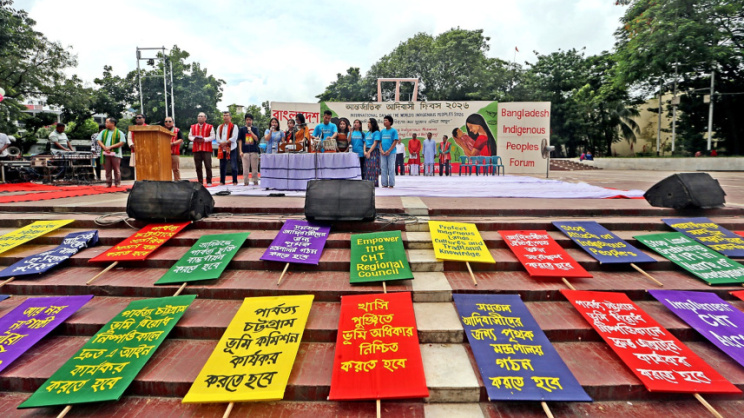
A plural Bangladesh would not freeze indigenous peoples in the past. Quite the opposite. It would give them greater capacity to negotiate their own futures. There is a tendency on indigenous Day to celebrate diversity through clothing, dance, food and photographs. There is nothing objectionable about this. But a culture cannot survive indefinitely through performance alone once the social relationships that sustained and shaped it have disappeared. The real task would be to ensure that indigenous peoples have the space to carry their cultures forward while changing them in their own ways.
There is also a reason to look beyond Bangladesh. indigenous societies do not provide a ready-made alternative to modernity. But their languages, ecological knowledge, institutions and long-standing relationships with particular landscapes constitute part of humanity's accumulated experience of living on this earth. It would be foolish to romanticise that experience. It may be equally foolish to lose it. At a time when humanity is searching urgently for ways of living within planetary limits, Bangladesh should listen to its indigenous peoples—not simply as minorities asking to be accommodated, but as fellow citizens and historically constituted peoples from whom the majority, too, may have something to learn.
Dr Khairul Chowdhury is Professor of Sociology at the University of Dhaka. His research and publications focus on indigenous peoples, the Chittagong Hill Tracts and political ecology. He is Joint Coordinator of the CHT Accord Implementation Movement and Regional Editor for Bangladesh (Coordinator) of Global Dialogue, the quarterly magazine of the International Sociological Association (ISA).
Send your articles for Slow Reads to slowreads@thedailystar.net. Check out our submission guidelines for details.
Can the new strategy achieve Bangladesh’s renewable energy targets?
André Wink speaks / What we get wrong about the Indo-Islamic world
Bengali Muslims and the ghosts of India's citizenship politics

Bangladesh’s solar growth: Will the incentives be enough?

The missing link in Bangladesh's innovation economy
Dhaka’s battery rickshaw problem is economic, not just about traffic

The staircase between our mothers and care
Is Bangladesh prepared for the next food shock?

From more power to better power: Rethinking Bangladesh’s energy future