


What's holding women back from riding bicycles?

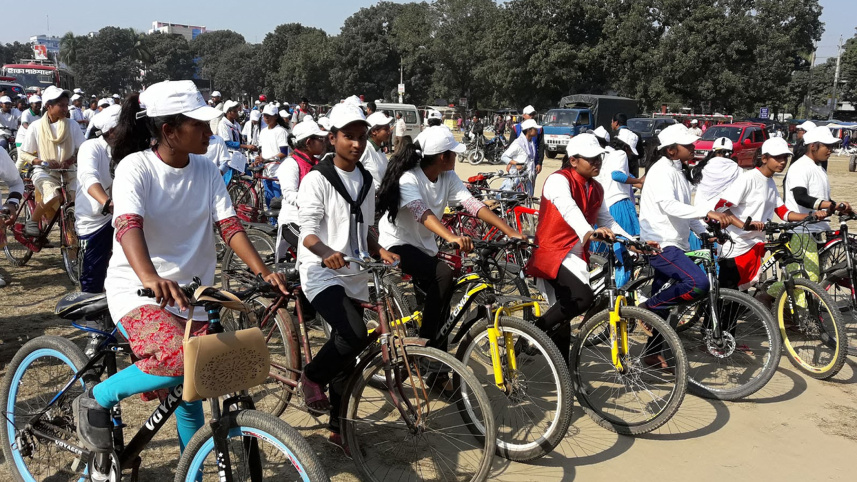
Stand on any road in Dhaka. Men and boys cycle freely, weaving through traffic with ease. Now look for women—you will see very few. And when you do, they draw stares. This is not just cultural; it reflects a persistent economic exclusion the country has been facing for decades.
The stigma is rooted in perceived immodesty and a stubborn assumption about where women are meant to exist. Half the population is locked out of one of the cheapest and most liberating forms of transports available. According to a 2018 IMF estimate, reducing gender disparity in labour force participation could raise Bangladesh’s GDP by almost 40 percent. Another figure by the Household Income and Expenditure Survey (HIES) by the Bangladesh Bureau of Statistics (BBS) shows that only around 42.5 percent of working-age women participate in the labour force in the country, against some 81.3 percent of men. Here, the reason is not that the women are not as qualified or educated as men, but the fact that men are allowed to have more access and more freedom to move.
 For all latest news, follow The Daily Star's Google News channel.
 According to a programme by the Women’s Empowerment for Inclusive Growth (WING) of the United Nations Development Programme (UNDP) that connects women across five different districts to build their entrepreneurial skills, physical mobility is among the most pressing constraints for female entrepreneurs. Distance is also one of the main causes of dropouts among schoolgirls in the country and ensuring mobility could effectively tackle that problem. For example, India’s Mukhyamantri Balika Cycle Yojana in Bihar—launched in 2006—was an initiative aimed at solving the distance problem many girls faced by providing them with bicycles. A study in the American Economic Journal found it raised girls’ enrolment by up to 59.8 percent and cut the gender education gap by 51.2 percent. In Zambia, a UN-documented programme found girls with bicycles experienced 22 percent less sexual harassment while travelling to school.
One of the barriers to women not using cycles to commute to and from their places of education or work is a lack of institutional support and infrastructural capacity. For example, the Netherlands—known for its cycling culture—heavily invested in safe infrastructure including dedicated bike lanes with speed limits up to 50 kph to close the gender gap among people using cycles. So, one thing is fairly clear: infrastructure does not follow demand, it creates it.
There is also a public health lens that can be considered here. For example, a ten-year Swedish cohort study of 23,732 adults found that those who cycled to work had significantly lower odds of obesity, hypertension, and elevated blood sugar. Another 2023 study found that active commuting reduces cardiovascular risk by around 11 percent, with stronger protective effects for women. In light of recent unrest in the Middle East, Bangladesh is facing a structural energy strain, with 46% of supply imported and costs rising and more people switching to cycling might help to solve this problem.
So, what methods can Bangladesh adopt to ensure more people—especially women—can safely pick up their bikes to make regular journeys? Well, three actors must stop waiting for each other. First, the private sector, especially the ready-made garment industry where women are the workforce majority, can introduce subsidised bicycle access for female employees. Development organisations can also come forward by initiating schemes like “Cycle to Work”. The government can play the most important role by making roads safer, building cycling lanes, ensuring safety lighting, and running public campaign that would normalise women using cycles. It is worth remembering here that Bangladesh has shifted norms before—from girls’ education to women’s work. A bicycle has the potential to unlocks access to markets, schools, and healthcare. Keeping women off bicycles is not only cultural, it is an economic and social cost the country can no longer ignore.
Nazma Sultana manages business development of several strategic business units of Akij Venture Group.
Views expressed in this article are the author's own.
Follow The Daily Star Opinion on Facebook for the latest opinions, commentaries, and analyses by experts and professionals. To contribute your article or letter to The Daily Star Opinion, see our guidelines for submission.
Comments