


Back, again, to the cycle of broken promises?

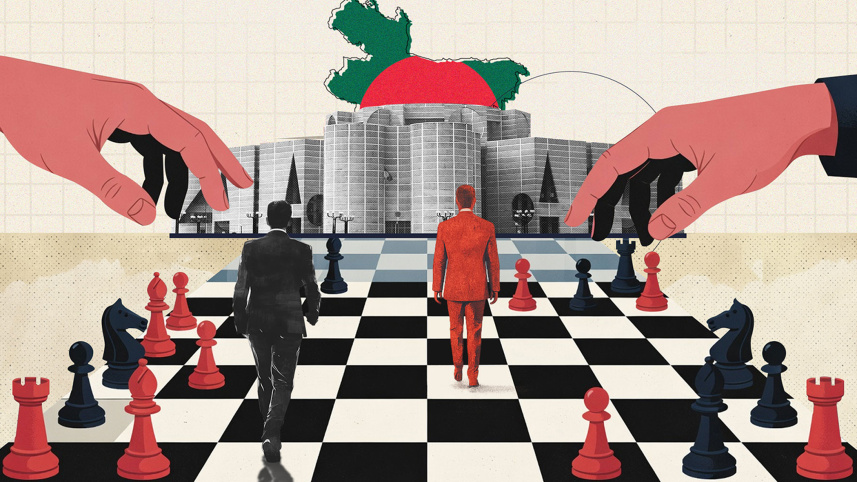
In Bangladesh’s political history, perhaps the most defining years are 1971, 1990, and 2024. Much has been said about the political, military, and social dimensions of these watershed moments. People made supreme sacrifices at these junctures to realise their political aspirations, but came up short each time. Curiously, the shortcomings receive little scrutiny in our history. We revel in glory, but avert our gaze from the erosion that follows. We hesitate to confront failure with honesty.
The Italian thinker Antonio Gramsci spoke of two interrelated spheres within the state: political society and civil society. At present, Bangladesh’s civil society finds itself unsettled, even paralysed, by the conduct of the political society. Efforts at state reform and institutional renewal seem to have faltered, with the new parliament making it clear that the reformist demands of civil society will not be fulfilled so easily, nor is there a roadmap as to when or how those might be realised.

Members of the ruling BNP, despite campaigning for a “yes” vote in the referendum, have yet to take oath as members of a Constitution Reform Assembly. The gap between political commitment and action, further exemplified by the dilution, expiration, or repeal of key ordinances passed during the interim period, has left civil society largely disillusioned. More than 20 months after the uprising, it finds itself with diminishing agency, unable to either advance the reform agenda it once championed or meaningfully process the trauma of the uprising.
A similar pattern unfolded in the years after 1971. Freedom fighters and freedom-loving people who defeated the Pakistani military gradually lost ground to the entrenched bureaucratic order that effectively absorbed and neutralised the promise of transformation. The same policing system, the same DC offices, the same land administration, the same hierarchical structures returned, as if in a tribute to their colonial masters.
Similarly, the post-1990 period saw little substantive change. Military rule was overthrown, pro-democracy students and protesters handed a “ten-point” programme to the two leaders, but subsequent decades saw major parties alternate in practising the same politics of power, leaving the British-era bureaucratic order intact. Alongside came political corruption, organised patronage networks, enforced disappearances, killings, the erosion of electoral systems, etc. So, civil society had to begin from scratch again. This time, school and college students stepped forward, their demand for safe roads taking aim at the dysfunction and injustices of the state. These students would later return to the streets to resist quota-based inequalities that subsequently evolved into a broader mass uprising.
So, another “December 16” moment came, powered by people’s aspirations for building an inclusive society. Its continuity led to the February 12 election and referendum. The interim government conducted various experiments on the ideas of reforms before finally placing a portion of uprising-induced demands before the nation through the referendum. Despite procedural flaws and signs of coercion in the reform process, the majority of voters endorsed it as an expression of collective will and necessity, including support from BNP. Yet BNP persistently refuses to join the Constitution Reform Assembly. Of the ordinances issued by the interim government, as per Law Minister Md Asaduzzaman, 97 have been ratified without changes, 13 amended before becoming law, and seven repealed, with the remaining 16 left to face further scrutiny and change. It is the fate of key ordinances that has caused particular concerns.
The message emerging from the conduct of the government and parliament over the past two months is difficult to ignore. The last election, to them, seems little more than a regime-change vote. As if the “Red July” did not happen. As if hundreds were not killed to bring about this moment. As if thousands of young people did not want something through their defiance and ouster of an autocratic regime. During the interim period, BNP functioned as a principal political actor, deeply embedded in the process. The interim government could scarcely act without its consultation and consent. But since the election, many structural legal reforms have been diluted, dismantled, or stand at risk of meeting either fate. Ordinances aimed at preventing enforced disappearance, improving human rights conditions, and strengthening judicial independence have been lost to political inertia.
The contradictions are striking. At the outset of its election manifesto, BNP had pledged to implement its “31-point” reform programme alongside the July charter. It promised to end enforced disappearances and extrajudicial killings, adopt legal frameworks in line with international conventions, and ensure accountability for those involved in grave abuses. It also pledged to strengthen the independence of the judiciary, stating that control of the subordinate courts will be placed with the Supreme Court, a law for the appointment of judges will be enacted, and the separate secretariat for the judiciary established in 2025 will be strengthened.
These commitments echoed the spirit of earlier reform agendas. The interim government’s ordinances reflected similar intentions. For instance, provisions were introduced for a Supreme Judicial Appointment Council to recommend judicial candidates independently to the president. Measures were proposed to ensure that decisions on appointments, promotions, transfers, and discipline of judges would fall under a separate secretariat, reducing political interference. But such reforms have now been rendered ineffective through the repeal of Supreme Court-related ordinances.
Meanwhile, had a strong and independent human rights commission existed during the long Awami League period, it might have mitigated some of the widespread abuses committed then. Interim ordinances created space for independent investigations into allegations against security forces. But that, too, has now been stalled. Among the victims of such abuses, BNP leaders and activists form a significant proportion; one wonders what the families of those victims felt as these reform measures were quietly undone in parliament.
At its core, meaningful reform requires a transformation of political culture—a departure from entrenched hierarchies and colonial legacies. It demands an undiluted commitment to change. Recent parliamentary experience suggests that Bangladesh remains trapped within its old structures and tendencies. Political parties themselves do not appear ready for genuine transformation. When one party holds an absolute majority in parliament, the opposition can hardly do anything beyond protests and walkouts to impact outcomes. But after decades of bitter experience, people no longer wish to see the parliament reduced to a platform for rhetorical speeches without effect. We have yet to see meaningful reform legislation emerging with bipartisan support through discussions between the government and the opposition. Instead, there are growing signs that the aspirations of July are being sidelined.
BNP policymakers insist they will implement reforms in their own way. It is also true that a government barely two months old requires time. Civil society, too, must exercise patience.
But if the civil society is sceptical, it is because it has endured repeated cycles of hope and betrayal before. Since 1972, it has waited to see the realisation of the ideals of the Liberation War; since 1991, the implementation of the ten-point programme; and for the past 21 months, the fulfilment of the promise of “Red July.” This prolonged uncertainty risks pushing society towards extremism on one hand, while allowing entrenched power structures to continually reproduce themselves on the other.
It also raises an uncomfortable question: how much of our independence and uprisings since 1971 can still be claimed as unqualified achievements? Are we, in reality, still struggling to move beyond zero? For the country’s oligarchic structures, neither 1971, nor 1990, nor 2024 appears to have posed a fundamental challenge. It is time for the citizens to look closely in the mirror and determine a workable course.
This article has been translated from Bangla by the editorial team.
Altaf Parvez is a researcher and political analyst.
Views expressed in this article are the author's own.
Follow The Daily Star Opinion on Facebook for the latest opinions, commentaries, and analyses by experts and professionals. To contribute your article or letter to The Daily Star Opinion, see our guidelines for submission.
 For all latest news, follow The Daily Star's Google News channel.
Comments