


Registration-based fuel rationing can ease long lines at filling stations


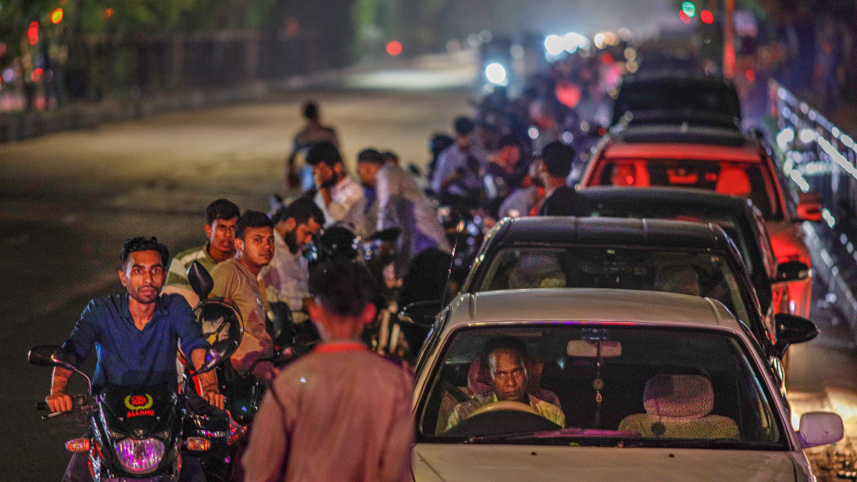
New crises! New vices! Stand in a fuel queue for an interminable 20 hours. Come back tomorrow and repeat the drill. This is not a dramatisation. This is what thousands of vehicle owners across Bangladesh have been living through. And the worst part is that most of this suffering is not being caused by an actual shortage; in fact, the country’s octane stock has almost reached full storage capacity after a fresh consignment of 25,000 tonnes of octane arrived at the Chattogram port on Friday night. So, the suffering for fuel is being caused more by panic, hoarding, and the absence of any structured distribution system. And as we understand, the new fuel prices alone might not be able to tackle the situation very desirably.

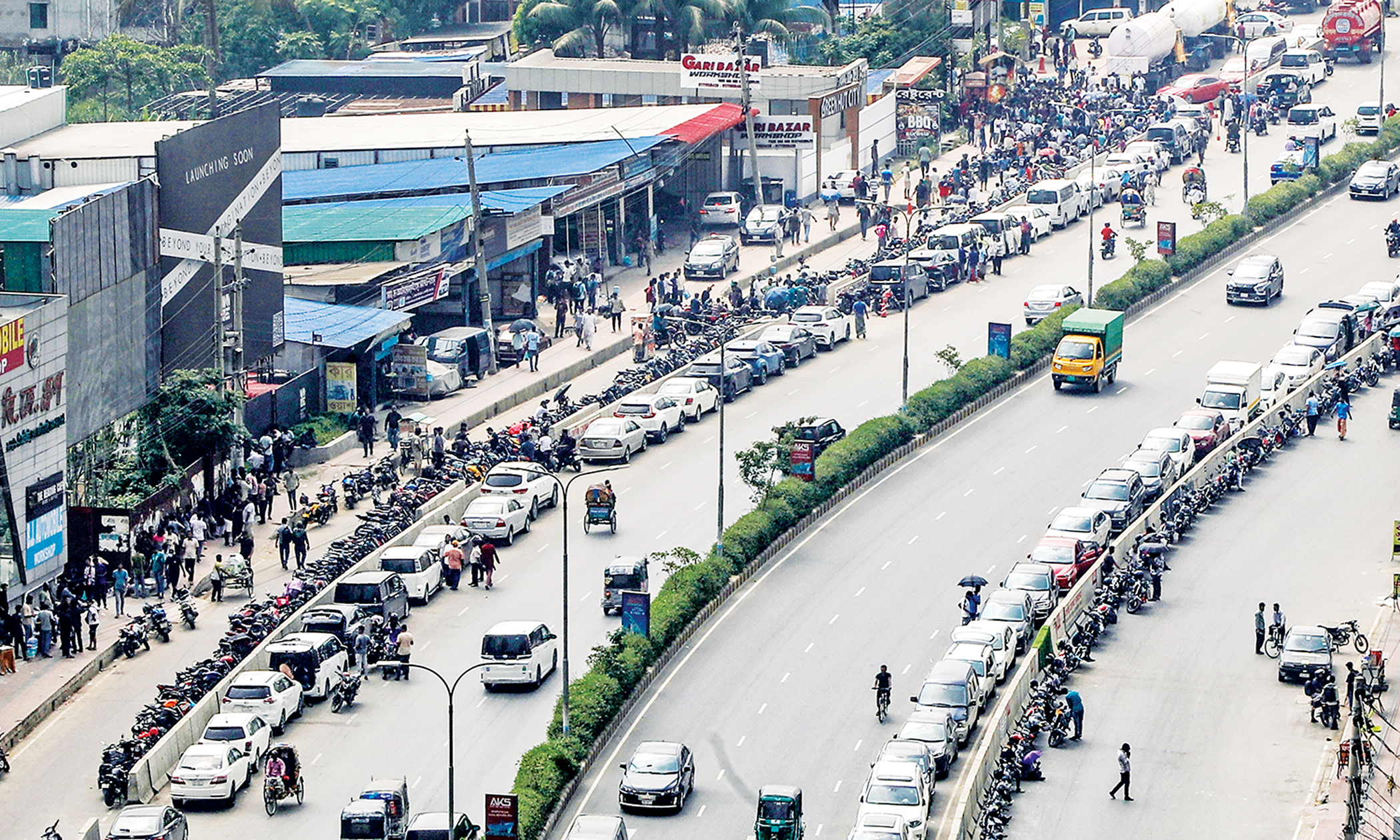
Energy security depends not just on supply availability but also on the equitable and efficient distribution of that supply to end users. When that distribution collapses into a free-for-all, even a country with “historically” large reserves can be pushed into a functional crisis beyond possibilities for swift recovery. That is precisely where we find ourselves.
In this context, our proposal for the distribution of fuel—particularly for vehicles—is straightforward: assign fuel access days based on the last digit of a vehicle’s registration number. It may simply go like this: Digits 0 and 1 on Day 01, 2 and 3 on Day 02, and so on across every five consecutive days. A less complex odd-even system will not effectively solve the current remarkable situation. Every vehicle gets its designated window. No one will be permanently denied access. They are simply scheduled more constructively.
One might question, what if someone needs fuel on a day other than the one assigned to them? Our answer is simple. That problem already exists. Right now, countless people cannot access fuel at all because they cannot physically afford to wait in a queue for 15 to 25 hours. A scheduled system does not create hardship; it distributes it more fairly and more predictably.
Fuel rationing during supply stress is not a radical idea. It is a tested instrument of crisis management. During the 1973 oil embargo, the United States introduced odd-even rationing by licence plate number to manage demand at the pump. The approach reduced queue lengths and curbed panic buying within weeks. The principle works because it replaces uncertainty with structure, and structure calms behaviour.
Unmanaged distribution systems disproportionately harm working-class citizens under fuel supply stress, while those with resources and connections find workarounds. Those with the capacity to keep a driver waiting for a full day are quietly filling every container they own. Those without that capacity are abandoning their vehicles entirely.
There is a second dimension to this that we cannot ignore. Individual-level hoarding creates an artificial scarcity that feeds on itself. Sometimes people hoard not because they need more but because they fear others will take it first. A rationing calendar breaks that psychological spiral by removing the uncertainty that drives it.
The five-day plan also needs a geographic dimension to be effective. It should be designed in a way so as not to encourage people to drive 60 or 70 kilometres to the nearest open station in another district to refill fuel, which will then defeat the entire purpose.
If the five-day model proves insufficient, the fallback is a stricter 10-day system where one digit in the registration number gets one day exclusively. Under that model, no single vehicle can refuel within a 10-day window. That is not cruelty. Anyone who has genuinely managed their vehicle responsibly knows that a full tank may last longer than 10 days under normal usage. Genuine hardship comes from inequality of access, not from having a scheduled access window.
We are not blind to implementation challenges. Enforcement needs cooperation from fuel station operators, law enforcement, and a verification mechanism tied to registration numbers. Bangladesh has demonstrated the capacity to roll out systems at scale when the political will exists. The question is whether that will arrive before this situation deteriorates further.
If we do not act, the demand-side disorder during supply disruption can push even a well-stocked economy into a genuine shortage within days. We are not at that point yet. But we are not far from it either if the Iran-US ceasefire doesn’t hold. The response to these reasons and propositions can either be that they receive the intended attention, are scrutinised, and perhaps, following a few necessary changes here and there, a proactive initiative is taken to roll out the rationing system. Or, this proposition will be fired and disposed of with dozens of counter-arguments. It remains to be seen where we are headed as the queues for fuel keep getting longer.
AKM Lutfur Rahman is a Commonwealth scholar who served as a transport director at an international institution.
Nafis Ehsas Chowdhury is a columnist and studies human resources management at United International University.
Views expressed in this article are the author's own.
Follow The Daily Star Opinion on Facebook for the latest opinions, commentaries, and analyses by experts and professionals. To contribute your article or letter to The Daily Star Opinion, see our guidelines for submission.
 For all latest news, follow The Daily Star's Google News channel.
Comments