


The Radda attack shows the dangers of rising parallel power

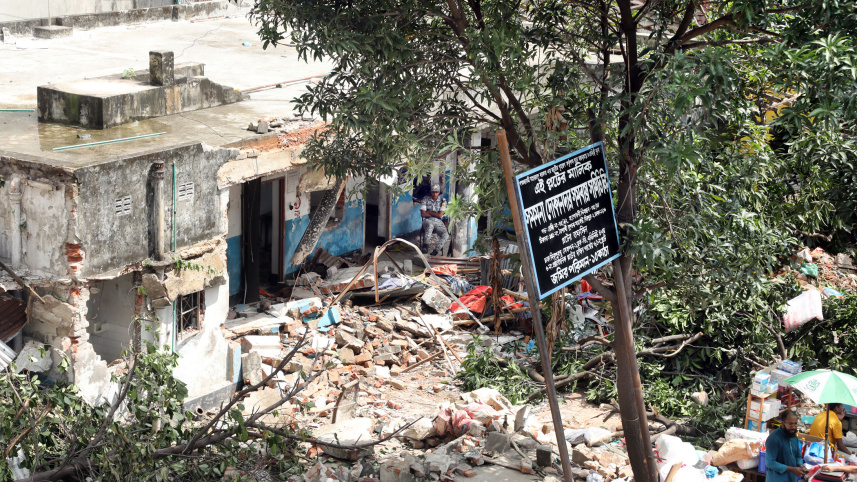
An excavator is difficult to hide, and so are more than 200 people, many of them masked and carrying weapons, moving through a neighbourhood in the middle of the night. Nor can refrigerators, computers, medical equipment, and other property be removed without vehicles, manpower, and time. Demolishing several structures requires even more of all three. What happened at the Radda MCH-FP Centre in Mirpur-1 shortly after midnight on September 25 was not the kind of crime that could unfold in a few hurried minutes. It required planning, preparation, coordination, and significant time for the operation to be carried out.
According to the case filed over the incident, more than 200 masked men entered the premises carrying sharp weapons , restrained two security guards and removed medicines, government vaccines and vaccination records, family-planning supplies, ultrasonography machines, computers, refrigerators, CCTV cameras and other property. Heavy machinery was used to demolish the structures, after which a signboard bearing the name of a shopkeepers’ cooperative was erected on the property. Reconstructing the sequence makes the institutional failure behind this orchestra of mayhem hard to ignore. People had to be gathered, weapons and equipment assembled, an excavator located and brought to the site, valuables loaded onto vehicles, buildings brought down and possession physically imposed. These were not isolated acts; rather a part of a planned theatric.

That is why the reported police presence at the time is significant. Preliminary findings said officers were present while attackers loaded valuables onto a pickup truck but did not take effective action before it left, while CCTV footage showed police personnel at the scene as the looting continued. Dhaka Metropolitan Police Commissioner Mosleh Uddin Ahmed later acknowledged that preventing such an incident fell within the responsibility of the police, a probe was ordered into possible negligence, and the officer-in-charge of Shah Ali Police Station was subsequently withdrawn. Home Minister Salahuddin Ahmed later said negligence had been found and that departmental proceedings would follow. But the question is, how could an incident involving hundreds of people, large vehicles, and heavy machinery continue in the presence of law enforcers?
There is an important complication here that should not be underplayed. The land itself is disputed. Sammona Dokandar Samabaya Samiti Limited has reportedly claimed that the plot was allotted to the cooperative by the National Housing Authority and later registered in its name, while Radda disputes the attempted takeover and says it received no notice before the demolition. However, the existence of a dispute does not justify what happened at Radda.
Section 141 of Bangladesh’s Penal Code defines an unlawful assembly to include five or more people whose common object is to use criminal force to take possession of property or enforce a “right or supposed right”. This phrase is especially important because the law does not make private force permissible simply because those using it believe their claim is more legitimate. Courts determine rights, lawful authorities enforce orders, and police are supposed to prevent cognisable offences. When this chain is broken, politics of coercion seeps into the system and corrupts the structures of power.
This trend or tendency predates the current government. Land grabbing, politically connected coercion and the use of muscle power to settle disputes have persisted under successive administrations, but that history cannot justify present failure. Despite repeated promises to curb mob violence, extortion, and illegal occupation, persistence of such incidents shows how wide the gap remains between official rhetoric and enforcement on the ground. Radda did not occur in isolation, as we all know by now. Over roughly the same three-day period, Dhaka saw several attacks involving vandalism, looting and attempted forced takeover, including incidents in Mohammadpur and Adabor as well as at ECB Chattar. The repetition of such incidents raises an uncomfortable question: are parallel structures of enforcement again emerging alongside the state, where disputed claims can be imposed through coercion?
Parallel power becomes dangerous not simply when non-state actors use force, but when people begin to behave as though that force carries authority. Once this becomes internalised in public memory, coercion stops looking like an aberration, and begins to function like an alternative enforcement mechanism. For the BNP government, this should serve as a wake-up call. There is no way such non-state criminal activity can be reduced to a “dispute” and brushed aside lightly, as we have seen some officials attempt to do. Such mindset is deeply flawed and completely unacceptable from officials responsible for upholding the rule of law.
Instead of making such offhand statements and trying to use state machineries to further victimise the victims, the government would do better to conduct a root-cause analysis of the pervasive rise of non-state actors and identify the systemic gaps that allow such parallel power structures to emerge and expand with such speed and force. Once those gaps are identified, law enforcers must pursue those responsible, while the judiciary determines punishment through due process. The government must also act on the commitments it made to the nation in the run-up to the elections to uphold the rule of law and demonstrate the political will necessary to dismantle emerging parallel centres of power.
Getting back to Radda, an act of this scale is unlikely to be undertaken without some risk calculation. Those planning it would have to consider factors such as police intervention, operational feasibility, and any resulting legal or political consequences and how these could be managed. An attack like this is more likely to proceed when criminals believe those risks could be contained or neutralised. This is why accountability cannot be measured only by the number of arrests made after the event. Police have arrested a number of people in connection with the attack, but reporting has also raised questions about whether those who organised, financed or directed the attack have been really identified or detained.
Prothom Alo, citing residents, law-enforcement sources and CCTV footage, reported allegations that local figures were involved in gathering attackers, supplying weapons and arranging the excavator. Those claims require investigation. But they point towards the questions that matter most if the state is serious about dismantling the mechanism rather than merely punishing its most visible participants. In organised violence, the easiest people to arrest are often those closest to the execution and furthest from the decision-making behind it. If investigators stop with hired participants caught carrying looted property, law enforcement will remain confined to the lowest level of the criminal chain.
There is another consequence visible among Radda’s ruins. The centre has provided maternal and child healthcare, vaccinations and family-planning services in Mirpur since 1974, particularly to lower-income communities. After its buildings were demolished, health workers resumed limited services from the damaged premises, continuing to vaccinate children despite the loss of normal infrastructure. The image shows who stand to lose when a property dispute is turned into an exercise of muscle power. The Radda incident has also exposed a deeper institutional vulnerability.
A state may possess courts, police stations, criminal statutes, land registries, and administrative agencies and still fail when it comes to protecting the interests of the underserved. So, the real test here is not simply about whether Radda is compensated or some attackers are sent to prison. It is whether the law enforcement and legal machinery are able to bring the real criminals to book. This is important because once people begin to believe that an excavator can accomplish overnight what a court may take years to decide, coercion becomes the alternative go-to solution.
Tasneem Tayeb works for The Daily Star. Her X handle is @tasneem_tayeb.
Views expressed in this article are the author's own.
Follow The Daily Star Opinion on Facebook for the latest opinions, commentaries, and analyses by experts and professionals. To contribute your article or letter to The Daily Star Opinion, see our guidelines for submission.
 For all latest news, follow The Daily Star's Google News channel.
Comments