


The cost of leaving the LPG market to private control

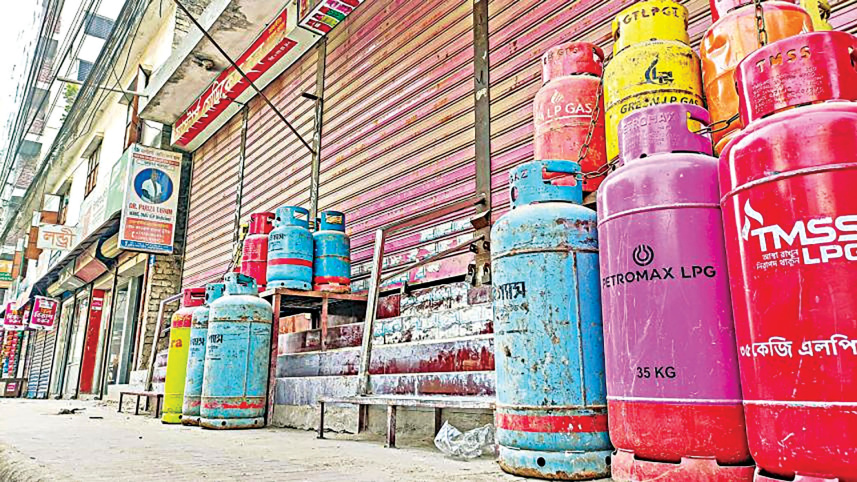
Forcing consumers to pay higher prices for an essential commodity by reducing supply and creating an artificial shortage in the market, to which the government subsequently responds by formally raising the commodity’s price, is a known tactic that was used repeatedly—be it for soybean oil, sugar or LPG—under the Awami League government. It was not expected under an elected government that came to power with a huge mandate. Rather, people hoped that essential commodity markets would be free from the monopolistic control of business syndicates. But the recent price hike of LPG indicates otherwise.
The LPG market has been unstable for nearly two weeks: 12kg LPG cylinders were being sold for Tk 400-900 more than the government-fixed price. In some places, consumers could not buy LPG cylinders even after agreeing to pay higher prices.

Against this backdrop, the Bangladesh Energy Regulatory Commission (BERC), from the evening of October 4, raised the price of a 12kg LPG cylinder in the private sector by Tk 252 to Tk 1,837, and that of autogas (LPG used in vehicles) to Tk 84.62 per litre from Tk 73.09. BERC cited higher international prices of propane and butane, the two main components of LPG, as well as increased shipping costs to justify the hike. Since the increase was imposed unilaterally without any public hearing, how accurately it reflects the rise in international prices remains a question.
The LPG price hike comes at a time when Bangladesh has already been suffering from prolonged high inflation—the highest in South Asia. Just two weeks ago, on September 21, a fuel price hike pushed up the prices of essential commodities further.
Nearly one crore consumers use LPG as fuel in the country. Around 80 percent of it is used for cooking, while the rest is consumed by industry and transport. The sharp increase in LPG prices will directly raise household cooking costs and increase the operating costs in the transport and industrial sectors that use LPG.
While the country’s LPG market is experiencing turmoil, the market in neighbouring India remains relatively stable. Consumers there can obtain LPG cylinders on time at government-fixed prices, delivered to their homes.
Since the war began in the Middle East, India has raised the price of domestic LPG—used in households—twice. The first increase, in March, was by 60 rupees, equivalent to Tk 77, and the second, in June, was 29 rupees, or Tk 37—a total increase of 89 rupees or Tk 114 since the war began.
The price of a 14.2kg domestic LPG cylinder in India now stands at 942 rupees, or Tk 1,205, and it has not been increased since June. Based on this price, a 12kg cylinder—the type used in Bangladesh—would cost 796 rupees, or Tk 1,015, in India. Compared to this, the government-fixed price of LPG in Bangladesh, even before the war, was higher: a 12kg cylinder cost Tk 1,341. In reality, however, consumers often had to pay even more.
After the war began, Bangladesh raised the LPG price by a total of Tk 599 in two rounds in April. After several subsequent increases and reductions, the official price eventually reached Tk 1,837. But in reality, consumers are buying LPG from the market at much higher prices.
The war in the Middle East is the same, but its impact on ordinary people in the two countries differs greatly. The reason for this difference lies in the contrasting structures and management of the two markets.
In Bangladesh, the LPG sector is almost entirely dependent on a handful of private companies, over which the government has little effective control. Rather, these companies appear to exercise considerable influence over the government. Whenever they create an artificial shortage, the government ends up raising LPG prices.
The same allegation has been raised over the latest price increase. The LPG Traders’ Cooperative Association says LPG-importing companies began reducing supplies to the market from September 20. Initially, supply was cut by 30 percent; later, it exceeded 50 percent, creating the LPG shortage in the market.
Surprisingly, LPG imports into Bangladesh did not decline drastically. The country imported 1,58,000 metric tonnes of LPG in August and another 1,56,000 tonnes in September. This raises the obvious question: why did market supply decline? Unless LPG was being stockpiled, there should have been no reason for market supply to fall.
India, by contrast, has an LPG market controlled almost entirely by three state-owned companies: HP Gas, Indane Gas, and Bharat Gas. Through these companies, the Indian government imports LPG and sells it at regulated prices through designated dealers. Consumers book LPG through mobile apps, telephone, or SMS. Dealers then deliver the cylinders to consumers’ addresses at the fixed price, with no additional delivery charge. The delivery charge is included in the LPG price. A consumer can purchase one 14.2kg LPG cylinder per month at the government-fixed price of 942 rupees. If more LPG is required, additional cylinders have to be purchased at comparatively higher market prices.
To prevent cylinders from being diverted and sold at inflated prices on the black market, the government uses a Delivery Authentication Code (DAC) system. When a consumer books an LPG cylinder, an OTP or DAC is sent to their registered mobile number. The delivery can be marked as complete only after the consumer receives the cylinder and shares the code with the delivery worker. This makes it difficult for dealers to charge above the fixed price or divert cylinders elsewhere.
For years, people in Bangladesh have been suffering from a shortage of cooking fuel because of the country’s natural gas crisis. Ensuring the availability of LPG at affordable prices, safely and reliably, could have been a solution. Clearly, this solution cannot be achieved by leaving the LPG market entirely in the private companies’ hands. Bangladesh could adopt India’s approach of ensuring LPG sale at regulated prices through state-owned companies. At the same time, the government must regularly monitor and oversee private companies’ LPG imports, storage and supply to ensure sale at government-fixed prices and to prevent artificial shortages.
Unless proper regulation and state intervention curb private companies’ monopolistic dominance over the LPG market, the current chaos will continue.
Kallol Mustafa is an engineer and writer who focuses on power, energy, environment, and development economics. He can be reached at kallol_mustafa@yahoo.com.
Views expressed in this article are the author's own.
Follow The Daily Star Opinion on Facebook for the latest opinions, commentaries, and analyses by experts and professionals. To contribute your article or letter to The Daily Star Opinion, see our guidelines for submission.
 For all latest news, follow The Daily Star's Google News channel.
Comments