


Can ICT prosecutors turn press questions into a crime against humanity?

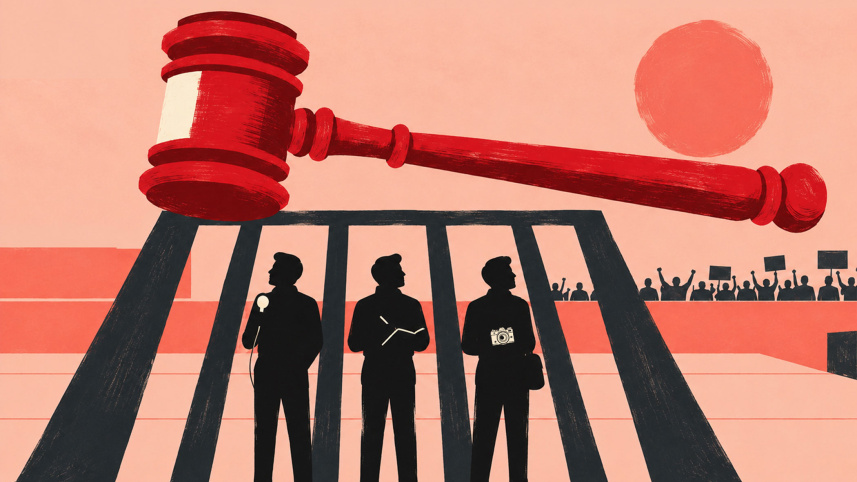
Of the growing number of arrests at the International Crimes Tribunal (ICT) that look more like retribution than legitimate accountability, few seem as nakedly political as this one. Three journalists known for their sympathies towards the ousted ruling party—Mozammel Babu, Shyamal Dutta, and Farzana Rupa—are being held on crimes-against-humanity allegations over the questions and comments they had made at a press conference with Sheikh Hasina on July 14, 2024.
On Sunday, October 4, 2026, when asked why the three were implicated on such charges, ICT prosecutor Gazi Monawar Hossain Tamim said there were “specific allegations” against them. Earlier, on August 17, Tamim explained those in greater detail: “On July 14, 2024, at a press conference at Ganabhaban held by the then Prime Minister Sheikh Hasina, several journalists, in the name of asking her questions, made some statements aimed at instigating her. In response to those statements, Sheikh Hasina called the protesters Razakars, children of Razakars, and grandchildren and great-grandchildren of Razakars.”

He added: “Holding press conferences, or asking questions at press conferences, is the duty of journalists. But during that period, we saw that certain journalists would attend the then prime minister’s press conferences, and the statements they made were not actually questions at all. They were praise of the then prime minister, and a kind of provocative instigation aimed at getting her to say certain things. That is why these offences were committed.”
The prosecution’s written “preliminary allegation” provides a little more detail, suggesting that the journalists’ alleged instigation of Hasina led to the deaths of seven people on August 5, 2024.
Before examining why the prosecutors got it so wrong, it is important to acknowledge that between July 16 and August 5, 2024, law enforcement agencies killed hundreds of protesters and others in deliberate or arbitrary shootings. There are legitimate crimes-against-humanity prosecutions to be brought against those who ordered or carried out those killings, provided they rest on substantive evidence.
But nothing that happened at the July 14 press conference—nothing said by those journalists—provides a credible basis for their arrests on such grounds. To claim otherwise is to misapply the law and misuse the criminal justice process. ICT prosecutors appear to believe that any act or statement made by journalists between July 14 and August 5, 2024 can be treated as evidence of a crime against humanity, regardless of whether it constitutes criminal conduct. In doing so, the prosecutors are clearly stretching the law beyond its intended scope.
So what did the journalists actually say?
Shyamal Dutta, then editor of Bhorer Kagoj, did not even ask a question. Why the prosecutors named him at all is a mystery.
Mozammel Babu, then managing director and editor-in-chief of Ekattor TV, made three comments rather than asking questions. Only the first concerned the protests; the others dealt with media coverage of agreements signed during Hasina’s China visit and the teachers’ pension strike.
He said the protesters were “anti-constitution” and were “directly or indirectly [attacking] the freedom fighters, or [creating] division among them,” and that “they are making our impressionable young people anti-court, anti-Liberation War, anti-constitution.” But he ended: “These [young people] are actually victims. We can’t be angry with them… They are victims of the evil tactics of these pseudo-intellectuals. We have to free them.”
Some may agree with that view, others will not, but it is still a permissible opinion, and one that casts young agitators as “victims”.
Ekattor TV journalist Farzana Rupa, unlike Babu, did ask a question. She raised the plight of a 1971 freedom fighter who had given evidence at the tribunal: “His wife has cancer. His own health is very bad. But there is no money for treatment. This is the condition of our freedom fighters even now.” She then asked, “Is there anything this state can do [for him]?” She ended: “Those who are running the anti-quota movement want the whole solution from you. They don’t want to go the court route. And the solution—as head of the executive—whether Prime Minister Sheikh Hasina will keep the quota or not keep the quota?”
Some may dislike its premise, but again this is a question that can be asked at a press conference. It neither calls for nor instigates violence. If ICT prosecutors think otherwise, any journalist in Bangladesh who asks a question at a press conference could similarly risk arrest or prosecution.
As part of her long digressive response, Sheikh Hasina then made a remark that went on to define the press conference. Asking why there was “so much resentment against the freedom fighters,” she answered: “The freedom fighters’ grandchildren won’t get anything. Then, will the Razakars’ grandchildren get it? That is my question. A question to the people of the country. That the Razakars’ grandchildren will get everything, and the freedom fighters won’t. What is their crime?”
This was taken to mean that the protesters were themselves the grandchildren of Razakars, those who collaborated with the Pakistan army in 1971. It triggered much larger protests, with students turning the insult around: “Who are you? Who am I? Razakar, Razakar! Who said so? The autocrat!”
The remark was provocative and insulting, and proved to be a monumental political mistake, strengthening the protests and winning them wider public support. But even if Hasina had gone further and directly called for violence—for example, by calling for the “Razakars’ grandchildren” to be attacked—the journalist whose question elicited it could not be held criminally responsible for the answer. A journalist is not responsible for how a politician chooses to answer.
That the prosecution still sought to detain these three journalists on such allegations raises serious questions about the direction that the ICT prosecutors are taking. They are trying to persuade a tribunal created to try the gravest of crimes known to law to treat questions asked at a press conference as one of them. This comes on top of the crimes-against-humanity charges already brought against two of the three journalists over the May 2013 Shapla Chattar killings, based on the claim that a documentary broadcast after the killings made them complicit in the killings themselves.
When reporting or even questions put to politicians are recast as atrocity crimes, the ICT is no longer simply prosecuting crimes against humanity. It risks becoming an instrument for prosecuting journalism and pursuing those whose politics the prosecutors oppose.
David Bergman is a journalist who has written about Bangladesh for many years. His X handle is @TheDavidBergman.
Views expressed in this article are the author's own.
 For all latest news, follow The Daily Star's Google News channel.
 Follow The Daily Star Opinion on Facebook for the latest opinions, commentaries, and analyses by experts and professionals. To contribute your article or letter to The Daily Star Opinion, see our guidelines for submission.
Comments