


Teachers must be the pivot of change in our education system

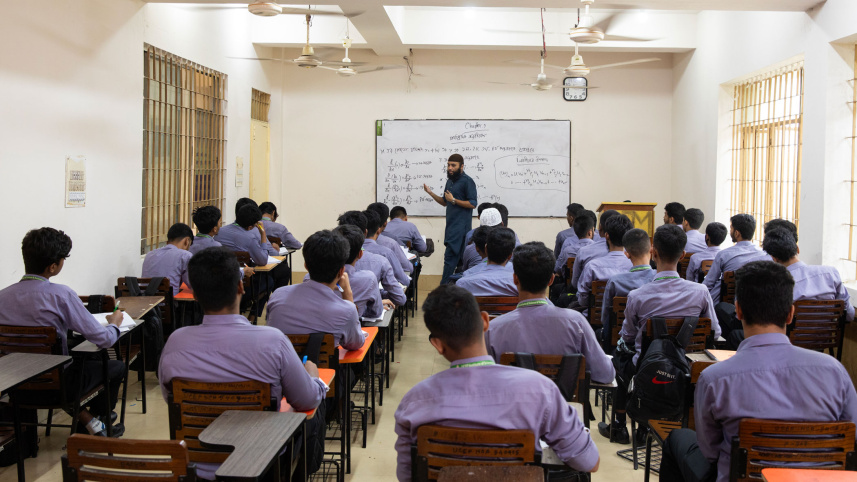
The theme for World Teachers’ Day 2026 is “Standing with teachers: 60 years of protecting the profession, advancing its status and shaping our futures.” It has been six decades since UNESCO and the ILO adopted the Recommendation concerning the Status of Teachers in 1966, and this year’s teachers’ day theme provides an opportunity to reflect on the challenges facing teachers and the teaching profession—an issue that resonates particularly in Bangladesh. Since its independence, the country has struggled to define and enhance the role of teachers in building an education system that is equitable, inclusive, and of acceptable quality.
Ensuring enough teachers with the required skills and motivation has become a global challenge with burgeoning educational expectations and demands since the launch of the Education for All movement in the 1990s. Unesco estimates that at least 44 million teachers worldwide must be added to the 94 million current teachers to meet the requirements of Sustainable Development Goal 4 (SDG4) by 2030. The global teacher crisis prompted the convening of the first World Summit on Teachers in Chile in August 2025, which highlighted how a lack of trained teachers disproportionately impacted low-income countries, especially the rural, remote, and marginalised communities.

The core recommendations of the summit included: i) preserving dignity in teachers’ work conditions with governments guaranteeing job security, fair and competitive salaries, realistic workloads, and support for teacher well-being; ii) sustainable financing by prioritising education in national budgets and establishing legal minimum allocations, backed by coordinated international donor support; iii) professionalisation and training by strengthening initial teacher preparation, continuous professional development, and specialised digital and AI competencies; iv) social dialogue within countries by teachers and their unions directly participating in national policy design and decision-making processes; and formally recognising teacher-student relationship as part of common cultural and human heritage; and v) strong accountability through tracking progress transparently via national monitoring mechanisms, etc.
To apply the general guideline for improving teacher performance and status as reflected in the Santiago Consensus, countries must adapt these broad principles to their specific circumstances. In Bangladesh, two consultation committees appointed under the interim government to recommend reforms in primary and secondary education devoted a chapter on teachers in their two reports.
There, a lack of a clearly defined framework for teachers’ responsibility, effort, and performance standards at both primary and secondary levels was found. Not enough teachers are on the payroll or deployed to maintain a reasonable class size in schools. Shortage of subject teachers for core subjects is a particularly serious shortcoming in secondary schools. Teaching personnel management, including recruitment, placement, transfer, and promotion, is a source of inefficiency, corruption and huge discontent among teachers. Pre-service professional preparation, in-service professional support, and a culture of mentoring new school teachers are largely absent or ineffective. A reliable career path for teachers is virtually non-existent.
In secondary schools, only government teachers (3 percent of the total) are placed at the government salary level of grade 10 (out of 20 civil service grades). The MPO-listed teachers (97 percent of secondary teachers) receive the basic salary and about a quarter of the benefits paid to government teachers. Non-MPO teachers, paid from the school’s own funds, receive substantially less. Meanwhile, government primary school teachers are employed at grade 13, which is traditionally classified as a third-class government job. Majority of primary-level institutions and teachers are non-government, with no salary regulations.
In fact, Bangladesh school teachers’ salary is the lowest in South Asia. The average teacher salary is 50 percent higher in India and 30 percent in Pakistan. Besides, teachers’ professional organisations, often linked with political parties, mostly bargain for material gains with little discussion on system performance.
Both consultation committees recommended ways to strengthen teachers’ role, performance and status, including early and medium-term actions, essentially within the existing structure of teaching personnel management. They also proposed a longer-term view to bring about a transformative change in how teachers perform and perceive themselves and how society perceives and values teachers, so that the “best and the brightest” are attracted to the profession.
In this connection, it’s worth mentioning the BNP government reform initiative called Bangladesh NextGen Overhaul. Developed with the Global Partnership for Education (GPE) Partnership Compact, it ambitiously aims to “transform teacher professionalisation for effective teaching towards enhanced learning outcomes.” The Partnership Compact will be funded, in addition to government funds, by a $48.8 million System Transformation Grant from GPE with an additional $350 million package of an Asian Development Bank concessional loan and GPE grant.
The “key transformative pillars” of the initiative are indicated as: a) Blended Learning and Technology Deployment providing training to 7,00,000 teachers nationwide in digital delivery tools and modern pedagogical techniques; b) System Synergy and Transition Rates, in which success will be measured by the rate of students transitioning from primary to secondary school and the boost in secondary completion rates; and c) Long-Term Funding Commitment from Bangladesh government to scale up public education spending progressively from under 2 percent of GDP toward a 5 percent GDP target.
The partnership compact focusing on change in teachers’ role and performance—aiming at a policy shift, mobilising domestic and external funding, and assessing measurable progress—is commendable but, in the past, such initiatives faltered and promises remained unfulfilled. This raises the question: does the new initiative rely on a technocratic formula ignoring political and cultural barriers, system capacity, work ethic and accountability deficits?
The “teacher professionalisation” relies heavily on standardised, metrics-driven outputs, such as training 70,0,000 teachers and deploying digital learning infrastructure. These quantifiable metrics are necessary, but does leaning on them risk treating systemic issues as mere logistics while glossing over deep-seated cultural, political, and institutional deficits? It can be justifiably argued that a primary vulnerability of the GPE model is its assumption that training activities translate directly into classroom performance.
Besides, a technocratic formula assumes that teacher recruitment and professionalisation operate within a meritocratic system. However, our education policy and practices are deeply intertwined with local political economy. The NextGen overhaul mandates massive digital and blended-learning transformations across tens of thousands of primary and secondary schools. Does this overlook severe disparities in basic system capacity? Is the economic reality of the teaching profession being overlooked? How will the perception change that school teaching is a low-status, underpaid civil service track, not attractive to top-tier graduates? How can the economic cycle that drives the private coaching market be broken?
While this initiative provides an infusion of resources and focuses on teachers’ issues, its success clearly hinges on whether the government can execute structural anti-corruption and civil service reforms. Without breaking the underlying political and institutional patterns, the initiative risks operating as an expensive and dysfunctional technical solution to what is essentially a deeply political problem. It also neglects a longer-term transformative rethinking of the teaching profession emphasised in the two consultation committee reports.
Dr Manzoor Ahmed is professor emeritus at Brac University, chair of Bangladesh ECD Network (BEN) and adviser to Campaign for Popular Education (CAMPE). Views expressed in the article are the author’s own.
Views expressed in this article are the author's own.
Follow The Daily Star Opinion on Facebook for the latest opinions, commentaries, and analyses by experts and professionals. To contribute your article or letter to The Daily Star Opinion, see our guidelines for submission.
 For all latest news, follow The Daily Star's Google News channel.
Comments