


Can incentives help Bangladesh attract more FDI?


Invest Bangladesh, the country’s apex investment promotion agency, has introduced an incentive scheme to encourage Bangladeshis at home and abroad to attract fresh foreign direct investment (FDI), seeking a cost-effective way to promote the country to overseas investors.
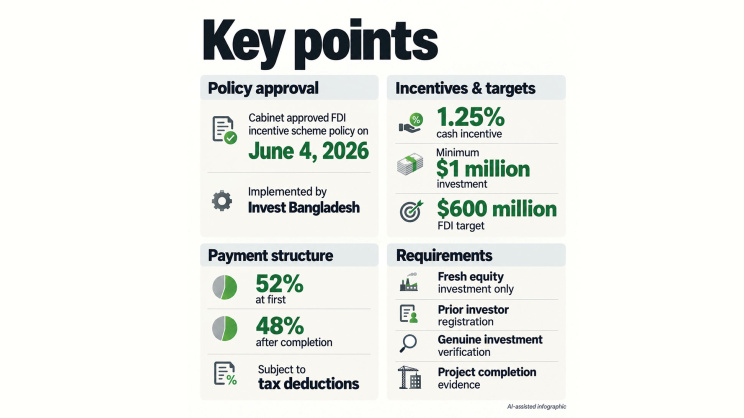
The scheme will offer a cash incentive of 1.25 percent to individuals who mobilise at least $1 million in fresh foreign investment, according to an official of the agency.

It targets around $600 million in fresh equity investment, based on the previous year’s benchmark, against Bangladesh’s average annual FDI inflow of about $1.5 billion, a significant portion of which comes from reinvestment.
The initiative comes amid sluggish FDI growth in Bangladesh, particularly compared with regional peers.
The Cabinet approved the Foreign Direct Investment (FDI) Incentive Scheme Policy, 2026, on June 4 to encourage expatriate Bangladeshis and other citizens to leverage their networks to attract foreign investment.
However, the Cabinet Division did not disclose the specific benefits or incentives under the policy at the time.
The policy addresses a key challenge for Bangladesh: the country remains relatively unknown to many potential investors, while promoting it overseas requires substantial spending.
Speaking to The Daily Star, Nahian Rahman Rochi, an executive member of Invest Bangladesh, said many investors, particularly in emerging markets, remain unaware of Bangladesh’s market size and investment opportunities.
“We do not have the budgetary support to promote Bangladesh on a mass scale,” he said.
The incentive scheme aims to address this limitation by tapping Bangladeshis and non-resident Bangladeshis (NRBs) who have established business and professional networks abroad.
“Many NRBs are in very good positions abroad. They have the right connections,” Rochi said.
The government wants to leverage these networks to reach potential investors, particularly in emerging markets where Bangladesh has limited visibility and companies are exploring new investment destinations.
Rochi cited Turkey, where high inflation and interest rates have prompted some businesses to consider relocating. Turkish textile and advanced textile companies, for instance, are exploring investment opportunities in countries such as Egypt and Ethiopia.
Bangladesh, with its established textile industry, could potentially attract some of these investors, but reaching the right decision-makers remains a challenge, he said.
The incentive scheme seeks to reward individuals who can turn their overseas connections into actual investments in Bangladesh.
The scheme will focus on fresh foreign equity investment rather than existing investments or reinvestment. Prospective investors must be registered under the scheme before making the investment, and incentives will be paid only after the funds have been brought into Bangladesh and verified.
Authorities will assess whether investors have taken concrete steps, such as opening bank accounts, acquiring land or starting construction, to ensure that investments are genuine.
The incentive will be paid in two instalments, with 52 percent disbursed after the investment is verified and the remaining 48 percent after the project is fully completed, Rochi said.
For instance, an individual who mobilises Tk 100 crore in investment will be entitled to a cash incentive of Tk 1.25 crore. After deductions for taxes and VAT, the individual will receive Tk 1 crore, he added.
Rochi said the scheme’s objective is not merely to increase the headline FDI figure but to attract fresh foreign equity that might otherwise not reach Bangladesh.
 For all latest news, follow The Daily Star's Google News channel.
 The initiative will enable the country to tap into the networks of Bangladeshis based in key overseas markets, reducing the need to establish and maintain an extensive investment-promotion infrastructure abroad, he added.
Comments