


Development cannot come at the cost of human lives

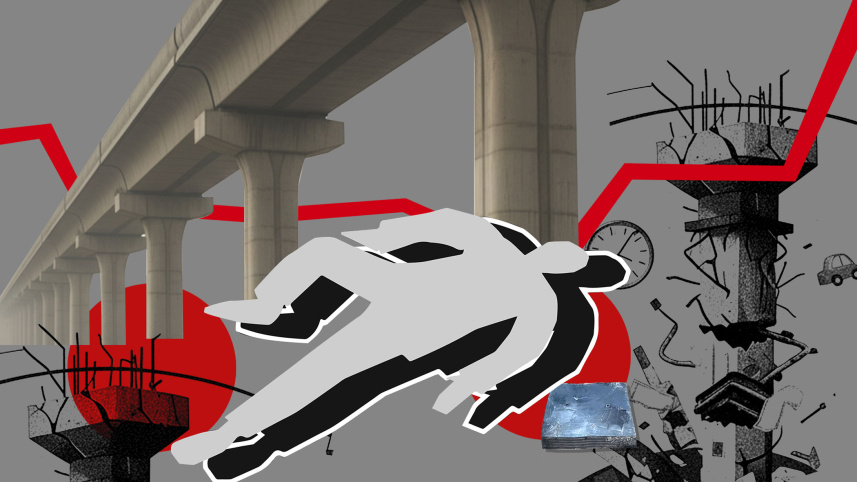
Let me start with some sorry statistics on deaths in Bangladesh. On average, road crashes claim more than 30,000 lives every year. It is estimated that more than 2.5 lakh people die prematurely due to air pollution, contaminated water, poor sanitation and hygiene, and lead poisoning every year. As I am writing this, the death toll of children from measles in the latest outbreak has crossed 1100, and counting.
One of them is Tajim, who was a test-tube baby, born after 11 years of marriage. His mother, Farzana, has been trying to find solace through posting about her son on Facebook. Let me now remind you of Abul Kalam Azad, whose life was cut short by a metro rail bearing pad failure, or the tear-jerking letter from 8-year-old Zayma to her friend Hiya, who lost her life to dengue. These incidents touched the souls of thousands, something mere statistics cannot contain. In fact, countless stories remain hidden from public eyes behind each of the statistics mentioned above. Stories of aspiration, struggle, love, and desire to live.

Ask any ordinary Bangladeshi whether they feel secure in their lives, and it is highly unlikely their answer would be “yes”. We live in a state of constant anxiety, knowing any one of our loved ones can turn into a statistic or a news headline. It seems that death is lurking in every corner, with its different faces, waiting to cut our lives short.
Philosopher Martha Nussbaum lists 10 central capabilities that every human being should enjoy regardless of their identities. Guess which one is at the top? Life, the capability to live a human life of normal length; not experience premature death, or die before reaching a life so reduced that it is not worth living. The Universal Declaration of Human Rights recognises the right to life as a fundamental right in Article 3. Our constitution protects this fundamental right in Article 32.
Bangladesh has a remarkable history of reducing child mortality and ensuring widespread access to primary healthcare, which has raised the country’s average life expectancy to around 75 years. Yet, a cursory reading of newspapers and the statistics I mentioned at the beginning illustrates that a considerable number of citizens die prematurely, with a significant number from preventable causes. Why are we not able to save these lives? As the protector of the right to live for all, can the state absolve itself of the duty of guarding every citizen’s life?
A fundamental problem here is the mindset of not valuing every human life equally and normalising premature death by the state authorities and political bodies. Take the case of road crashes, for instance. Experts suggest that using the term “accident”, rather than “crash”, hints at a sense of “inevitability”, masking the real reasons behind the death of thousands, including poor road design and maintenance, weak enforcement of laws under the pressure of politically influential transport owners and workers’ unions, and an appalling system of payment per trip for the drivers that encourages deadly, cut-throat competition. Even after the horrific shooting of Sharif Osman Hadi, the Chief Election Commissioner made an extremely insensitive remark that “one or two murders happen occasionally” during every election season. This culture of devaluing human lives while absolving authorities of their responsibilities reflects the fragile state of accountability of the governing bodies in our country.
Another reason lies in the fetishisation of growth and economic development by the policy environment, rather than prioritising human lives and well-being. Using the example of road crashes again, it is evident that the focus is on implementing mega-projects, such as building bridges and roads that are strong, visible symbols of development with greater political currency. In contrast, ensuring road safety requires continuous effort, with improvements that are incremental, which does not help political parties much in showcasing their performance. Similarly, reducing air pollution, along with other environmental issues, remains at the bottom of the barrel in the policy circle. Jeopardising human lives is thus considered a necessary cost of economic growth, which, to borrow from Amartya Sen, is not an end in itself but only a means to human wellbeing.
This is not to say that we don’t require economic development. But matters concerning human lives and wellbeing should be the driving force behind that development. The transport and communication sector has received the largest allocation in Bangladesh’s Annual Development Programme (ADP) over the years, with rapid economic growth cited as a major goal. But this does not have a strong road safety component, a classic example of the deprioritisation of human lives and wellbeing.
We don’t want a state that devalues human lives, where children die because of dilly-dallying with vaccine purchase and a broken healthcare system, where we experience premature death by merely breathing the air. The state authorities need to recognise that every human life is priceless. The state must become our true custodian. We also want policies centred around human lives and wellbeing. We want our capability to live. A life worth living as citizens.
Jahid Nur is a PhD researcher at the University of Glasgow and research associate at Brac Institute of Governance and Development (BIGD), Brac University.
Views expressed in this article are the author's own.
Follow The Daily Star Opinion on Facebook for the latest opinions, commentaries, and analyses by experts and professionals. To contribute your article or letter to The Daily Star Opinion, see our guidelines for submission.
 For all latest news, follow The Daily Star's Google News channel.
Comments