


Personal preferences should not become public restrictions

Death could not seal the controversies for Jason Arday. One would have thought that, with the demise of the Cambridge professor accused of plagiarism and subjected to a media trial, the centre of uninvited attention would wither away. Now that the American postdoctoral fellow who brought charges against Arday has been removed from his post at the University of Ghent, we are in for a spin-off. Nathan Cofnas, who had been dismissed from Cambridge’ Emmanuel College in 2024 because of his racist comments, brought charges of academic dishonesty against Arday—charges that were not proven. Cofnas’s Belgian employer suspended him, saying, “We attach immense importance to academic freedom and to open academic debate, even when views are controversial. However, that freedom is not unlimited.”
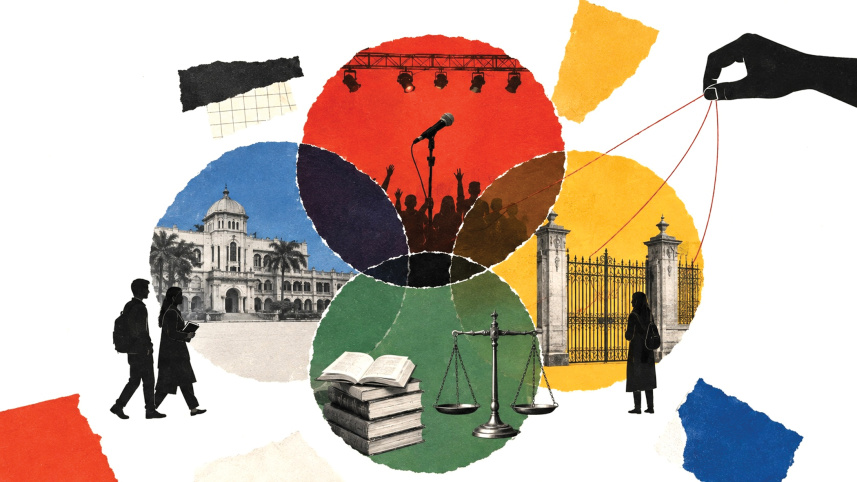
Recently, many Venn diagrams of freedom have emerged, with alternative views circled or forced to exist in the shadowy arcs. There are two things that I aim to unpack to relate them to some of the events unfolding here. They tell us of some worrying signs of social dynamism. In Kishoreganj, a concert featuring a popular band named Ashes, had to be suspended on Wednesday due to a stricture that came from the local religious leaders. The local administration yielded to the demands, citing a legal loophole in the organiser’s registration as an event manager.

In Brahmanbaria, a musical event inside the police lines came under attack from local madrasa students who felt the music was too loud. The students entered the police lines and vandalised the venue. Police retaliated with baton charges, resulting in injuries to nearly 30 individuals in the process. Again, the freedom to perform music clashed with the right to quietness in the sleeping hours. However, the overlapping circles create shadow lines that compel us to consider whether the attack on the police was related to the anti-drug campaign they were celebrating or to the religious sentiments of the students. We would have considered the issues isolated had there not been other instances of moral policing driven by religious supremacy. We have heard of students allegedly storming private residences and demanding marriage certificates. Then again, some of these issues might involve local agendas that use conservatism and coercive moral policing for self-serving interests. We need to examine who is pitting religious freedom against cultural freedom, and for what purpose.
Religious individuals, like any other group, have the right to uphold their views. They can choose not to attend concerts, prefer modest clothing as per their religious beliefs, pursue religious education, object peacefully to public policy, or raise legitimate complaints about noise, licensing or safety. However, problems occur when individual preferences intrude on others’ circles and engage in coercive moral policing. The clash of the circles often results in violence or disorder. Such actions may involve compelling organisers to remove women, claiming authority to prohibit lawful cultural expression, vandalising venues, using a crowd to override legal processes, and putting pressure on the nation to adopt one group’s moral preferences.
A law-abiding society has the responsibility to respect the boundaries of the weak, the minority, and others. Religious devotion does not require compulsory imitation. Meanwhile, the other camp also needs to realise that the opposite of religious preference is not hostility towards religion. There was significant backlash when the Ducsu officials created a covered area for female students inside the TSC cafeteria. The news came as a shock to many who felt that Dhaka University had traditionally been the vanguard of all progressive movements. Locating women in one veiled corner of the dining hall, especially when they are attending classes in a co-educational institution, is a regressive decision.
Concurrently, there was another movement inside Dhaka University where some female students were asking for relaxation of the hall curfews. They did not want the hall gates to be regulated, stating that the hall administrations are very rigid and don’t entertain special circumstances. The students expressed their dissatisfaction over the lengthy permission procedures before they were allowed to leave the hall at night. “Even if our father dies, we still have to write an application by hand and get permission before we can leave,” one student told Dhaka Tribune. “Even in cases of serious illness, it takes two to three hours. We want these inhumane rules changed.”

For the university administration, the security concerns are legitimate as they become the proxy guardians once students are enrolled. But the problem arises when the university creates one circle for its male students and another for its female students, with two different sets of expectations, even when they have come to chase the same aspirational goals of graduation. Male students are thus granted adulthood while female students are granted supervised safety. The university recognises the man as a citizen and the woman as someone’s daughter. The hidden assumption is that the night belongs naturally to men. For women to enter or engage with nightly events, permissions are required.
The underlying patriarchy assumes that controlling women’s movement can manage danger. Institutional reputation may depend more on preventing women’s visibility than preventing male misconduct. That’s why the same university that sends women to dormitories in time allows men to act as vigilantes at night, going after street hawkers, homeless people and floating populations.
This control mechanism exposes the lopsided distribution of power. The centre of power doesn’t have to be in parliament or the presidential palace. These powers operate through smaller permissions. Local actors and actants decide who may sing, who may stay outside after dark, and who can dine in a cafe without fear. These images alone don’t prove that Bangladesh has surrendered to conservatism. Together, however, they ask whether we are gradually mistaking segregation for safety, silence for order, and fear for morality. A free society is not one in which everyone approves of the song. Disapproval lacks the power to stop the music or late entry to the university residential hall. We shouldn’t promote segregation for safety, silence for order, or fear for morality.
Dr Shamsad Mortuza is vice-chancellor at the University of Liberal Arts Bangladesh (ULAB).
Views expressed in this article are the author's own.
Follow The Daily Star Opinion on Facebook for the latest opinions, commentaries, and analyses by experts and professionals. To contribute your article or letter to The Daily Star Opinion, see our guidelines for submission.
 For all latest news, follow The Daily Star's Google News channel.
Comments