


Re-spawn: rethinking esports in Bangladesh
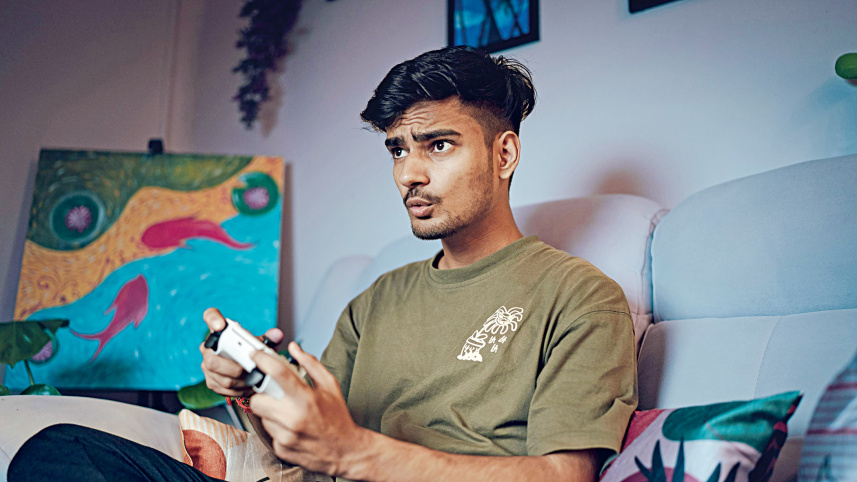
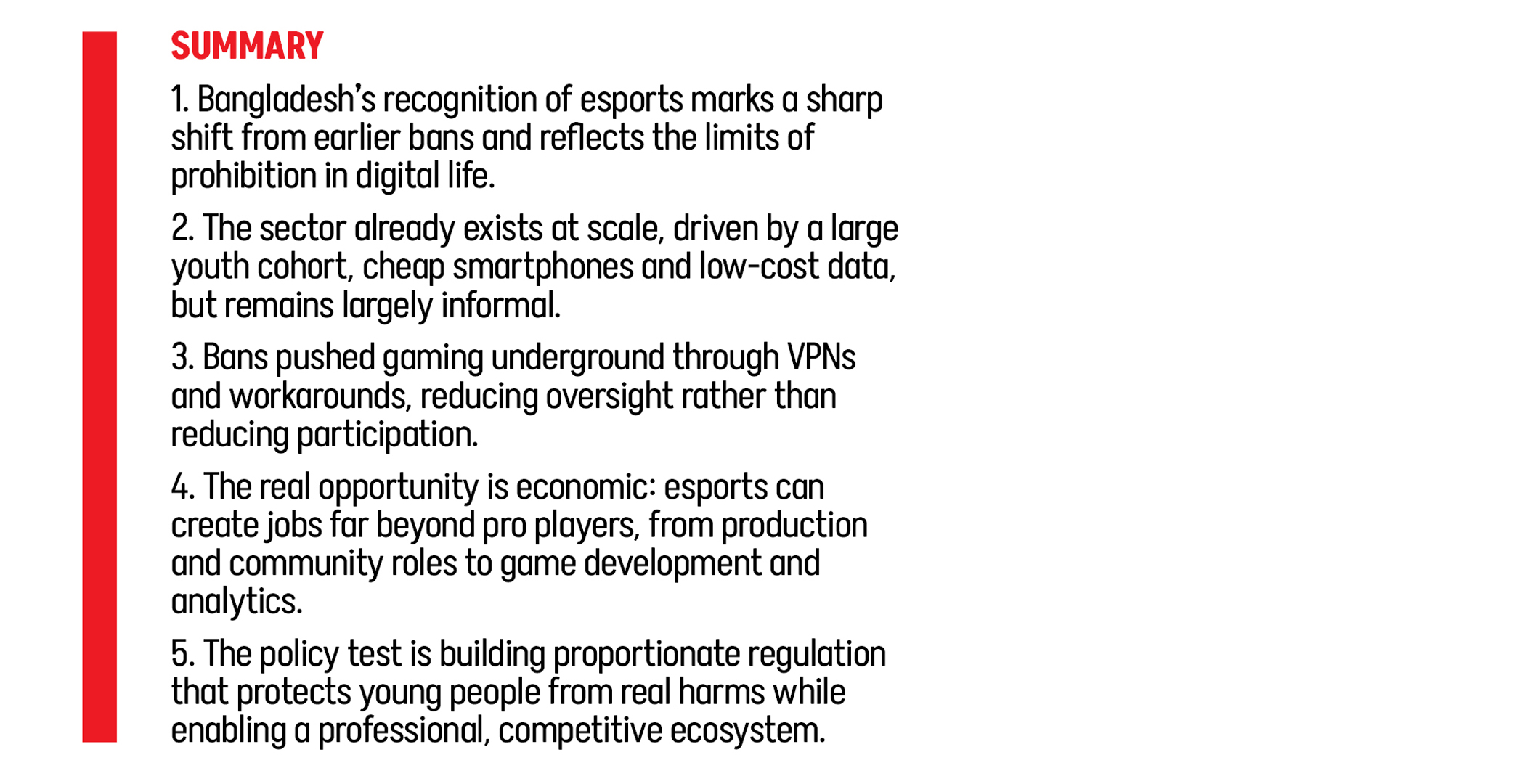
When Bangladesh’s Ministry of Youth and Sports formally designated esports as an official sport in July 2025, it marked a significant departure from the country’s previous posture towards competitive gaming. Just four years earlier, courts banned a few of the most popular titles that command enormous followings among Bangladeshi youth, amid concerns about addiction and social harm. This volte-face reflects a government belatedly recognising that prohibition rarely succeeds when confronting an industry already embedded in the daily lives of tens of millions.
The question now is not whether Bangladesh will have an esports sector. It already does. Rather, it is whether policymakers can construct a regulatory architecture that allows the industry to flourish while mitigating its genuine risks, an approach several south-east Asian neighbours have been refining for years.

The demographic reality
The numbers are difficult to ignore. Bangladesh’s population includes roughly 46 million people aged 15 to 29, nearly a quarter of the country’s total. This cohort has grown up with smartphones rather than inherited them. Cheap handsets and low-cost data packages have placed gaming within reach of suburban and rural youth who might never have access to a PlayStation or gaming PC.
Globally, the esports market was valued at about $2.1bn in 2024, with projections suggesting it could reach $7.5bn by 2030. Bangladesh’s share remains modest, but the trajectory is clear. Local tournaments attract significant viewership on Facebook and YouTube. Content creators, shout-casters and community managers have carved out livelihoods in the ecosystem’s margins. The infrastructure, however rudimentary, exists.
The case against prohibition
Bangladesh’s earlier experiment with bans illustrates why prohibition tends to fail in a digital economy. When courts upheld restrictions on PUBG and Free Fire, players simply migrated to VPNs or shifted to alternative titles. Gaming continued; what ceased was any meaningful oversight of an activity involving millions of young people.
This pattern will be familiar to regulators elsewhere. In the United Kingdom, the Online Safety Act 2023 represents Parliament’s attempt to impose duties of care on platforms where users interact, including, increasingly, online games. The legislation does not ban gaming. It requires services to assess risks of harm, implement content moderation and provide mechanisms for reporting abuse. Xbox has begun age verification for UK players. Ofcom, the regulator, has published guidance specifically addressing the video games industry.
The contrast with outright prohibition is instructive. Where bans push activity underground, regulation brings it into the open. Where bans punish legitimate and harmful behaviour alike, regulation distinguishes between them. Where bans leave authorities blind to what young people are actually doing, regulation creates reporting obligations and transparency requirements.
None of this is to suggest that concerns about gaming are illegitimate. Excessive screen time, disrupted sleep cycles and the mental pressure of competitive play are documented phenomena. In the worst cases, online disputes have escalated into real-world violence. These are not imaginary problems. But they are problems of oversight, not of gaming per se.
Building the ecosystem for better economic prize
Bangladesh’s newly formed committee on esports policy faces an enviable opportunity wrapped in a daunting challenge. The opportunity is to establish frameworks before the industry matures, rather than attempting to retrofit regulation onto entrenched interests. The challenge is to do so without the institutional infrastructure, regulatory experience or funding that established markets enjoy.
For a government seeking to create skilled employment for a vast youth population, esports presents a compelling proposition. The industry’s labour requirements extend well beyond the handful of players who achieve competitive success. Game development, 2D and 3D art, animation, sound design, narrative writing, quality assurance, community management and data analytics all represent career pathways that can be cultivated through targeted training programmes.
Several south-east Asian markets have recognised this. Singapore’s institutions offer esports management qualifications. Malaysia has integrated gaming into its creative industries development strategy. Even South Korea, where esports achieved mainstream acceptance decades ago, continues to invest in pipeline development, recognising that the stars on stage represent only the visible fraction of an industrial base.
For Bangladesh, the economic logic is strengthened by demographic realities. A quarter of the population in the gaming-intensive age bracket represents either a problem or an opportunity, depending on policy choices. Channelled into a regulated, professionalised industry, that cohort could generate export revenue, project a modern national image and develop transferable digital skills. Left to unstructured consumption, it risks the outcomes that originally prompted judicial intervention.
A moment of choice
The temptation for policymakers will be to declare victory upon formal recognition and move on. This would be a mistake. Recognition is a necessary condition for building a sustainable esports sector, but it is far from sufficient. The committee now drafting governance proposals will determine whether Bangladesh captures the industry’s benefits or merely imports its pathologies.
The model should be cautious promotion accompanied by proportionate regulation, nurturing domestic talent and infrastructure while establishing safeguards against the genuine harms that competitive gaming can facilitate. This is harder than either blanket prohibition or laissez-faire permissiveness, requiring ongoing engagement with an industry that evolves faster than regulatory processes typically accommodate.
But the alternative, oscillating between bans that fail and recognition that achieves nothing, serves no one. Bangladesh’s young gamers deserve better than to be alternately criminalised and ignored. And the country’s policymakers, having belatedly acknowledged the reality of digital leisure, now bear responsibility for shaping its trajectory.
 For all latest news, follow The Daily Star's Google News channel.
 The game, as it were, is on.
Shafkat Alam is a veteran CTO with extensive experience building startups and shaping technology policy across South Asia.
Comments