


When our indifference breaks our children

The posthumous Swadhinata Padak for Maherin Chowdhury, a teacher who died saving at least 20 students from the burning remains of Milestone School and College after it was hit by a fighter jet last year, brought back sad memories of losing children and teachers in a single tragic blow. Her heroism gave us hope in a world that remains oblivious to the pain and sufferings of children. Last week, we saw how a reckless attack by US-Israel killed 160 children in a school in Iran. These children had nothing to do with the war game or geopolitical interests of the grown-ups. Yet, they fell prey to our rivalry, greed, lust, ego, whim, and political machinations. We approach an apocalyptic future where, in the words of WB Yeats, “The blood-dimmed tide is loosed, and everywhere/ The ceremony of innocence is drowned.”
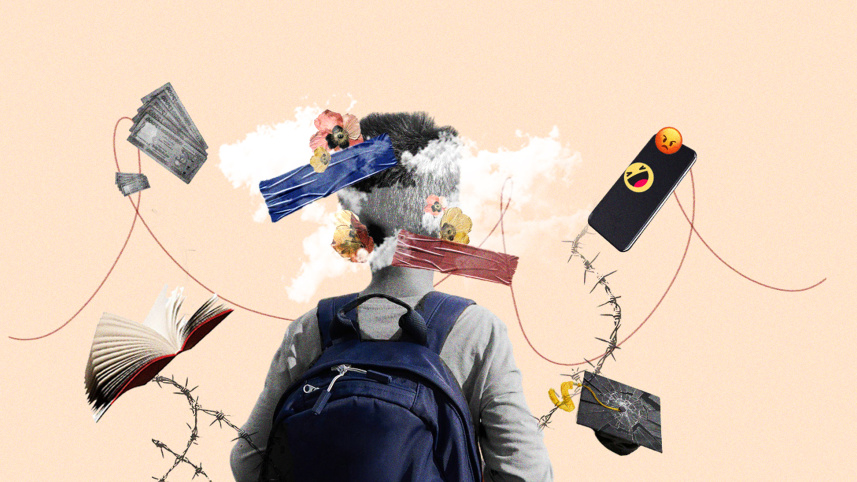
However, our reflection on helpless and hapless children seems to have a blind spot. Far from the headlines and battlefield smoke and rubble, there is an emotional battle that our children are waging daily. They suffer and choose harm’s way as they fail to match the expectations of the adults or peers, as they feel misunderstood, underappreciated or ignored, and as they yearn for space to ventilate their anger or frustration or to love and be loved.

This harm is slow and invisible. They were made visible by a recent survey conducted by Aachol Foundation, a mental health awareness platform, which showed a spike in the number of student suicides in Bangladesh: 403 cases reported in 2025, up from 310 in 2024. The actual figure could be higher as there are many unreported incidents. But what these figures will not tell us is that, behind each number, there is an absent figure who has left a deep hole in the lives of the ones they have left behind.
The figures will not tell us of the blank stare of the parents with which they feel the empty room, the reading desk, or the seat at the dining table. The folded school uniform that will never be worn will keep on posing questions: why did we not see it coming? Why did we not listen to them when they reached out? The education-level distribution of students who committed suicide presents sobering data. Out of the 403 reported incidents, 190 students are from school (47.4 percent), 92 from colleges (22.8 percent), 77 from universities (19.1 percent), and 44 from madrasa (10.7 percent). The adolescents and pre-teens are clearly among the most vulnerable groups.
The survey, based on media reports, identifies depression, emotional stress and resentment as the main causes. It’s about time we identified the indifference and ignorance of grown-ups as one of the major contributing factors behind the failure to protect children’s emotional health. Often, albeit unknowingly, we expose children to our own frustrations, anxieties and stresses. We try to distract them with gadgets and devices and thereby expose them to ideas foreign to them. We exert undue pressure to perform and excel in a competitive academic world. We expect them to live our dreams instead of nurturing their own. At school, they feel added peer pressure. Bullying, harassment, insensitive teachers, beatings and public humiliations are common in many education institutions. Many do not have trained psychosocial counselling services or proper orientation to deal with young minds. Teachers, already overburdened with workload normally, work overtime to supplement their main income with second jobs or coaching. They perhaps do not have the headspace to deal with each student with the required personal care and attention. Since students share their time at both home and school, both institutions need proper orientation of mental health.
Losing around 30 students in a plane crash or 160 students in a missile attack is shocking. But losing 400-plus students through a slow process of death is no less tragic. Most of these deaths probably had an ordinary beginning. Grown-ups often say things in front of children, not even realising how they are impacting them. “Why don’t you die?” is a common phrase that adults use to express their frustrations. But for a child, this may sound literal. In our culture, suicide is also presented as an emotional blackmail. “You should think of your family?” can act as a trigger for a troubled mind who might think the priority is being shifted from the individual to the rest.
Then there’s the overexposure to social media, where our children enter a bubbled reality where everything is curated and perfected, or a perverted reality where the dark and primitive side of humanity is on full display. The algorithms are designed to capture the users’ attention, which can eventually cause screen addiction. Children in a fragile state may not have the maturity to sift the imagined from the real. Their self-esteem is compromised, often leading to depression. The other atrophy of early exposure to digital media is an unrealistic attitude towards love and intimacy, which adds confusion with a toll on their emotional health.
The use of narcotic substances is becoming normal among teens and young adults. Gateway drugs like tobacco and weed as well as hard synthetic drugs can impact the decision-making process of individuals. Consequently, many decisions are taken impulsively. Instead of investing in or engaging solutions, many young ones find death as an easy way out.
Emotional health is a complex and nuanced issue. It should be dealt with by trained professionals. All education institutions must come up with awareness campaigns for both parents and teachers. Losing 400 students to self-harm can never be a good sign for a country. This is a ravaging blow, more than an air crash or a missile attack. We must stop the system that kills our children slowly and softly from within.
Dr Shamsad Mortuza is vice-chancellor at the University of Liberal Arts Bangladesh (ULAB).
Views expressed in this article are the author's own.
Follow The Daily Star Opinion on Facebook for the latest opinions, commentaries, and analyses by experts and professionals. To contribute your article or letter to The Daily Star Opinion, see our guidelines for submission.
 For all latest news, follow The Daily Star's Google News channel.
Comments