


BNP promises a govt answerable directly to citizens


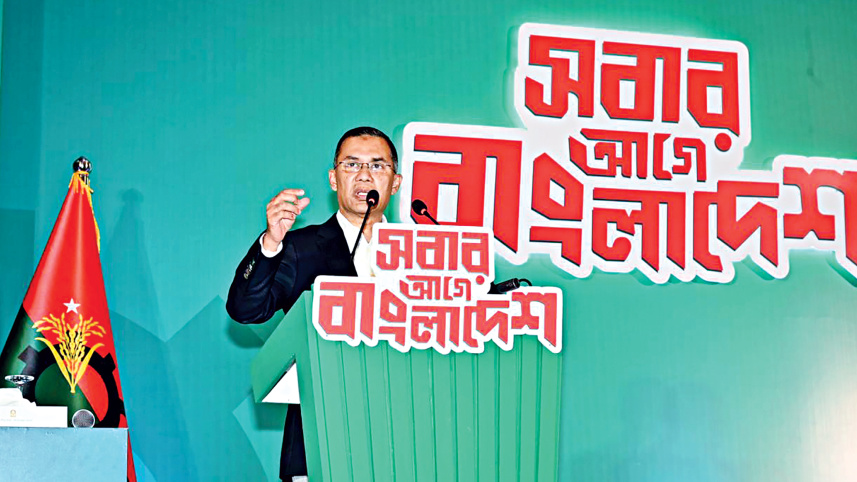
BNP yesterday unveiled its election manifesto, pledging nine key commitments across critical sectors and vowing to establish an accountable, responsible, and a “just state” directly answerable to the people.
If voted to power, the party said it would build a sustainable democratic framework through constitutional and electoral reforms under the core principle “Bangladesh Before All.”

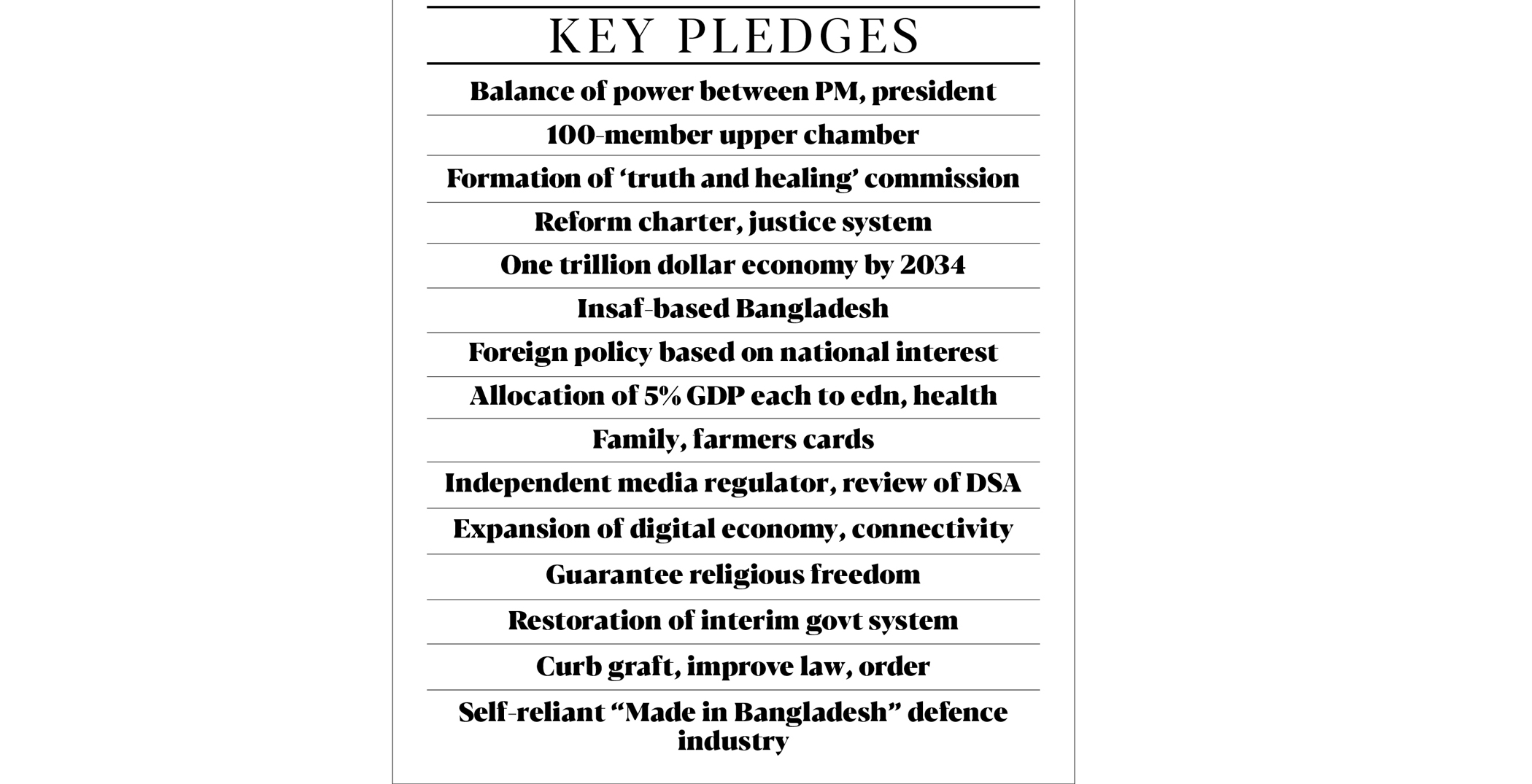
The nine major commitments include family and farmers cards, a corruption-free and humane healthcare system, and an employment-oriented education system. Other pledges focus on youth job creation, technical and language skill development, environmental protection, climate resilience, excavation and re-excavation of 20,000 kilometres of rivers and canals, religious and social harmony, and expansion of the digital economy and global connectivity.
The manifesto was designed in line with former president Ziaur Rahman’s 19-point programme, former prime minister Khaleda Zia’s Vision-2030, and Chairman Tarique Rahman’s 31-point agenda.
For the first time, the manifesto, which sets out 51 commitments under five broad sections, was presented by Tarique at the Sonargaon Hotel in Dhaka. In previous elections -- the fifth, sixth, seventh, eighth, and ninth -- manifestos were announced by Khaleda Zia.
Presided over by Secretary General Mirza Fakhrul Islam Alamgir, the event was attended by representatives of 38 countries, teachers, senior journalists, and civil society members.
“This manifesto is not merely an electoral pledge; it is a declaration of a new social and state contract with the citizens of Bangladesh,” Tarique said after a nearly two-hour presentation, six days before the national election.
He said BNP’s governance philosophy will centre on upholding the fundamental mottos of the Liberation War: equality, human dignity, and social justice.
“The BNP believes not in revenge, but in a politics of justice and humanity. The rights of the people, not power, are at the core of our politics. Production, not plunder; rights, not fear; fairness, not discrimination -- these are the principles that will guide the governance of the state,” he added.
Tarique said, “All the plans and programmes I have presented today will not be possible unless we address three issues -- corruption, rule of law, and accountability. Whoever forms the government, if these three issues are not addressed, we will never succeed.” He added that BNP, if elected, would give the highest priority to these issues.
The manifesto stressed human values and dignity. “No form of black law in the name of rule of law will be acceptable. The Special Powers Act of 1974 will be repealed,” it said. It also committed to justice for crimes against humanity during the fascist era, including the July uprising.
According to the manifesto, a list of martyrs of the Liberation War, the 1990 movement, and the 2024 mass uprising will be compiled under state initiative and accorded proper recognition. Freedom fighter allowances will be increased in line with inflation. A Truth and Healing Commission will focus on victims of human rights violations, ensuring compensation and bringing perpetrators to justice.
It pledged to implement the July National Charter signed on October 17, 2025 with highest priority and the way it was signed.
The party also committed to create the post of vice president, balance power between the president and prime minister, and ensure judicial independence.
“My family, my mother, and I were the worst victims of the judiciary during the fascist regime. Having experienced it personally, if BNP is voted to power, I will ensure judicial independence,” Tarique said, adding that a Judicial Reform Commission will be formed to reform the justice system.
According to the manifesto, a person may serve as prime minister for a maximum of 10 years, regardless of previous terms. A PM may also serve as party chief.
It also pledged to introduce a 100-member upper chamber in parliament to assist governance while keeping the Constitution unitary. Of the two deputy speakers in both chambers, one will be nominated by members outside the ruling party.
It promised to reform the Constitution and the electoral system and pledged to re-establish a neutral caretaker government during elections.
Under the constitutional reform, article 70 of the constitution will be amended to ensure MPs can express their opinions freely on all matters, except votes of confidence, money bills, and others national security issues.
The manifesto said BNP’s goal is to transform Bangladesh into a modern, democratic, upper middle-income country, where a one trillion dollar annual national GDP economy will be built by 2034. Efforts will be made to raise foreign direct investment from 0.45 percent to 2.5 percent of GDP.
 For all latest news, follow The Daily Star's Google News channel.
 The party also pledged that national interest and state security will be the highest priority in concluding international treaties.
According to the manifesto, BNP will take strict measures to curb corruption and improve law and order. An independent inquiry commission will investigate officials accused of state-sponsored terror during the July uprising and probe vote-rigging and corruption.
Guided by faith in Almighty Allah and the Prophet Muhammad’s (PBUH) model of just governance, BNP’s guiding principle will be justice, it said, adding that the party will work to build a Bangladesh based on fairness (“insaf”).
In ensuring religious freedom and harmony, BNP said that based on the fundamental principle “religion is personal, the state is for all,” every religious person will enjoy full rights to practise their own religion.
“No one will be allowed to hurt any citizen’s religious beliefs. People of different religions and every group, clan, and community in the country will celebrate their respective religions and religious festivals without hindrance or worry,” it said.
In foreign policy, BNP will treat other nations as friends, not masters, prioritising sovereignty, national interests, security, and the welfare of its people. Bilateral and multilateral relations will be based on equality, fairness, pragmatism, and mutual interest.
Tarique pledged to keep the armed forces out of political controversies to protect their integrity.
“Defence is part of foreign policy. We want the armed forces free from all controversies and politicisation,” he said, adding that BNP plans to build a self-reliant “Made in Bangladesh” defence industry to meet their needs.
He also reiterated the party’s commitment to the One Rank, One Pension (OROP) policy for retired military personnel, aiming to enhance veterans’ welfare.
“If entrusted with responsibility by the people, BNP will build a Bangladesh where the dignity of the vote is upheld, no one is above the law, and every citizen can proudly say -- Bangladesh before all,” he said.
The “Family Card” will provide Tk 2,500 monthly in cash or essential commodities to low-income families. The “Farmer’s Card” will ensure fair prices, subsidies, loans, insurance, and state-managed markets.
Healthcare reforms include the recruitment of 100,000 health workers nationwide. It promised to increase health sector funding to 5 percent of GDP and introduce an E-health card to reduce unnecessary costs.
It also pledged to form an education reform commission, allocate 5 percent of GDP to education, provide free school uniforms, introduce skill- and value-based education with technology support, and implement a midday meal programme.
To build a service-oriented civil administration, BNP will form an Administrative Reform Commission and swiftly appoint over five lakh government employees.
Environmental commitments include excavating and re-excavating 20,000 km of rivers and canals, planting 250 million trees over five years, and introducing modern waste management through public-private partnerships.
BNP plans to expand the digital economy and global connectivity via international payment systems, regional e-commerce hubs, and promoting exports of “Made in Bangladesh” products.
According to the manifesto, the party aims to create 200,000 jobs in five key areas -- cybersecurity, BPO, Al data, semiconductors and Industry 4.0 -- by rapidly activating the ICT sector and indirectly create another 800,000 jobs through freelancing and content creators.
By strongly promoting innovation and ICT service exports, the contribution of the ICT sector to the country’s GDP will be raised to 5-10 percent, it read.
Major reforms in revenue mobilisation aim to raise the tax-to-GDP ratio to 15 percent by 2035.
Rail will be revitalised as the backbone of national transport through electrification, double tracks, and an integrated network including metro, elevated, and commuter lines. High-speed trains will link Dhaka to major cities.
Regional connectivity will be strengthened through Myanmar and the Dhaka-Kunming route with public-private partnerships and smart monitoring. By 2034, Bangladesh will be transformed into one of the leading aviation hubs in South and Southeast Asia, according to the manifesto.
BNP also pledged to improve Dhaka’s traffic management, transport systems, air quality, and women’s safety. The manifesto includes satellite towns, a monorail alongside the metro, ring roads and waterways, electric vehicles, regulated rickshaws, shared parking, women-only buses, smart traffic systems, expanded CCTV coverage, and a Metropolitan Transport Authority.
BNP will make the Securities and Exchange Commission independent, form a Capital Market Reform Commission, and investigate 15 years of share market irregularities. In banking, it pledged to return depositors’ money from liquidated Islamic banks and establish an Economic Reform Commission for financial stability and economic justice.
The party, in the manifesto, said that it aims to develop the creative economy to 1.5 percent of GDP, creating 500,000 jobs; prioritise the blue economy; and ensure fast, reliable internet nationwide.
To promote arts, culture, media, and social harmony, BNP pledged to discourage anti-national cultural practices, promote democratic values, restore morality through education, religion, and social movements, and reform curricula and media to build a humane and inclusive society.
Press freedom will be ensured by reviewing the Digital Security Act, preventing attacks on media outlets, withdrawing politically motivated cases, ensuring justice for tortured and murdered journalists, and establishing an independent media regulator similar to the UK’s Ofcom. Measures will be taken to curb fake news and hate speech, protect journalists’ welfare, and end political bias in advertisement allocation.
BNP also pledged to protect ethnic and cultural diversity, reassess the 1997 Peace Accord, and strengthen religious freedom and welfare for all faiths.
As per the manifesto, power generation capacity is targeted to reach 35,000 MW by 2030 with transparent contracts.
Comments