


Electricity price hikes: Why is BNP reverting to failed power policies?

The BNP, in its election manifesto, pledged to build an affordable, reliable, and environmentally sustainable power and energy system. It promised to review existing power purchase contracts, including capacity payments, in order to reduce unnecessary and irrational expenditure while ensuring transparency and efficiency. Soon after forming the government following its electoral victory, top officials of the relevant ministry pledged that electricity prices would not be increased for two years.
Iqbal Hassan Mahmood, the minister, clearly laid out this priority then, noting that instructions were given to reduce system losses. He added, “System loss currently exceeds 7 percent. If it can be reduced to 5 percent, the government will save Tk 10,000 crore.” Meanwhile, Aninda Islam Amit, the state minister, said that electricity prices had been increased repeatedly in the past, with the burden ultimately falling on ordinary people. “As a government elected by the people, we want to explore how these problems can be solved without increasing electricity prices and without causing hardship to citizens.”

In reality, however, just a little over three months after these commitments were made, retail electricity prices have now increased by 16.68 percent and the wholesale tariff by 19.85 percent. The decision comes at a time when people are already under severe strain from prolonged inflation. For a considerable period, Bangladesh has recorded the highest inflation rate among South Asian countries. While inflation in most South Asian economies remains below 5 percent, Bangladesh’s inflation continues to hover around 9 percent.
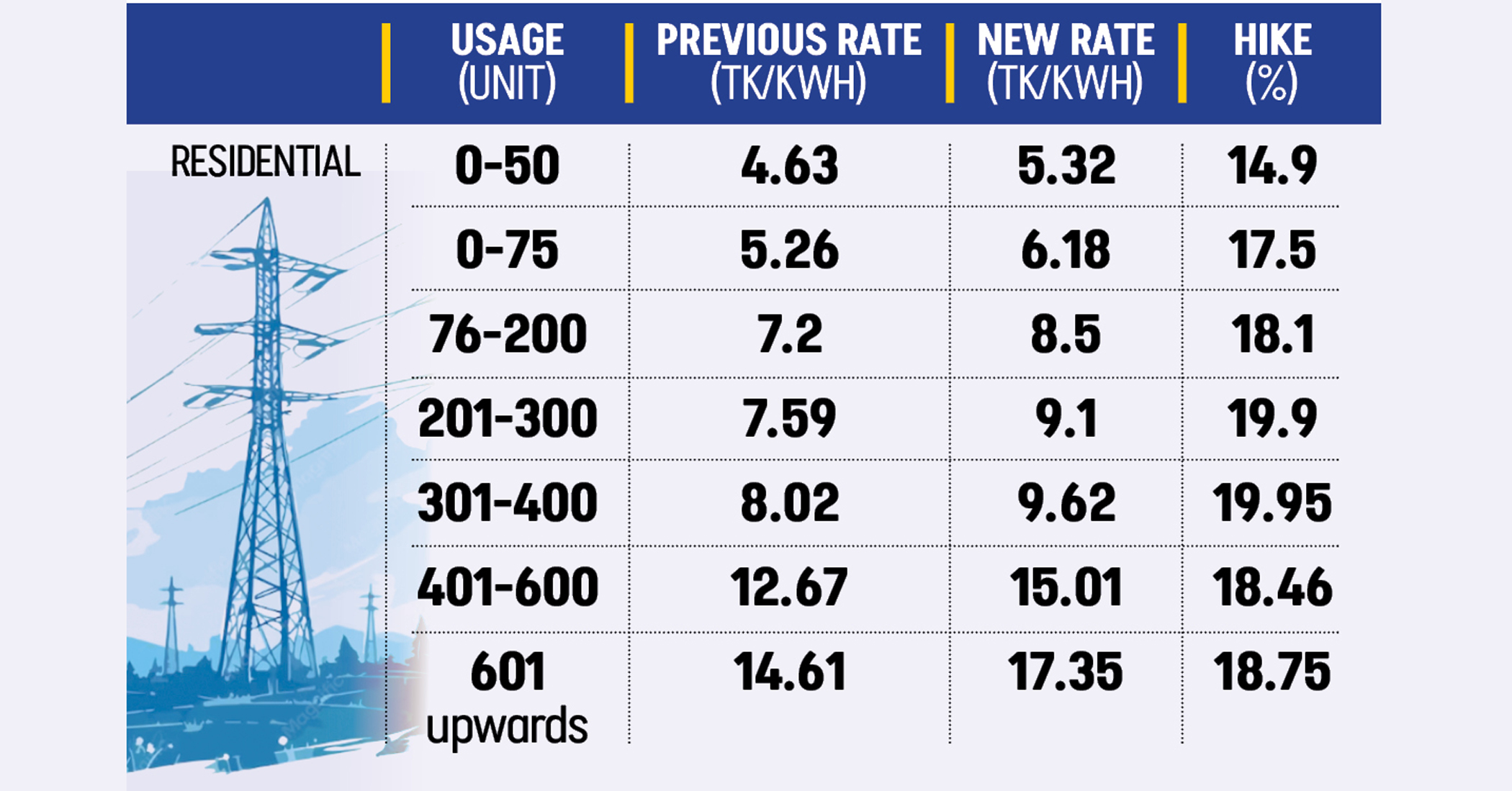
People had expected that an elected government, especially one carrying the spirit of the 2024 uprising, would finally provide relief from the scourge of persistently high inflation. Instead, the government’s decision to increase both fuel and electricity prices may only intensify it. Over the past month and a half, fuel prices have already been increased twice, resulting in higher transport costs and rising prices of essential goods. Now, following the increase in electricity prices, consumers will not only pay more for electricity but will also bear the cost of higher prices for all goods and services produced using electricity. Production costs in agriculture, industry, and services will rise, creating a multiplier effect throughout the economy. Consequently, the lives of low- and fixed-income households will become even more difficult.
The rationale behind the tariff increase appears to be reducing government expenditure on subsidies in the power and energy sectors and meeting conditions set by the International Monetary Fund (IMF). However, increasing prices is not the only way to reduce subsidies, which can also be reduced by lowering production costs. Moreover, it is necessary to examine where these subsidy payments are going and whether they are justified.
To understand how subsidies can be reduced, one must first examine why they are necessary in the first place. Subsidies are required because the Bangladesh Power Development Board (BPDB) is forced to purchase electricity at high prices from privately owned independent power producers (IPPs) that rely on imported and expensive fuels. A significant portion of these subsidies is spent on capacity payments. Due to fuel shortages, a substantial share of installed power generation capacity remains idle throughout the year but, under existing contracts, BPDB, as the sole purchaser of electricity, must pay capacity charges to power plants even when it does not buy any electricity from them.
As private-sector generation capacity expanded over the years, capacity payments increased correspondingly, and so did BPDB’s financial losses. Successive governments responded by raising electricity tariffs. During the previous Awami League government, electricity prices were increased 12 times at the wholesale level and 14 times at the retail level over 15 years, ostensibly to reduce losses and subsidy requirements. But neither losses nor subsidies declined. Instead, repeated tariff hikes became a recurring reality. Clearly, this is not a sustainable solution to reducing subsidies. We must focus on lowering the cost of electricity generation itself.
This can be achieved in the short term by revising unequal contracts with private power producers and reducing the burden of capacity payments. Pakistan provides an instructive example. Pakistan’s power sector also suffered from excessive capacity payments and dependence on expensive fuel imports. But it has recently achieved significant progress through a series of reforms, including renegotiation of IPP contracts, pricing electricity in local currency, and reducing returns on equity.
For instance, the Pakistani government cancelled contracts with six independent power producers and renegotiated agreements with 16 others, converting them to a “take and pay” model while reducing capacity charges. It also amended power purchase agreements to replace dollar-denominated pricing with pricing in Pakistani rupees. Meanwhile, the rate of return on equity for state-owned power plants was reduced from 30 percent to 13 percent. To achieve this success, the government had reportedly warned IPPs that they must either agree to renegotiate their contracts, face cancellation, or undergo forensic audits—and the strategy worked. Renegotiating contracts with just 14 IPPs generated total savings of Rs 1.4 trillion.
Pakistan has also reduced fuel import costs by rapidly expanding solar power generation. Through lower import duties on solar panels and incentives for establishing rooftop solar systems, renewable energy deployment has accelerated significantly. Between January 2022 and December 2025, Pakistan added solar generation capacity equivalent to nearly one-fifth of its total power generation, while reduced LNG consumption has enabled the country to avoid approximately $12 billion in fuel imports.
Bangladesh could likewise significantly reduce electricity generation costs by renegotiating or cancelling IPP contracts, converting agreements from capacity-payment structures to take-and-pay arrangements, pricing electricity in taka rather than dollars, and expanding its renewable energy capacity. The previous interim government did not implement any such reforms, but it did establish a committee to review power contracts signed under special legislation during the Awami League era. Towards the end of its tenure, the committee submitted its final report, highlighting irregularities and corruption in the procurement of electricity from private power producers at inflated prices as well as the practice of paying capacity charges.
According to the committee, these contracts enabled the purchase of electricity from furnace-oil-based plants at prices 40-50 percent above market rates and from gas-fired plants at prices 45 percent above market rates. The per-unit cost of electricity imported from India’s Adani Group is Tk 4-5 higher, partly because of higher coal prices but largely due to one-sided contractual terms, high capacity charges, and provisions transferring taxes and commercial risks to Bangladesh. The committee estimated that an excess generation capacity of roughly 7,700 to 9,500 megawatts is causing an additional annual expenditure of $900 million to $1.5 billion (Tk 11,000 to Tk 18,000 crore) in capacity payments.
To address these problems, the committee recommended that contracts containing evidence of corruption as per international standards should be cancelled immediately. It also recommended targeted renegotiation of high-cost and unequal power purchase agreements.
The latest electricity tariff hike will increase BPDB’s annual revenue by around Tk 14,000 crore. Yet capacity payments to power plants were Tk 42,000 crore in the last fiscal year, and have been increasing every year. If the contracts are revised and converted to a take-and-pay model, it would be possible to significantly reduce these enormous capacity payment costs.
But instead of taking steps to reduce power generation costs, the BNG government has chosen the same path pursued by the Awami League government, passing the burden of capacity payments on to consumers. This suggests that, much like its predecessor, the government is prioritising the interests of power-sector business groups and compliance with IMF conditions over public interests in shaping economic policies.
Kallol Mustafa is an engineer and writer who focuses on power, energy, environment, and development economics. He can be reached at kallol_mustafa@yahoo.com.
Views expressed in this article are the author's own.
Follow The Daily Star Opinion on Facebook for the latest opinions, commentaries, and analyses by experts and professionals. To contribute your article or letter to The Daily Star Opinion, see our guidelines for submission.
 For all latest news, follow The Daily Star's Google News channel.
Comments