


Labour ordinance to be enacted soon
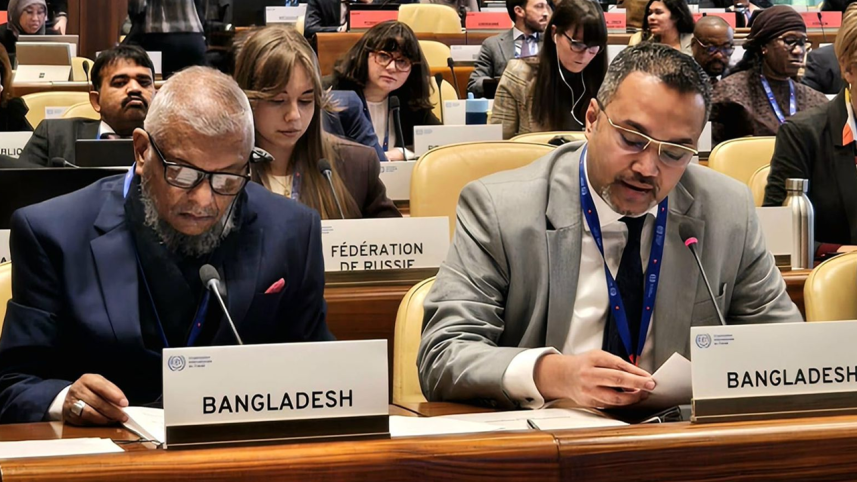
The Bangladesh Labour (Amendment) Ordinance 2025 passed by the interim government will be enacted by the government and will be placed before the parliament soon, said Mahdi Amin, the prime minister’s adviser on labour and employment.
“We will make every effort to expedite its enactment, at the earliest possible time,” he said in his speech before the 356th Governing Body session of the International Labour Organisation in Geneva on Monday.
The speech updated the ILO Governing Body on the progress made by Bangladesh in updating its labour rights to global standards.
The ordinance represents a significant step forward in advancing the decent work agenda in Bangladesh.

“These amendments are aligned with our party’s electoral pledges,providing strong impetus for reform,” Amin said.
The amendment expands the coverage of the Labour Act, particularly by extending freedom of association and collective bargaining rights to include workers who were previously excluded from these rights.
“Our government is firmly committed to ensuring human rights, including freedom of expression and association,” he said.
The minimum membership requirement for trade union registration has been reduced, documentation requirements simplified and confidentiality safeguards strengthened.
The law removes penalties for unregistered union activities, prevents arbitrary rejection of applications, increases the maximum number of unions in a factory from three to five and prohibits blacklisting of workers.
The amendments introduce provisions for unannounced inspections and strengthen penalties for violations, including anti-union discrimination, unfair labour practices, child labour and gender-based violence and harassment.
The law also criminalises forced labour and blacklisting of workers.
The scope for social dialogue has been expanded through the recognition of national-level trade union confederations and the establishment of a National Social Dialogue Forum, alongside existing tripartite mechanisms.
The amendments include provisions on institutionalising an employment injury scheme, strengthening occupational safety and health, revising minimum wages every three years instead of five and clearly defining sexual violence and harassment.
In line with the amendments, the government is now working to review the Bangladesh Labour Rules, Amin said.
The Export Processing Zones Authority has signed a two-year agreement with the ILO to revise the EPZ Labour Act in alignment with the amended Labour Act.
Bangladesh has expanded the labour inspection department to 1,129approved posts, including 724 inspectors, according to Amin.
Currently, 554 inspectors are in place, with 122 new inspectors joining soon.
A digitalised labour inspection system has been fully implemented, and the government will continue strengthening both capacity and standards through dialogue and consultation.
Bangladesh has operationalised six new labour courts, reduced case backlogs and introduced an independent ADR system, with clear legal provisions.
In a coordinated effort by the concerned ministries, all 45 criminal cases filed against labour leaders and workers after the November 2023 minimum wage protests have been settled through due process.
Bangladesh has recently ratified three major ILO Conventions,becoming the first Asian country to ratify all fundamental conventions.
In total, 39 ILO Conventions and one Protocol have been ratified, which remains the highest number in the region.
“This reflects our firm political commitment to international labour standards and to the rights of workers, while acknowledging the significant efforts required to implement such extensive ratifications.”
Recognising the significant progress under the roadmap, particularly regarding Conventions 81, 87 and 98, Amin requested the ILO Governing Body to close the case by consensus.
In June 2019, five worker representatives from the International Trade Union Confederation filed a complaint under Article 26 of the ILO Convention, alleging Bangladesh’s failure to comply with ILO Conventions 81, 87 and 98.
In response, the then government in 2021 formulated a five-year roadmap on labour sector reforms and submitted it to the ILO Governing Body.
Progress under this roadmap was discussed in eight ILO Governing Body sessions. In the latest session, the current government provided the ninth progress report.
 For all latest news, follow The Daily Star's Google News channel.
Comments