


Deadly spillovers from Myanmar's civil war can no longer be ignored


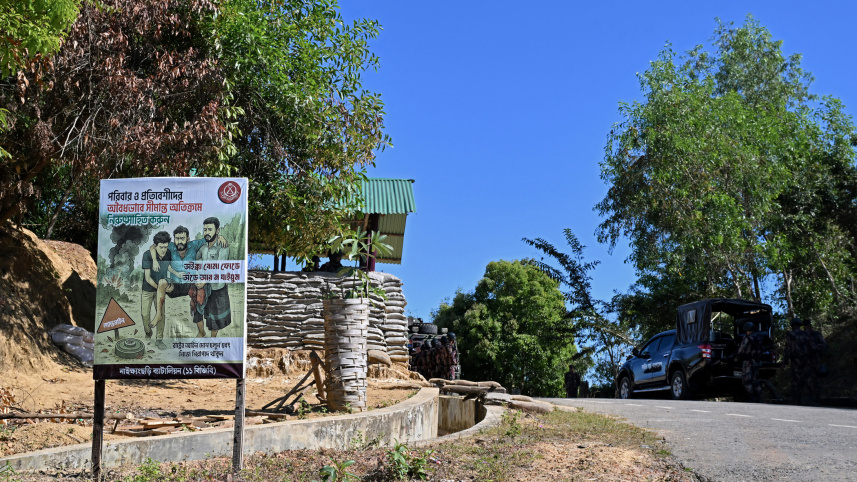
On May 24, three Bangladeshis were killed in landmine explosions near the Bangladesh-Myanmar border in Bandarban’s Naikhongchhari. Days later, on June 2, a 12-year-old boy was killed in a mortar shell explosion left abandoned in the same area. These incidents are not isolated tragedies, but rather symptoms of a deeper transformation unfolding across the southeastern frontier of the country. As Myanmar’s civil war intensifies, the borderlands of Bangladesh are increasingly becoming extensions of a conflict that Dhaka neither controls nor can afford to ignore.
The victims were ordinary people from an indigenous community, navigating familiar terrain near the border—farmers and local residents whose lives are now entangled with an external war. Over the past years, such incidents have become a recurring phenomenon: Bangladeshis killed or injured by stray mortar shells and landmines, fishermen abducted on the Naf River by the Arakan Army, and border communities living under a constant threat of violence spilling over from Myanmar’s Rakhine State.

What was once viewed primarily as a humanitarian issue has evolved into a multidimensional security crisis. The border is no longer merely a territorial line separating two sovereign states; it is turning into an unstable and contested space where armed actors, refugees, smugglers, insurgent groups, and state forces intersect.
A recent study by XCEPT Research, supported by the UK government, described the Rohingya camps in Cox’s Bazar as “extended battlefields” of Myanmar’s civil war. Such phrasing captures how conflict now transcends conventional geography. The camps are not detached humanitarian zones insulated from regional politics; rather, they are embedded within the wider conflict dynamics of Myanmar. Armed recruitment, criminal networks, factional rivalries, and cross-border political influence increasingly shape life inside and around the camps.
For policymakers in Dhaka, the Myanmar crisis is often addressed in fragmented terms—refugee management, humanitarian aid, border security, or diplomatic engagement—treated as separate policy compartments. But for people living in Teknaf, Ukhiya, and Naikhongchhari, these issues are inseparable from one another. Their everyday lives are shaped by the cumulative effects of geopolitical paralysis.
The repeated deaths and abductions along the border also reveal the limitations of state control in frontier regions. Borders are often imagined as fixed and sovereign spaces fully governed by the state. Yet, the Bangladesh-Myanmar frontier demonstrates the opposite: sovereignty becomes uneven on the margins. The state appears present through checkpoints, patrols, and rhetoric, but is lax in guaranteeing security and livelihoods for local populations.
For fishermen on the Naf River, crossing invisible and shifting maritime lines can mean detention or disappearance. For farmers near the zero line, agricultural work has become a deadly gamble amid the proliferation of mines and armed activity. Border residents are effectively bearing the costs of a regional conflict without the protection usually associated with citizenship and territorial sovereignty.
Meanwhile, Bangladesh-Myanmar bilateral relations remain in a state of diplomatic hibernation. Formal engagement exists, but meaningful political trust has largely evaporated. Trade routes have been disrupted by fighting in Rakhine State, border commerce has declined in activity, and prospects for Rohingya repatriation remain distant. The collapse of effective governance on the Myanmar side has further complicated communication between the two countries. Dhaka is now dealing not only with Naypyidaw but also with an increasingly fragmented landscape of ethnic armed organisations and non-state actors controlling territories near the border.
This rupture carries serious implications for Bangladesh’s national security. The rise of Rohingya armed groups inside the camps, growing criminal economies, and the circulation of weapons and narcotics all threaten to deepen instability in the southeast. If left unmanaged, the camps risk becoming long-term theatres for militarised politics rather than temporary humanitarian shelters.
However, Bangladesh faces a strategic dilemma. An overly aggressive approach risks escalating tensions or undermining its humanitarian commitments towards the Rohingya population. At the same time, passivity creates space for insecurity to metastasise across the borderlands. The current approach—reactive, fragmented, and heavily dependent on crisis management—is becoming increasingly unsustainable.
Bangladesh therefore needs a more coherent borderland strategy that treats the southeastern frontier not as a peripheral concern, but as a central national security issue. This requires several shifts.
First, Dhaka must pursue a more assertive and multidimensional foreign policy regarding Myanmar. Diplomatic engagement cannot remain confined to rhetorical appeals for Rohingya repatriation while the security situation deteriorates along the border. Bangladesh needs stronger coordination with regional and international partners to address both the humanitarian and security dimensions of the conflict.
Second, border security arrangements require substantial modernisation. Modernisation of the Border Guard Bangladesh, enhanced surveillance, mine-risk monitoring, intelligence coordination, and rapid-response mechanisms are essential to protecting civilian populations.
Third, the government must recognise that borderland populations are not merely security subjects but citizens whose livelihoods require sustained protection. Development, infrastructure, and institutional presence are crucial to preventing long-term marginalisation and insecurity in peripheral regions along the border with Myanmar.
The Bangladesh-Myanmar border is no longer simply a boundary separating two states. It has become a fluid geopolitical space shaped by civil war, displacement, armed networks, and regional power competition. The recurring deaths and persisting insecurity are reminders that wars do not always remain contained within national borders. When borderlands become extended battlefields, state responsibility can no longer stop at the frontier line.
Dr Anas Ansar is assistant professor of Department of Political Science and Sociology and member of Centre for Peace Studies at North South University.
Dr Benjamin Etzold is research lead on XCEPT’s Study on Bangladesh-Myanmar Borderland and senior researcher at Bonn International Center for Conflict Studies (BICC), Germany.
Views expressed in this article are the author's own.
Follow The Daily Star Opinion on Facebook for the latest opinions, commentaries, and analyses by experts and professionals. To contribute your article or letter to The Daily Star Opinion, see our guidelines for submission.
 For all latest news, follow The Daily Star's Google News channel.
Comments