Mufazzal Haider Chaudhury and the idea of Bangladesh
This 22nd of July marked the birth centenary of my father, Mufazzal Haider Chaudhury. I harbour no illusions that he would have lived this long in the normal course of events, however. The men on my father’s side of the family tend to be notoriously short-lived; his father died when he was nine, both his brothers passed away in their fifties, and even my only brother, his older son, left us when he was 47. But my father did not die a natural death. He was abducted on 14 December 1971, just two days before his country’s victory in one of the bloodiest liberation wars of the twentieth century, and tortured, bayoneted and shot to death in the early hours of 15 December, along with many other pre-eminent intellectuals of the land.
Since he was abducted from his younger brother’s house, my mother, uncle, aunt, eight-year-old cousin and seven-year-old brother were all eyewitnesses to the fact that it was members of Al-Badr, the armed militia that collaborated with the Pakistani army in its campaign of mass murder, rape, arson and looting over the preceding nine months, who were the abductors. They all retained vivid recollections of the event.
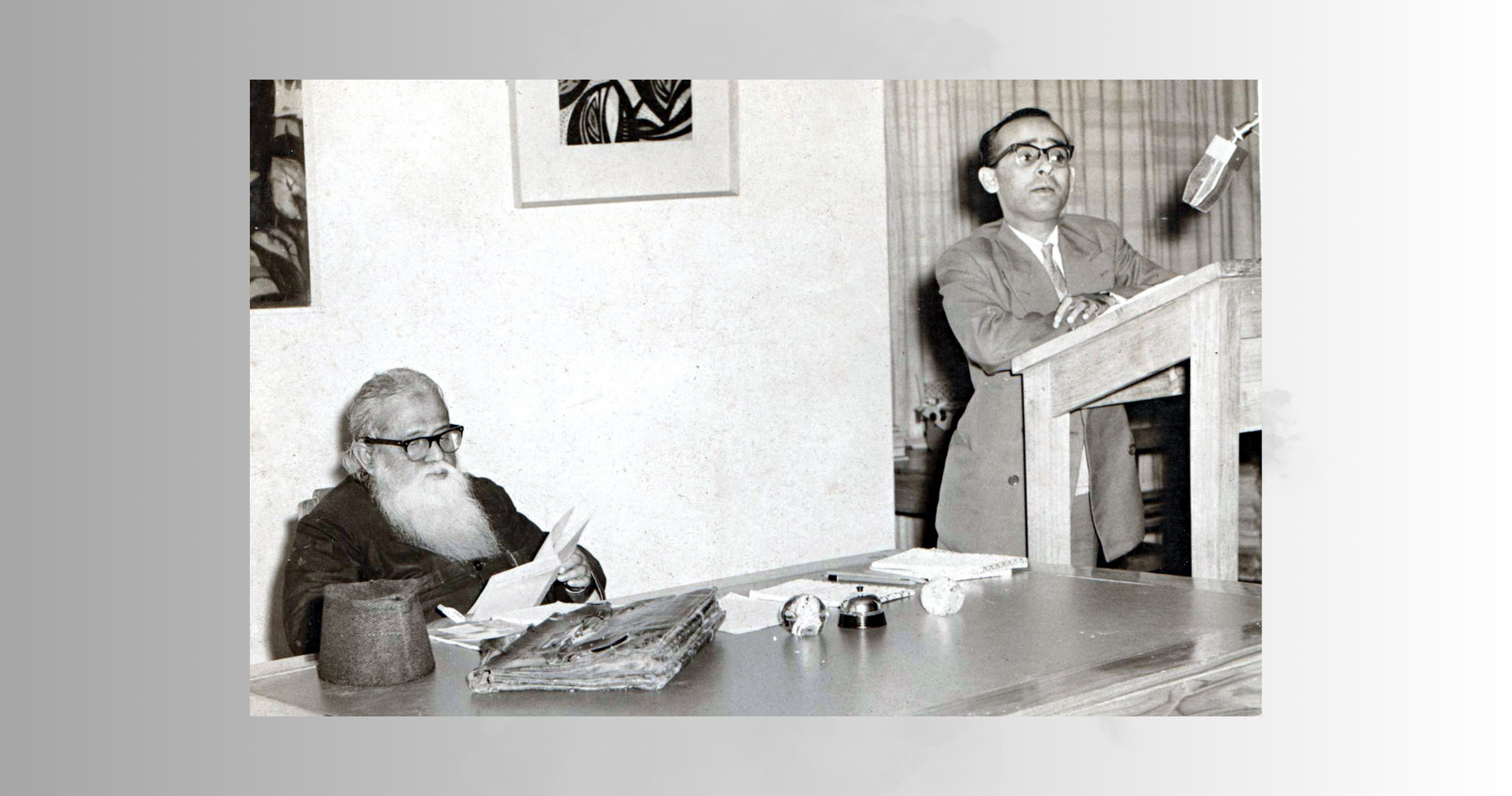
My father was a teacher of Bangla language and literature at Dhaka University (formerly Dacca University). He had never taken part in active politics during the forty-five years he lived. Yet he was marked for death by the ruling regime and its local collaborators, along with many other prominent intellectuals of the time who were similarly not active in the political arena. The common thread that connected these individuals was a vision of their country that was non-sectarian and secular; that embraced the rich diversity of all the peoples of this land; and that celebrated the ethnic and cultural heritage of the Bengali people, who constitute the overwhelming majority of its population. It is important to bear this in mind as we look at the Bangladesh of today.
Throughout its fifty-five-year history, Bangladesh has rarely been free of turbulence, both natural and man-made. The most recent and arguably most decisive was the student uprising of July–August 2024, in which a regime that had grown steadily more oppressive and corrupt, eventually transforming into a kleptocratic oligarchy embodying all the worst characteristics of crony capitalism, was overthrown by indignant, embittered young people who had simply had enough. They had lived through an era in which their government had become ever more intolerant of dissenting voices, clamping down on them through increasingly draconian measures: incarceration, enforced disappearances and targeted killings. They had seen the banking system and the capital market being looted and astronomical amounts of money being siphoned out of the country. During the agonising days of the July uprising, they also saw their government resort to unconscionable, murderous tactics in a futile attempt to contain its irresistible tide. Even though they emerged victorious, this generation also had its martyrs: gallant young women and men who made the ultimate sacrifice for their cause.

But as the dust settled after those dark days, we saw an unsettling trend begin to take shape. Sufi religious shrines (or 'Mazar Sharifs') and religious minorities were being attacked, misogyny and anti-women invective were on the rise, sculptures and murals commemorating heroes of the Liberation War were being desecrated and destroyed, and false cases were being filed against people who had any connection whatsoever with the ousted regime, resulting in their confinement for extended periods without any formal charge sheets or any progress in the investigation of their cases.
The previous regime made much of representing the amorphous 'spirit of the Liberation War' and practising secular values while nurturing sectarian elements within its own ranks and allowing the spread of intolerance and communalism throughout society. The government remained largely inactive during the series of killings of freethinking bloggers in 2015, only being goaded into action when the threat became too extreme to ignore after the Holey Artisan attack of July 2016, in which 24 people, both expatriates and locals, were murdered in the most exclusive part of Dhaka. Even then, the target was the foot soldiers of Islamic militancy, leaving the root causes unaddressed and largely unacknowledged.
At the same time, we saw a subtle ‘othering’ of innocent religious people take place: Muslims wearing overtly religious attire (caps, beards and robes for men, and hijabs, niqabs and burqas for women) were rendered largely invisible in the cultural landscape and sometimes associated with sectarian or anti-Bangladesh values. After the tide turned in the aftermath of the July uprising, everything associated with the previous regime, perhaps inevitably, was rejected, including the secular and liberal values to which it largely paid lip service.
Now, in a head-spinningly bizarre shift in narratives, we have reactionary ‘intellectuals’ patrolling the late-night TV talk shows, brazenly peddling the conspiracy theories that Bangabandhu Sheikh Mujibur Rahman was a traitor to the country whose emancipation he helped achieve; that we did not gain our liberty on December 16, 1971, but only became a client state of India; and that our true independence was won on August 5, 2024. And the outrageous, hoary old fiction that it was the Indian intelligence agency RAW that was responsible for the killing of Bengali intellectuals in December 1971, and not the Al-Badr cadres, acting in collusion with the Jamaat-e-Islami political party and the marauding Pakistani army, is also being circulated by these people. Incredibly, they have found new fools who have been taken in by these tales, nodding their heads in time to the metre of their lies.
This last narrative has particular relevance to what I write about today. Their story goes that the intellectuals who were murdered were all Maoist communists who were sworn enemies of the Indian government—given the context that the Naxalite movement was at its height at that point—and that, since the Pakistani army was on the run between 11 and 15 December 1971, when the abductions and killings took place, RAW had both the motivation and the wherewithal to orchestrate the killings.
The fact is that the martyred intellectuals were not Maoist communists. They were not even particularly active in the political arena. The eminent philosopher and essayist Sardar Fazlul Karim referred to this fact in his autobiography Atmojiboni o Onyanyo; he noted that some of the most prominent names among the martyred intellectuals had no particular political allegiance. He mentioned the name of Jyotirmoy Guhathakurta, the eminent Professor of English at Dhaka University, who was shot by the Pakistani army on 25 March and died of his injuries on 30 March, in this connection. And he referred to my father, Mufazzal Haider Chaudhury.
The lives and work of the intellectuals who were martyred in December 1971 speak for themselves and explain why the Al-Badr, Al-Shams and Razakar collaborators of the Pakistani army singled them out for elimination. Munier Chowdhury, the eminent educationist and playwright, was the writer of Kobor, the harrowing play that went a long way towards immortalising the Language Movement of 1952, which in turn had a decisive impact on the Bengali nationalist movement leading to the Liberation War of 1971. Shahidullah Kaiser, the famous journalist and novelist, was writing the novel Kobey Pohabe Bibhabori (When Will the Night Be Over) about the brutality of the Pakistani army during the 1971 war when he was abducted on 14 December. He also famously said, ‘I became a novelist because Ayub Khan sent me to jail.’ Anwar Pasha, the educationist and novelist, wrote the novel Rifle Roti Aaorat in the context of the 1971 war, which was published only posthumously because he, too, was abducted on 14 December.
And of course, there is the inconvenient fact that there are many eyewitnesses to the fact that it was members of Al-Badr, Al-Shams and the Razakars, acting in collusion with the Jamaat-e-Islami and the Pakistani military, who abducted the martyred intellectuals. My aunt, who unfortunately is no longer with us, provided video testimony to this effect in the British television Channel 4 documentary War Crimes Files, and many depositions and eyewitness accounts were presented before the International Crimes Tribunal during the trial of the 1971 war criminals in 2013–14.
And my father? He was a student of Santiniketan, a disciple of Rabindranath Tagore, forever enamoured of the great poet and philosopher's vision of a universal humanity, of harmonious coexistence with nature and its bounties, and of exploring the divine in all we see around us. He wanted that generosity of spirit to be reflected in the country where he was born and to which he devoted his life's work. He was a teacher devoted to and beloved by his students, and an essayist and a thinker who chose not to see divisions between people, but to focus on our commonalities. He was by no means naïve; on the contrary, he was a deeply erudite and accomplished scholar, but he chose to see the good in people and seemed to believe that no one was beyond redemption.
My father's student Humayun Azad, the well-known writer and educationist, has recorded in his book Amra Ki Ei Bangladesh Cheyechhilam that my father was the first person to coin the name 'Bangla Desh' for the nation about to come into being. On 23 March 1971, my father wrote in his diary that, in houses across the city, the flag of 'Bangla Desh' was being hoisted, and students were parading at the stadium and unfurling the 'Bangla Desh' flag to the accompaniment of the song Amar Sonar Bangla. The next day, he wrote that many government buildings were flying the 'Bangla Desh' flag. The day before the darkest night in the nation's history. He had such high hopes for his country. A hundred years after his birth, what would he have thought if he could see his country today?
Tanvir Haider Chaudhury is the younger son of Martyred Intellectual Mufazzal Haider Chaudhury. He is the CEO of Kazi Food Industries Ltd.
Send your articles for Slow Reads to slowreads@thedailystar.net. Check out our submission guidelines for details.
157th Birth Anniversary of Mahatma Gandhi / Gandhi’s return to Noakhali
Why does Tagore still trouble Bangladesh’s idea of ‘us’?
Can Bangladesh make better use of its zakat money?
Three revolutions that reshaped the world
Paradise lost and found: Rediscovering early modern Bengal
Unbound Mother: The making and remaking of Kaali in Bengal
Do great leaders make history, or does history make them?
Poison and cremation: A forensic history of colonial Bengal