Poison and cremation: A forensic history of colonial Bengal
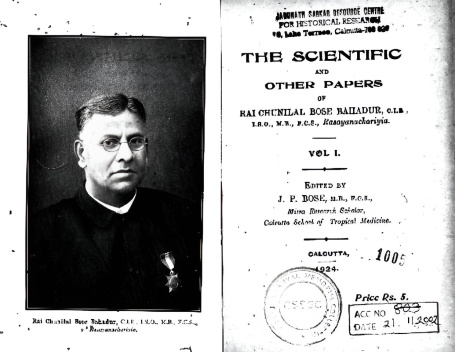
Forensic experts in colonial Bengal, including the military physicians known as “chemical examiners” who ran state toxicology laboratories, considered poisoning to be a South Asian speciality. Chunilal Bose, who would later become the chemical examiner in Calcutta, noted with his co-author, J. F. Evans, in 1895 that the per capita rate of known murder cases involving poison in Bengal was more than three times higher than that in England. For some in British India, statistics such as these bolstered the racialised colonial stereotype of “native mendacity”, the idea that South Asians were constitutionally dishonest and deceptive.
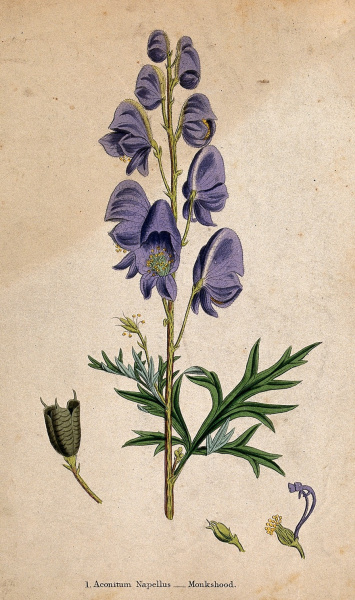
Poisoning occupied a special place among crimes of deception. Many colonial treatises on medical jurisprudence devoted a third of their pages to this form of crime. Poisoners could make use of local plant and animal toxins that were unknown in Britain. Botanical poisons such as aconite or oleander often grew wild in the countryside and were not the focus of toxicological tests developed in the Western world. Local botanical poisons also passed through the body more quickly than substances better known globally, such as arsenic, mercury or lead.
Nonetheless, mineral and metallic poisons also played a major role in Bengal's forensic history. In the late nineteenth and early twentieth centuries, arsenic was the leading poison used for murder worldwide, despite the availability of tests such as the Marsh-Berzelius procedure from the 1830s onwards. Arsenic had no colour, taste or smell and was fatal in small quantities, “two grains” in the units of the day.
In colonial South Asia, the difficulty with arsenic was that its symptoms, including diarrhoea and vomiting, were often indistinguishable from those of cholera. In a 1920 case, for instance, the civil surgeon of Rangpur sent the viscera of one Khairab Shaikh to the Bengal chemical examiner's laboratory.
An autopsy performed locally had revealed congestion and blood-tinged mucus in the man's digestive system. The civil surgeon believed that the death was probably due to cholera, but the chemical examiner's laboratory found arsenic.
Unsurprisingly, then, a cholera outbreak was an ideal time to poison one's rivals with arsenic. The cholera-arsenic trick was occasionally uncovered in Bengali land disputes. It also appeared in the plots of classic Bangla-language detective stories such as Priyanath Mukhopadhyay's Darogar Daptar, which were based on real cases.
A typical case from the Bengal chemical examiner's annual reports involved a man who died after four days of violent purging and vomiting in 1914. His relatives said that he had died of cholera and quickly buried his body. A few days later, however, a local official received an anonymous tip claiming that the man had been poisoned. He ordered the body to be disinterred and an autopsy performed, but it was so decomposed that the physician could not determine the cause of death. However, a sample of the viscera was sent to the chemical examiner's laboratory in Calcutta, which found arsenic “in marked quantity”.
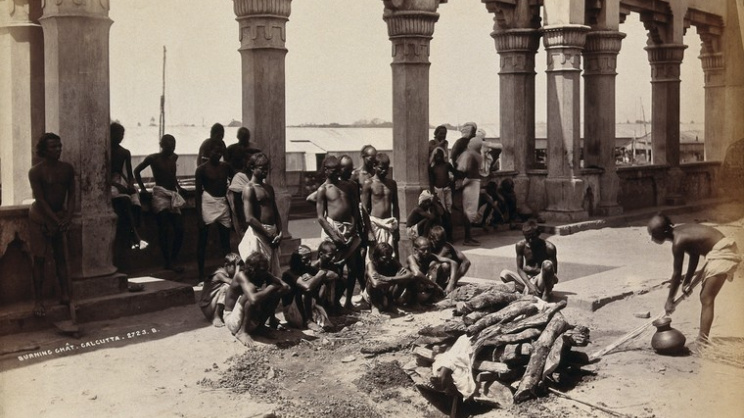
This case was uncovered partly because the body had been buried and could therefore be dug up, as the deceased was presumably Muslim or Christian. The more elusive cases involved cremation, which posed a major challenge for forensic experts because many Hindu communities carried out these rites within 24 hours of death. If a suspicious death occurred in a remote area, for instance, it was often impossible for the colonial authorities to intervene and collect evidence before the body was cremated.
The chemical examiner in Calcutta suspected that many poison murders escaped detection because relatives attributed the deaths to illness or snakebite and swiftly cremated the bodies. A chemical examiner based elsewhere in India called cremation “a most dangerous loop-hole” in relation to forensic science. Cremation would normally destroy any trace of a botanical poison. If a person had been poisoned with a mineral such as arsenic or a metal such as mercury or lead, however, and if the cremation had not been very thorough, it was sometimes possible to detect a non-botanical poison even after cremation, for instance in spongy bone tissue.
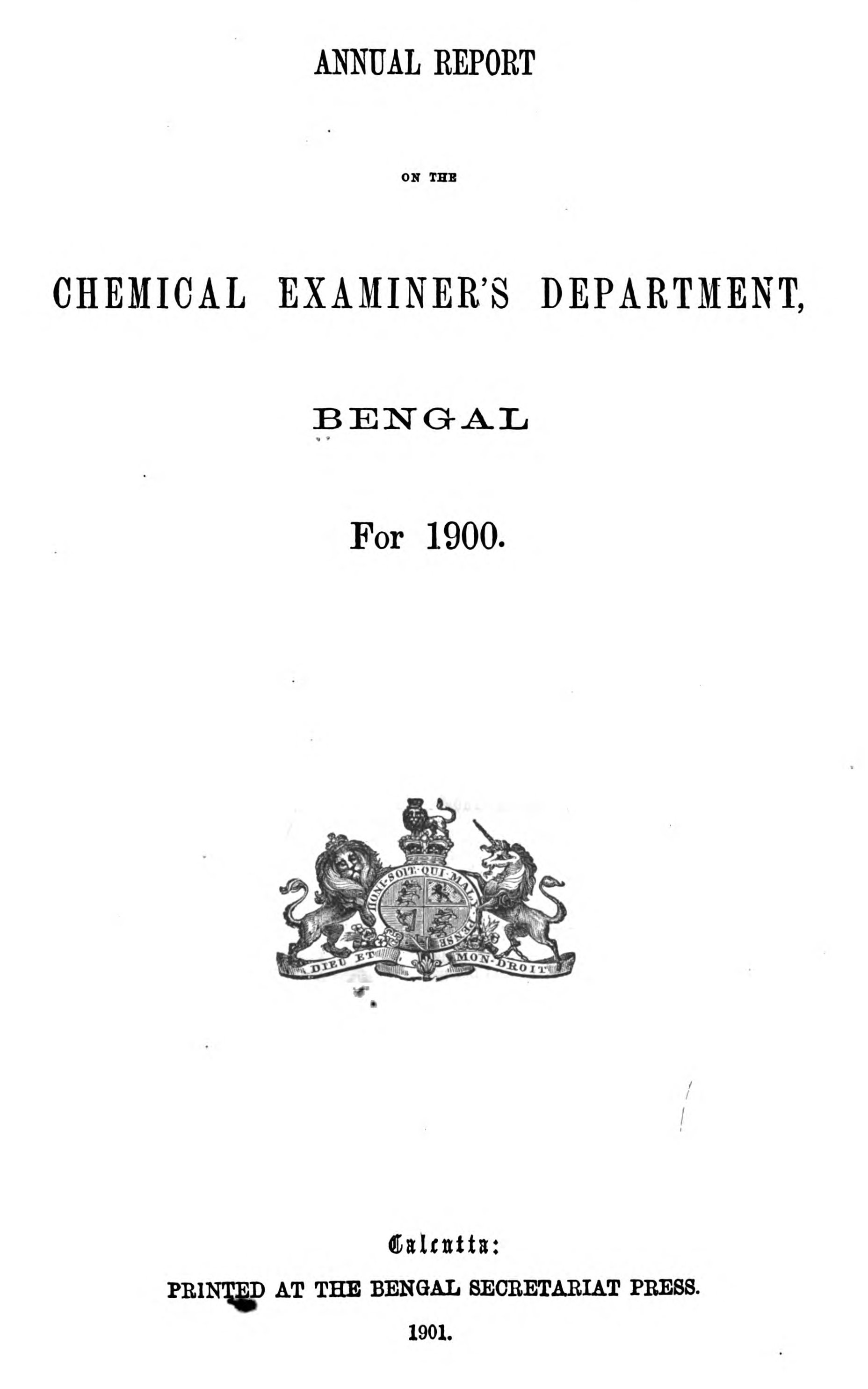
As a result, the chemical examiners included statistics on cremation and poisoning in their annual reports. Each year, they recorded the total number of suspicious samples of cremation ashes they received. They tested these cremains for poisons such as arsenic, mercury and lead and reported the number that tested positive. “Out of the 18 cases of burnt bones taken out of funeral pyre and sent to this office for detection of poison, arsenic was detected in one case only,” wrote the Bengal chemical examiner in 1904, for instance. They also described particular cases. In 1920, for example, a magistrate in Midnapore forwarded some burnt bones and ashes collected from the place where a woman named Sita Dasi had been cremated. The Bengal chemical examiner found arsenic in both the bones and the ashes.
Unsurprisingly, then, a cholera outbreak was an ideal time to poison one's rivals with arsenic. The cholera-arsenic trick was occasionally uncovered in Bengali land disputes. It also appeared in the plots of classic Bangla-language detective stories such as Priyanath Mukhopadhyay's Darogar Daptar, which were based on real cases.
Cremation ashes that tested positive for arsenic suggested that a poison murder case had been uncovered, despite the perpetrator's attempt to incinerate the evidence. But there was an added twist: the form of some poisons, such as arsenic or mercury, looked different once heated than if they had never been heated. Thus, on occasion, chemical examiners found that some cremation ashes tested positive for poison, but also that the poison had never been heated. Alternatively, in some cases, chemical examiners found poison in a location where it could not have survived the heating process. What this meant was that someone had added poison to the ashes after cremation in order to frame another person for murder by poisoning. The deceased could not have been poisoned because the poison was planted after they had died and been cremated.
Chemical examiners elsewhere in British India also encountered such cases of planted poison. In an 1891 case from Satara in the Bombay Presidency, T. D. Collis Barry's laboratory found white arsenic in the ashes of a corpse but realised that this was not a genuine poisoning case. "This is a very transparent fraud, but rather a favorite one amongst the natives of this Presidency," commented Collis Barry. "The intention is obviously to suggest poisoning of the deceased in order to implicate some enemy on a charge of homicide; but as arsenic volatilizes with very moderate heat, it is absolutely impossible that any of it could be present after cremation in the open air, except if it were added to the ashes after the process were completed and the fire extinct."
The chemical examiners' work on these false cases shows that they tried to prevent wrongful convictions. Because of their laboratory findings, the state would drop these cases, meaning that there would be no prosecution of the original suspect. Cases involving falsely planted poison in cremains also aligned with broader discussions in state forensic laboratories. Every year, the chemical examiners reported their poison detection rate. This figure represented the percentage of cases in which the laboratory had detected poison out of the total number of samples submitted for testing.
Military superiors assumed that the higher the poison detection rate, the more effective the laboratory. But sometimes a chemical examiner pushed back, urging a more nuanced and careful view of his laboratory's work. At the flagship Bengal laboratory, for instance, the reported poison detection rate in 1903 was 45.46 per cent. The chemical examiner's military superior criticised this figure as being low. But the chemical examiner objected: it was just as important for his laboratory to detect no poison in a case as it was to find poison. "As much assistance may be rendered to justice by proof that a charge of poisoning is false as by proof that such a charge is true," insisted David St. J. D. Grant. Clearing the name of a person wrongly accused of poisoning was just as important as helping secure the conviction of a genuine poisoner.
Today, in the US (where I live), the innocence movement works to overturn wrongful convictions, which were often based on unreliable forensic evidence such as bite-mark analysis or Shaken Baby Syndrome. Established in 1992, the Innocence Project has been driven by DNA evidence, which typically contradicts these other forms of evidence. It is important to remember that there is a history of wrongful convictions before the DNA revolution and outside the US as well. The chemical examiners' detection of planted poison in cremains and their debates over how to interpret the poison detection rate are cases in point.
It is also important to recognise that concern about wrongful convictions looked different in colonial South Asia from the way it does in the US today. In the US now, a key driver of the innocence movement is awareness of the race- and class-based bias inherent in American society and institutions. In colonial South Asia, by contrast, concern about wrongful convictions—at least in the early years, when the chemical examiners were British—was itself heightened by racial bias. Chemical examiners were on the lookout for planted poison and miscarriages of justice because they believed so deeply in native mendacity. Finding a planted poison case only hardened their resolve to keep looking. Suspicion fuelled detection, and detection, in turn, fuelled further suspicion. The British chemical examiners worried about miscarriages of justice caused by planted poison because they believed that "native trickery" was all around them.
This relationship between racial bias, false evidence, and the desire to avoid wrongful convictions started to change as South Asians rose through the ranks of the forensic professions in the early twentieth century. Chunilal Bose, who was the first South Asian chemical examiner anywhere in British India, explained Bengal's heightened poisoning rates not through racialised stereotypes of deceptiveness but through availability: botanical and animal poisons grew wild in the Bengali countryside and thus could not be regulated in the way they could in England. With his co-author Evans, Bose argued that what drove people to commit criminal poisoning was the same in India as anywhere else: tragic human emotions such as revenge, jealousy, lust and greed.
There is a longstanding debate over whether the internal decision-making of perpetrators or the ready availability of weapons is the more important factor leading to violent crime. In America today, the weapon on everyone's mind is guns (as the National Rifle Association slogan goes, "guns don't kill people, people kill people"). In colonial Bengal, it was poison. Bose and Evans argued that the problem was availability, not some inherent racialised propensity to deceive.
Chunilal Bose and the other South Asians who filled the upper ranks of the forensic professions by the late colonial period cared about the detection of poison, the challenges of cremation, and the avoidance of wrongful convictions, just like their British predecessors. But when Bose explained Bengal's high poisoning rate, or when forensic expert J. P. Modi published Medical Jurisprudence (still a leading textbook today), they rejected racial and cultural explanations for crimes of deception committed by South Asians. This is not to say that South Asian forensic experts rejected other social hierarchies tainted by accusations of mendacity, such as those based on sex or caste. Modi's Juris featured cases involving a South Asian woman and a Dalit man with self-inflicted injuries, although both claimed that someone else had attacked them. But on race, at least, most South Asian experts discarded the concept of native mendacity that had been used to explain crimes such as poisoning—and false poisoning cases—in colonial Bengal.
Of course, there was another way of looking at the history of false poisoning cases in colonial South Asia. Planting poison could lead to the framing of a rival for murder, harnessing the power of the criminal justice system for purposes unintended by the colonial state. At the same time, these attempts to manipulate colonial law could have doubled as anti-colonial sabotage or resistance—a malevolent but ingenious form of play by colonised tricksters. The individuals who planted the poison may have been trying to assert control in a way that simultaneously punished their rivals and subverted the system. It may have been, then, that cremation ashes mixed with arsenic represented sinister attempts to produce wrongful convictions and acts of anti-colonial resistance at the same time.
Mitra Sharafi is Evjue-Bascom Professor of Law with a History affiliation at the University of Wisconsin–Madison, USA. She may be contacted at mitra.sharafi@wisc.edu. From 2025 to 2027, she is President of the American Society for Legal History.
Send your articles for Slow Reads to slowreads@thedailystar.net. Check out our submission guidelines for details.

Partition, Bor Porong and the Chakmas’ unfinished struggle for belonging
The young radicals who challenged 19th-century Bengal

More men are cooking. But is patriarchy leaving the kitchen?

Everyday secularism and the Bangladesh we rarely talk about
Reading Sarat Chandra at 150, with empathy
Who really owned Britain’s royal jewels?
The 25,000-year history of betel nut chewing
The world map we know is distorted. Why does it matter?

Bengal and the coming of Islam: A story of soil and spirit