


Experts alarmed as man-child syndrome rises in Bangladeshi homes
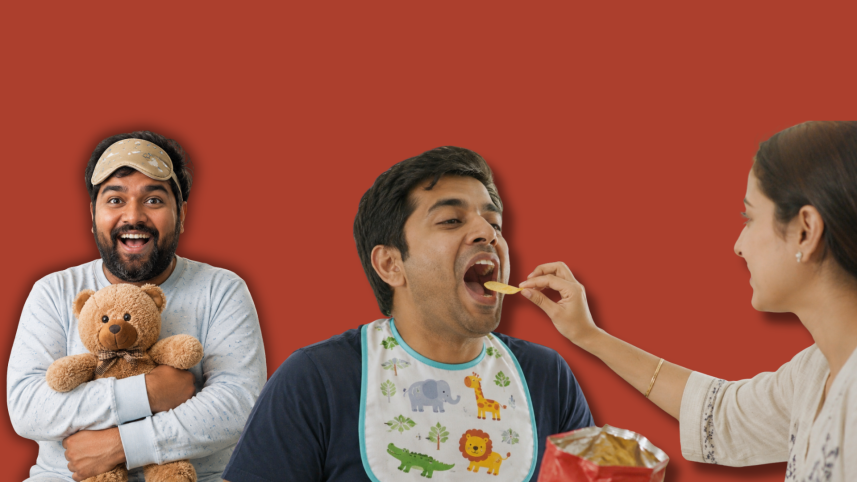
The first sign of the outbreak appeared in Block C, Bashundhara R/A, at 8:12 AM on a humid Tuesday, when 33-year-old Rashedul “Rash” Karim, senior brand manager, fantasy football patriot, and part-time geopolitical analyst, walked into the dining space and asked his wife, “Tuli, amar ID card-ta kothay?”
His wife, Tuli, was packing their son’s school tiffin, replying to client voice notes, mentally calculating what to cook for dinner, and trying not to black out from low iron. She looked at him the way people look at expired medicine.

“Check your office bag.”
“I did.”
“It’s in the front chain.”
Rash checked again. It was in the front chain.
Experts say the South Asian Man-Child Epidemic is now affecting households across Bangladesh, particularly among men aged 26 to 42 who can prepare a 14-slide presentation on national development but experience total systems failure when asked to soak lentils.
The condition usually begins in adolescence. A male child is told his only responsibilities are to study, eat, and eventually “be established.” Meanwhile, his sister is trained in a full range of practical governance: serving guests, finding missing remote controls, peeling potatoes, remembering birthdays, and sensing from footstep vibrations which family member is about to ask for tea.
By 30, the average infected male can compare three bank loan schemes, explain why Bangladesh cricket needs “a proper mindset,” and order biriyani through an app in under 11 seconds. He cannot, however, identify where the onions are kept in his own kitchen, despite living there through two general elections and one dengue season.
Rash was considered a mild case.
He was not openly oppressive. This made him harder to diagnose. He used phrases like “mutual respect,” “mental health matters,” and “I am very supportive of women”. His definition of support, however, appeared to be not physically preventing his wife from leaving the house.
One evening, while eating hilsa with dramatic concentration, Rash announced, “I am very supportive of women working.”
Tuli, who had just returned from work and was now serving dinner to three adults and a child, asked, “Supportive in what way?”
“I never stop you,” he said.
The room fell silent.
His mother, visiting from Uttara, nodded proudly. “Exactly. He is very broad-minded”.
This is how the epidemic survives. The South Asian man-child is often described as “a good family boy,” which usually means he has never been taught to perform routine adult tasks but has excellent posture while asking where his socks are.
One evening, Rash called out from the bedroom, “Tuli, have you seen my panjabi?”
It was hanging directly in front of him, like a large cotton ghost trying to save his marriage.
Tuli entered the room, pointed at it, and left without speaking. Rash later described the incident to a friend as “negative energy.”
 For all latest news, follow The Daily Star's Google News channel.
 His friend Tanvir “TB” Islam, another carrier, nodded solemnly. TB had recently become a father and now described himself as “very involved,” a claim based largely on once holding the baby during an Eid family photo while his wife adjusted the baby’s cap, smiled for the camera, and silently planned six future vaccinations.
Researchers say the condition often worsens after marriage. The patient begins outsourcing increasingly basic functions. He develops a dependency on one nearby woman for all executive functioning, including meal planning, folding the laundry, emotional interpretation, gift-buying for his own relatives, and locating objects visible to the naked eye.
In advanced cases, the patient may stand in front of an open fridge and ask, “Do we have anything to eat?”
The answer is always yes. What he means is, “Is there anything already plated in a way that does not require me to interact with reality?”
The turning point came one Thursday when Tuli developed a fever and could no longer maintain normal government operations.
The domestic worker was off. The child had school. Rash entered the kitchen and stared at a packet of suji as if it were an encrypted message from a hostile state.
“How do I make breakfast?” he asked.
“Take help from the internet,” Tuli said from the sofa.
He called his mother.
She did not pick up.
For the first time in documented history, Rash was left alone with a gas stove, two eggs, two lunchboxes, and consequences.
What followed has since been described as the Bashundhara Pilot Intervention. The child went to school wearing one Spider-Man sock and one plain white sock. The omelette looked emotionally unstable. The water bottle leaked inside the schoolbag. But by 8:47 AM, the child was fed, dressed, and not legally deceased.
This represented major progress.
Since then, Rash has entered what experts call the “early functionality” stage. He can now boil eggs with moderate confidence and once surprised Tuli by finding the cumin without requiring GPS coordinates.
Public health advocates remain cautiously optimistic.
Still, much work remains. Across Bangladesh, women continue to serve as unpaid logistics coordinators for otherwise employable adult men. Somewhere, right now, a 35-year-old software engineer is asking his wife where the salt is while standing beside the salt.
For now, authorities advise the public not to panic. The condition is widespread but manageable. Early intervention, strategic withdrawal of female over-functioning, and repeated exposure to phrases like “figure it out” have shown promising results.
Until a vaccine is developed, experts recommend raising boys with basic domestic competence, limited praise for microwaving leftovers, and zero applause for “helping” with their own children.
Because this is not merely a family issue.
It is a national productivity crisis.
Comments