


The rooftop
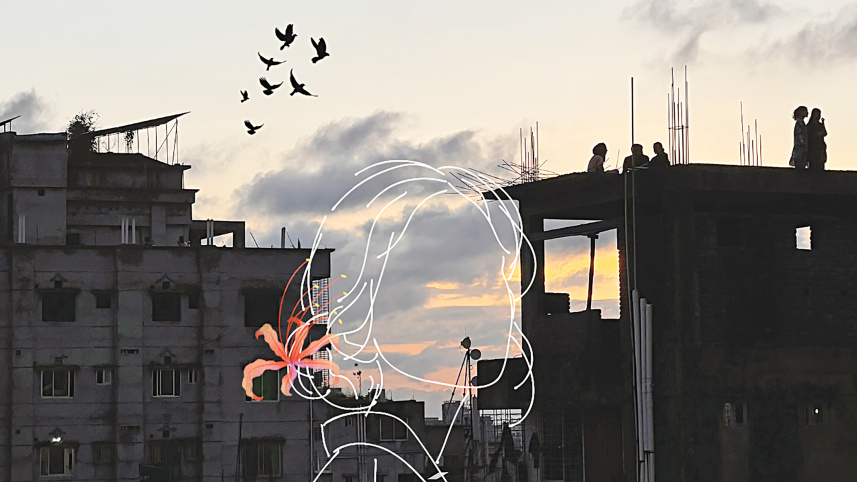
The rooftop is where she breathes.
It is a square of cracked concrete five stories above the noise of Dhaka, and it belongs to no one. Or perhaps it belongs to everyone and no one at once—a space unsupervised, unspoken, unscripted. Up here, the air is thick with the sound of pigeon wings and the far-off scent of turmeric frying in someone’s kitchen.

Up here, Asha can be someone else. Or, more precisely, she can be herself.
She leans against the rusting water tank, barefoot, listening to the city hum beneath her. A motorcycle backfires on the street below. A woman calls for her son. A faint azaan echoes from a distant mosque. The sky is a bleached grey, promising rain, but delivering nothing.
It is just after Maghrib, and Asha knows her mother will be calling soon. But she stays.
She is 21 and unmarried, which, in her building, makes her either tragic or dangerous, depending on whom you ask.
In the flats below, the women watch her closely—especially the widows. They nod at her in the elevator, but it is always a cautious nod, wrapped in disapproval. They do not like her lipstick, or how she laughs too loudly when boys pass by on the street, or how she does not cover her hair when she goes to buy bread. They do not understand why a girl like her lives alone.
She does not explain.
Her mother lives in Narayanganj. Her father died when she was fifteen. Asha now teaches Bangla at a coaching centre in Kalabagan, and in the evenings, she comes home, climbs five flights of stairs, and stands on the rooftop—the only space in the city that does not judge her.
On this rooftop, she has watched boys fly kites, watched clouds pull shadows across the pink-orange skyline, watched lovers whisper behind drying saris and steel rods.
But this evening is different. There is someone else up here.
A boy. Or rather, a young man in a faded green panjabi, sketching something in charcoal on a thick notepad. She stops. He looks up. Their eyes meet. The moment lingers. Then, with a quiet nod, he shifts slightly to make space.
She sits—carefully—not too close.
He does not ask her name. She does not offer it. The silence between them is easy, like water settling in a glass.
His name is Tanim, she learns a few evenings later. He studies architecture at BUET, but prefers drawing people to buildings.
“Buildings do not lie,” he says one night. “But people… they refuse to lie properly. That’s what makes them interesting.”
She laughs. “So you come up here to spy on people?”
He smiles. “I come up here to see.”
They talk for hours—about the heat, about films, about her students who mix English with Bangla like cake batter, about his childhood in Bogura, and how he used to sketch fishmongers and goats in the village market.
He never asks why she lives alone. Or whether she is married. Or why she does not wear a scarf. He does not ask the questions everyone else does.
 For all latest news, follow The Daily Star's Google News channel.
 And so she begins to wait for him.
Some nights, they do not speak at all. He sketches. She sits beside him, watching the moonlight skim across rooftops and laundry lines. Once, she touches a sketchbook page accidentally and leaves a faint oil mark from her fingertip. He does not mind.
There is freedom here, in the dark air and shared silence. But nothing in Dhaka stays unsupervised for long.
She stares at it, then looks at him.
“You made me look free.”
“You were,” he replies. The silence between them thickens, full of unsaid things.
She folds the sketch slowly. “I think I am not supposed to be seen.”
He hesitates. Then says, “Then do not let them see you shrink.”
Three days later, she’s handed a notice: “Due to complaints from multiple tenants regarding inappropriate rooftop behavior, your lease will not be renewed.”
No apology. No warning.
She packs her things that night. Every fold of clothing is tight with fury. She does not cry.
The sketch goes in last.
She moves to a smaller flat in Shyamoli. It is cheaper, darker. No rooftop access. The windows barely open. There are no pigeons. No skyline. It takes time to adjust. She misses the air, the way the evening opened like a curtain.
She misses Tanim, though she does not message him.
Some losses are too quiet for words.
Weeks pass.
One day, walking home from work, she sees a large banner hanging from an old colonial building in Dhanmondi: “Urban Lines: A Visual Essay on Dhaka’s Invisible People. Gallery Open to Public | 11.00 AM–8.00 PM.”
She does not plan to enter. But something pulls her in.
Inside, the gallery smells of paint and clean wood. Soft light falls on the canvases—Dhaka rooftops at twilight, old men dozing on verandahs, barefoot boys balancing on tin railings, women watering potted plants with uncovered hair.
And then, on one far wall—it is her.
The sketch. Larger now. Framed. Untouched except for a title card: “The Rooftop, 2025”–Tanim Hossain
A woman reclaiming space in a city that shrinks her.
She stares at it. Her chest tightens. People walk behind her, murmuring. A little boy tugs at his mother’s hand and asks, “Is that lady real?”
She smiles, faintly. For the first time in weeks.
Later that night, she climbs the stairs of her new building. There’s no rooftop—just a locked gate and a final step that leads nowhere. She stands there, one foot on the top stair. The air touches her face.
It is not freedom. Not fully. But it is something. She stays there for a while.
A month later, a letter arrives. No return address. Inside is a smaller sketch—quick, unfinished. It is her again.
But she’s not alone this time. He’s drawn himself beside her, both of them looking up at the sky.
Below it is just a line: “There’s a rooftop in Bogura. Come and see.”
Her breath catches. She folds the letter carefully and tucks it into her drawer.
Outside, a crow caws from a cable line. A neighbor’s child drops a ball down the stairwell.
She hasn’t decided yet.
But tonight, she’ll stand on that last step again.
And this time, she won’t be alone—not entirely.
Haroonuzzaman is a translator, novelist, poet, researcher, and essayist. Besides teaching English in Libya and Qatar for about 12 years, he has had 20 years of teaching experience in English Language and Literature at Independent University, Bangladesh (IUB).
Comments