


When independent newspapers burn, so does democracy

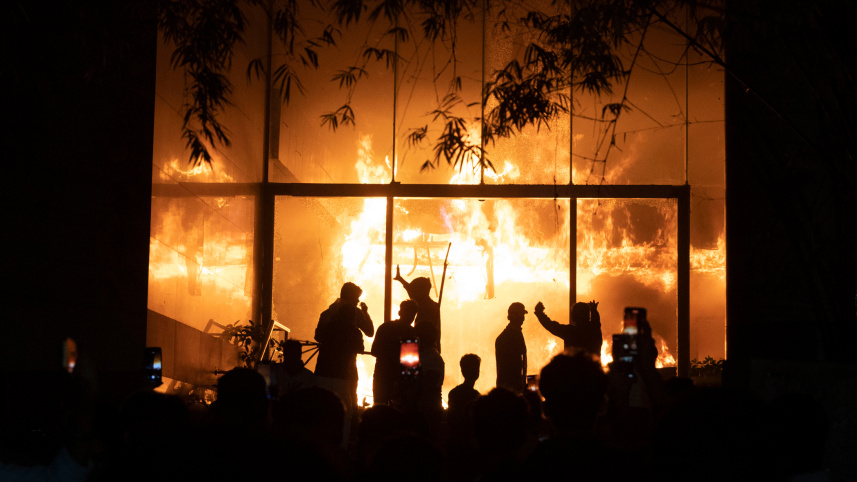
When independent, objective and fact-based newspapers are set on fire, it is democracy that burns. It is the diversity of views, the culture of dissent, and the right to protest that are set on fire. The need for debate, the practice of argument and counterargument in search of truth, and the ability to look at the same thing from different angles and perspectives are what get destroyed. From creative thinkers, we turn into obedient servants.
This was the real intention—destroying democracy—when The Daily Star and Prothom Alo, two leading newspapers that truly strengthened and institutionalised independent journalism in Bangladesh, were set on fire on the night of December 18, 2025.

Yes, the very institutions that held all governments to account, relentlessly criticised those in power for their repressive and corrupt measures, and fought against more than 15 years of Sheikh Hasina’s rule; whose editors were prosecuted, one charged in 84 cases and the other charged with murder; whose reporters were not allowed to attend the prime minister’s events and press conferences after 2014; who suffered forced curtailment of government and private advertisements; who endured attempts to change ownership, and were denigrated and called “enemies” of Bangladesh on the floor of parliament.
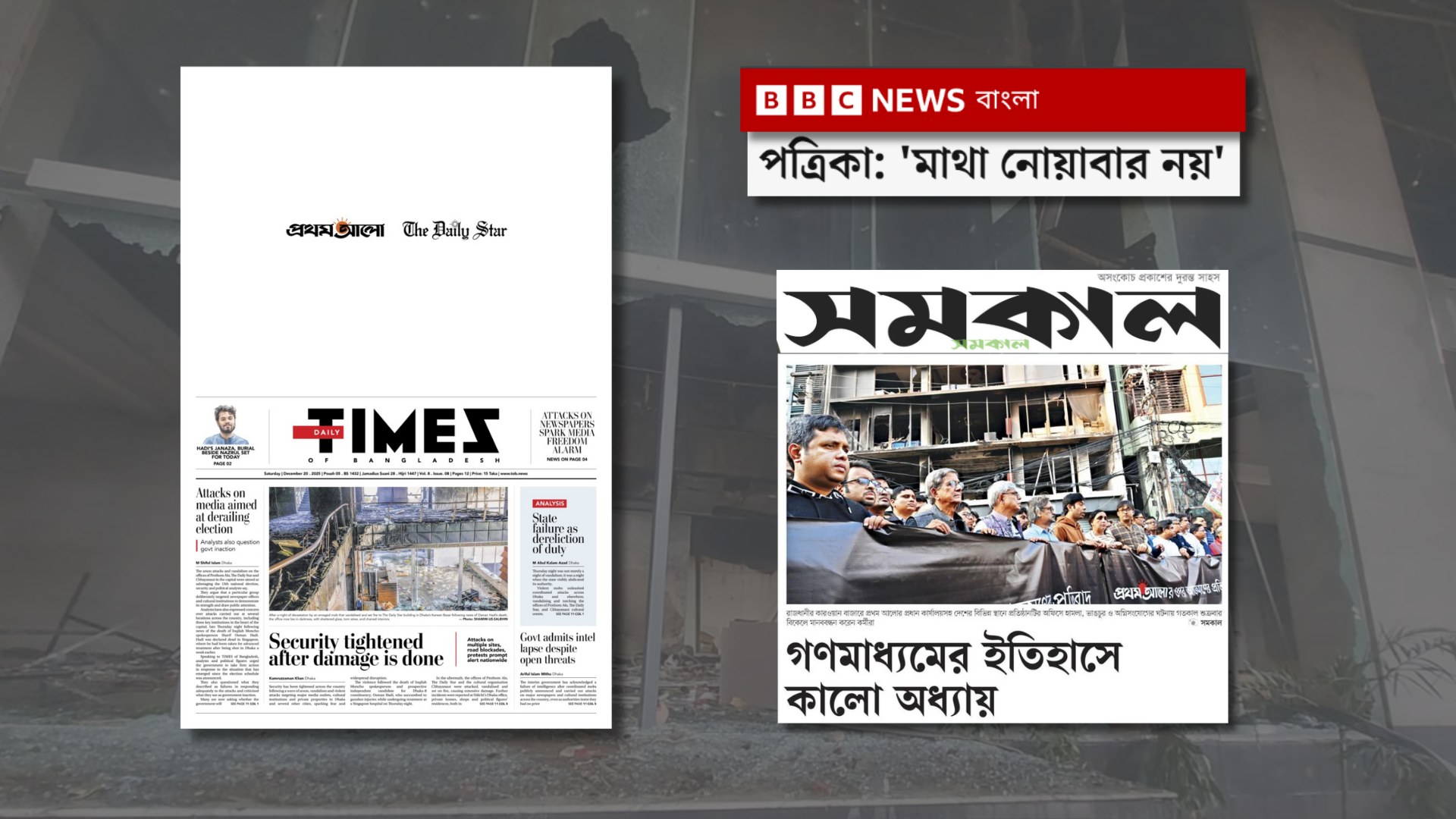
These are the two papers that stood up against enforced disappearances, custodial deaths, police brutalities, and other violations of human rights. We have always stood for democracy, the rights of opposition, and culture of dissent, and have relentlessly criticised any assault on human rights. It is these two papers that fought most spiritedly against the Digital Security Act and all other attempts to muzzle the press and suppress public opinion.
And these newspapers were set on fire with the hope that they would be reduced to ashes. Instead, we resurfaced with one single word: Unbowed.
The people captured in videos of the fire incident do not appear to be newspaper readers. So, how can people who don’t read us nurture so much hatred that they would take the law into their own hands, break the fundamental norms that govern a society, and commit criminal acts to burn down two of the most well-read and well-respected newspapers? The more one examines that night’s events, the more undeniable it becomes that these were pre-planned and meticulously organised. The planners were waiting for an “appropriate” moment to execute it. That moment came when the young and popular leader Osman Hadi was murdered.
Who were these people? Who indoctrinated them, instigated them, and finally set them out to burn us down?
What surprised us was the role played by members of the interim government. All of them knew us well. Some were columnists of these very papers, and others had written for us at one time or another. They knew us and were well-versed in our editorial policies. Many even sought our help in carrying out their programmes.
Where were their voices of protest, especially following December 18? They were well-aware of the social media vilification, and knew that the accusations being brought against us were completely false. Yet, they did nothing to protect the newspapers that had helped them and carried their columns, often angering the power of the day for doing so. They did nothing to prevent the destruction.
Most disappointing was the role of the then government as a whole. We still cannot reconcile ourselves to the fact that law enforcers did not prevent the arson attacks, especially when one newspaper was set on fire and the mob was publicly announcing that it would attack the other. The time gap between the two fires was about 40 minutes. Surely, something could have been done.
What is the story of The Daily Star’s 35 years of “journalism without fear or favour”? This is what we pledged to our readers in our first editorial: “… the strength of The Daily Star lies in its non-partisan position… in the freedom it enjoys from affiliation with or influence from any political party, grouping or alliance. On the other hand, we will be anything but neutral in conflicts between good and evil, justice and injustice, right and wrong, regardless of positions assumed by political parties—whether in power or in opposition. No politician will be able to take this paper for granted, but none will be given cause to doubt our fairness.”
Roughly speaking, over the last 35 years, we have written about 25,000 editorials and published about 42,000 articles, averaging two and four a day, respectively. From the start, our main focus was to strengthen democracy, ensure fundamental rights, fight corruption, and promote good governance. We devoted ourselves to people’s rights, press freedom, the right to dissent, and took a strong stand against all repressive laws. We always emphasised strengthening parliament as a “House of the people,” and not an extension of the executive branch. We worked tirelessly to institutionalise democracy by advocating for an independent judiciary, a powerful election commission, and depoliticisation of the bureaucracy, law enforcement and administration.
There is one distinct area where our hearts fill with pride: our focus on the environment. We ran countless reports and photo features on river encroachment, groundwater preservation, forest conservation, and air and noise pollution. We held hundreds of roundtables and seminars on women’s issues, child rights, human rights, the right to information, and the right to protest and dissent. Ours was among the strongest voices condemning all forms of repressive laws.
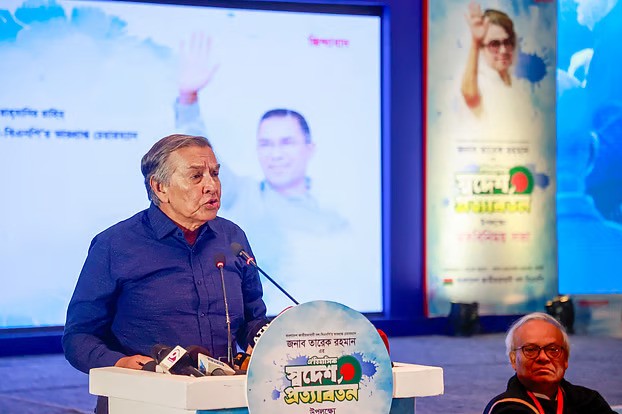
The July uprising came as a beacon of freedom, and it is towards freedom that we must march. Burning newspapers will not take us there. The uprising’s main theme was “anti-discrimination.” We want to make it The Daily Star’s main focus. The rich-poor gap has widened to a cruel and inhuman level. The AI revolution will further marginalise the poor unless we use this transformative technology for the opposite purpose. In universalising education, spreading skills, providing basic healthcare, and ensuring agricultural productivity and renewable energy, AI has tremendous potential to transform our society in ways that may seem like a fantasy at the moment. We must transform our thinking and recognise our population as our greatest asset. Each skilled individual with higher productivity can help turn Bangladesh into a prosperous country. AI can help us do that.
For that, we need to change our mindset—from seeing the poor as a liability to recognising them as an asset. We need to turn 180 degrees in our policy priorities.
It is in this technology-based and human resource-focused direction that The Daily Star feels convinced that our future lies, along with, of course, democracy and a free press. We have a new government and a leadership that is fresh and young. Will they show the innovation, courage, and determination that history has given them a rare opportunity to demonstrate?
Mahfuz Anam is the editor and publisher of The Daily Star.
Views expressed in this article are the author's own.
 For all latest news, follow The Daily Star's Google News channel.
 Follow The Daily Star Opinion on Facebook for the latest opinions, commentaries, and analyses by experts and professionals. To contribute your article or letter to The Daily Star Opinion, see our guidelines for submission.
Comments