


‘Even BNP is not beyond ICT’s reach if it commits crimes against humanity’


Minister for Law, Justice and Parliamentary Affairs Md Asaduzzaman, who previously served as the 17th attorney general during the interim government’s tenure, speaks with Baharam Khan of The Daily Star about the repeal of several key ordinances, the debate surrounding them, and other legal and legislative issues that have been in discussion of late.
Now that the National Human Rights Commission (NHRC) Ordinance has been repealed, and the 2009 act reinstated, what will happen to the current commission?

As soon as the repeal bill that was passed in parliament is enacted through the issuance of a gazette, the current commission will cease to exist. Until then, it remains operational.
Why didn’t you retain such a significant reform measure?
It’s not like it’s gone for good. The repeal and reinstatement bill that we introduced states that we will enact a law after further scrutiny and verification. This is not just an assurance; it’s a part of the bill, and thus creates a legal obligation.
Political governments often avoid enacting strict human rights laws. Couldn’t you have retained the ordinance instead of repealing it?
This ordinance was quite a hotchpotch. As per the ordinance, the NHRC can take cognisance of an abuse either suo motu or based on a complaint. The ordinance maintained two ways to go about the inquiry and investigation of an incident. While it specified a deadline for submitting an inquiry report, there was no timeframe for when that inquiry must actually begin. Once an inquiry finds preliminary evidence, it is sent for investigation. The ordinance failed to mention the timeframe for transferring the case from inquiry to investigation.
Furthermore, while the commission was given the power to impose a fine after a hearing between both parties, the basis and amount of that fine were not mentioned. Secondly, the commission could order compensation, but there were no guidelines on the specifics or amount of that compensation. Thirdly, the commission could provide legal advice to the victim. Fourthly, the commission itself could act as a plaintiff to file a case. What is the logic for a commission serving as a quasi-judicial body to become a plaintiff? What is the point of sitting with both parties for a hearing then?
Couldn’t you have passed the ordinance by addressing these and other limitations?
Like I said, we will conduct further scrutiny. The issue of enforced disappearance has been tagged here. The NHRC lacks the necessary capacity for investigation into such crimes. There is a provision for enforced disappearance in the International Crimes (Tribunals) Act. There is a dedicated, specialised investigation department for the International Crimes Tribunal (ICT).
You might argue that only widespread and systematic crimes of enforced disappearance would go there, but no such distinction was made in the ordinance for enforced disappearance.
These are but technical matters, and no law is above debate. Is it possible that the major issue here is political willingness?
No, that is not correct. We will fulfil our political commitments to the letter. How much vengeful politics have you seen in these few weeks of our tenure? Have there been any disappearances or crossfires? How many cases have been filed by BNP or the police as plaintiffs?
There have been custodial deaths. In the last four months, at least 40 people have died in custody.
We are looking into those cases. Most are related to medical issues. No incidents of torture have occurred.
During the Awami League era, medical issues were also cited as the cause for the deaths of many BNP leaders and activists. But even if we consider that to be the case, why has your government kept such sick people detained?
This is not a matter of us keeping them detained. You talk about the independence of the judiciary; here too, the judiciary is dealing with this independently. The detention has nothing to do with us.
Let’s get back to the ordinances. In an internal evaluation by the law ministry regarding the ordinances, we saw recommendations like requiring approval to arrest government employees or members of the forces, not granting financial powers to the chief justice, etc.
We will not take those into consideration when we go for consultations with stakeholders about the unpassed ordinances.
 For all latest news, follow The Daily Star's Google News channel.
 Does that mean those ordinances will be passed as they are?
That may not be the case. Something even better may come out of the consultation process once we start it.
How could it be made better?
I cannot say that right now. It can only be determined after the consultation.
The interim government also consulted with stakeholders. A foundation was already established.
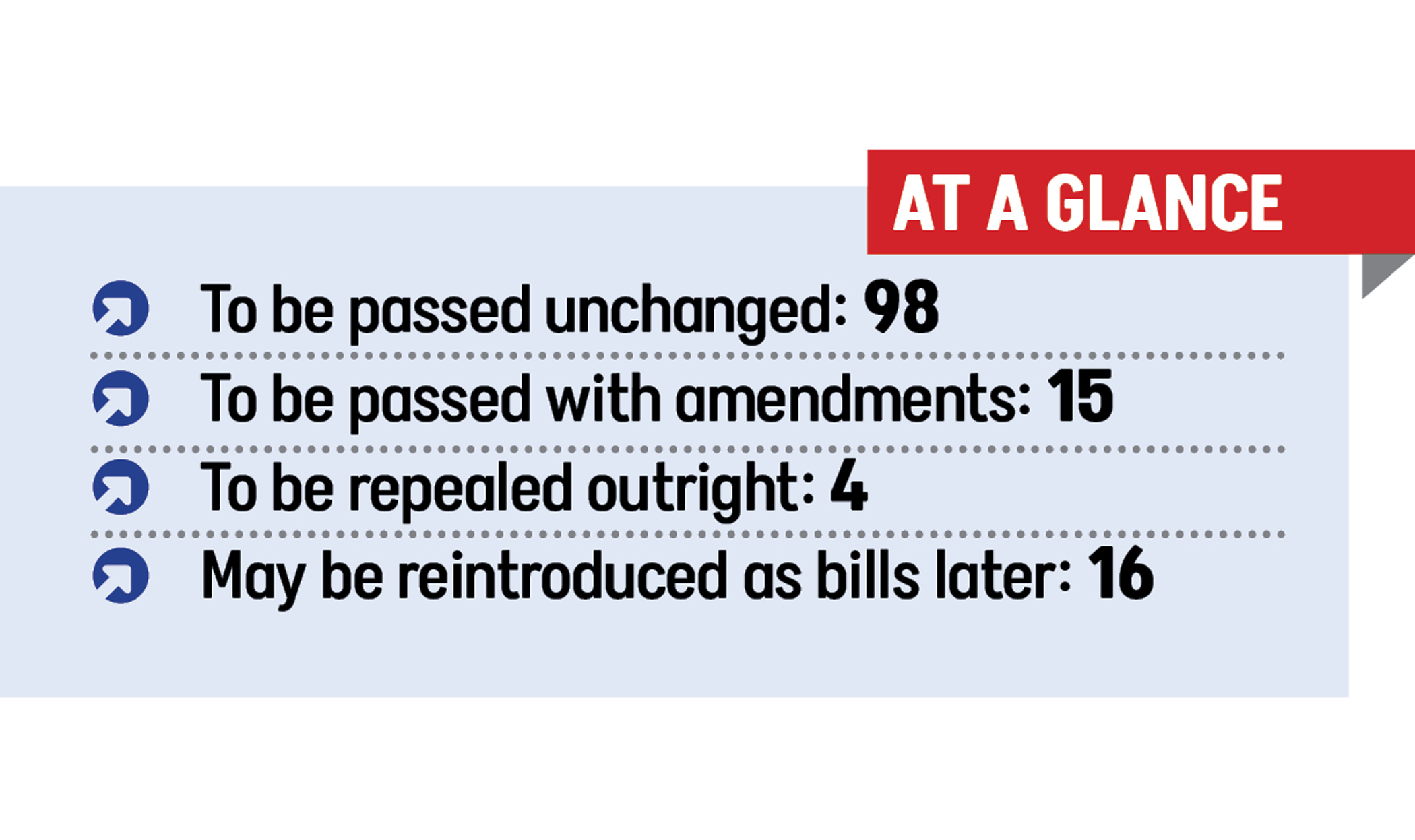
If you go back to the basics, there is no jurisprudential theory that says that an elected government or parliament must accept everything an interim government has done. We have accepted more than 100 out of their 133 ordinances. There is no rule that says all of them must be accepted.
In terms of numbers, this is undoubtedly notable. However, in terms of significance, some four or five ordinances are more important and in focus than the others.
Public policy is so deeply involved with those ordinances that the special committee of parliament and the parliament itself believed that further scrutiny is necessary.

Do you think the government has failed to shed enough light on its activities surrounding key ordinances to dispel misgivings about its reform commitment?
It’s also the responsibility of the media to clear up misconceptions. Take, for instance, the referendum, the July charter, and the July charter implementation order. If you try to present public perceptions regarding these three matters incorrectly, that’s your way of working. Our way is that we want to go by exactly what is stated in the July charter.
I don’t disagree that there is a debate surrounding the July charter implementation order.
Fraud was committed regarding the July charter implementation order. The order states that a bicameral parliament will be formed based on the proportion of votes received by parties in the national election. However, BNP gave a note of dissent on this very issue in Article 18 of the July charter. Not only that, a separate note was added to this article stating that if political parties or alliances gain a public mandate by mentioning it in their election manifestos, they can take measures accordingly. BNP is accepting almost everything related to the referendum, yet some people are alleging that we are going against the referendum ordinance.
Let’s get back to the discussion on the ordinance regarding enforced disappearances.
Defining the same crime (enforced disappearance) in two different ways in two laws has created ambiguity. “Widespread and systematic” disappearances were not mentioned separately in the ordinance for enforced disappearance. If someone facing trial at the ICT argues, “I can be tried under that other law (on enforced disappearances), so why am I being tried here?”, then what?
Secondly, regarding punishment, it mentioned life imprisonment or imprisonment not exceeding 10 years. Here, “or” is a disjunctive word. “Not exceeding 10 years” could mean a sentence as short as one hour. We are working to bring clarity to these areas of ambiguity.
Couldn’t you have brought these changes after passing the law?
If passed now, those currently under trial at the ICT would try to take advantage of this law. That would create new legal complications. We don’t want to leave room for such complexities.
But the ICT is not a court that is meant to last forever.
Why not? If even this government becomes involved in crimes against humanity, why shouldn’t there be a trial? The ICT law is perpetual unless it is repealed.
Does that mean the ICT will continue to function like a regular court indefinitely?
It is a tribunal. If there is a necessity, it will continue. If not, it won’t.
But don’t we need a specific law to address the issue of enforced disappearances?
Will disappearances continue forever?
People may have that fear.
We can bring back this law (ordinance) at any time. I believe we have clarified our position in this regard both inside and outside parliament. We have an MP whose husband was a victim of enforced disappearance; the home minister himself was a victim of disappearance. Is their pain any less?
Besides, this matter does not fall under the law ministry; it belongs to the home ministry. It is the home ministry that felt this issue requires further consultation with more stakeholders.
So, can we expect the law on enforced disappearances to be enacted in the next session of parliament?
After May 15, there will be discussions with stakeholders regarding the NHRC Act. Later, discussions on the enforced disappearance law will also take place.
Does that mean it is likely to be placed in the next session?
We will try.
What was the problem with passing the Supreme Court Judges’ Appointment Ordinance?
According to Article 95 of the constitution, the president appoints Supreme Court judges in consultation with the chief justice. The ordinance, however, mentions a council for appointments, which is not in the constitution. While the idea of the council is sound, we are considering how to make it consistent with the constitution. Nevertheless, we have safeguarded the activities conducted under that ordinance.
What is the government’s stance on the Supreme Court Secretariat?
Firstly, the ordinance was not aligned with the guidelines of the Masdar Hossain case. Secondly, the High Court has issued a certificate following the verdict on Article 116; so this will go before the Appellate Division. There is also the matter of discussing it with stakeholders. But we never said we wouldn’t establish this secretariat.
An adviser to the interim government told me that some lower court judges didn’t want a separate secretariat. Is that credible?
Yes. I have received such lobbying as well.
What kind of lobbying?
They believe that if a separate secretariat is formed, it will lead to greater subjugation rather than protecting the independence of the judiciary. This is because sometimes some retired Supreme Court judges lobby so extensively in some cases that if those requests are not met and some lower court judges face consequences as a result, they may have no place to place their grievances. Since the chief justice remains extremely busy with judicial work, some lower court judges fear they will not get a remedy if they face injustice. This is why further scrutiny is required.
That means the matter of complete judicial autonomy…
What do you mean by the complete independence of the judiciary? An independent judiciary does not mean that one organ of the state is completely separate from the others. Rather, it means that the judiciary functions independently in its judicial activities and decision-making. In other words, a judge should not be influenced in any way while carrying out judicial duties.
For this, appointments, promotions, postings, and disciplinary actions must be transparent, along with ensuring financial autonomy. At the same time, judges must have the confidence that they cannot be transferred, denied promotion, dismissed, or otherwise penalised simply for writing a judgment that the government may not like. Only then can a judge truly act independently.
Since 1975, the law ministry has not had the power to transfer even an assistant judge unilaterally.
Consultations take place though.
It’s not consultation; the government sends recommendations, and the Supreme Court makes the decision.
They want to carry out the process themselves. What is the problem with that?
The government will scrutinise before granting that.
Does that mean government interference will remain?
It is not a matter of interference. Supreme Court judges are completely independent; there is no risk of them losing their jobs.
Let’s talk about the Bank Resolution Act. Many stakeholders were surprised by the amendment allowing discredited owners of merging banks to reclaim ownership. Why was this necessary?
You would get a better answer from the finance ministry. However, from what I understand, there is currently no significant record of looted money being brought back to Bangladesh from abroad. Now, if someone wants to return by paying back the money, and we can recover it with interest, that is one aspect. But the law does not state that this will exempt them from any charge of crimes or corruption.
In other words, there is no guarantee of asset recovery even after spending years in foreign tribunals and incurring huge costs, and in that context, this provision creates a scope for recovering the looted money. The media should look at this objectively rather than being influenced by unnecessary fear or rumours.
Has the government received any such assurance or application?
I am not aware of any.
Let’s talk about the individuals who have been in detention without trial after being arrested during the interim government’s tenure. Will they remain in custody indefinitely?
In this regard, the concerned individuals can take advantage of Section 173A of the Code of Criminal Procedure. If the victims provide sufficient evidence to the concerned metropolitan police commissioner or the superintendent of police at the district level regarding harassment, they can investigate and provide relief through an interim final report. To my knowledge, many are receiving remedy this way.
But bail is hardly granted if the government raises an objection in court.
We perform our duties as usual and as necessary; the matter of bail is for the court to decide.
There is criticism regarding many cases filed in the post-uprising period. What is your comment on that?
Victims must seek remedy according to the Code of Criminal Procedure. A committee is already scrutinising false and harassing cases. Another committee is working under the leadership of deputy commissioners.
Recently, we saw the arrest and swift bail of former Speaker Shirin Sharmin Chaudhury. Could this have been possible without the government’s consent?
There is no issue of government consent here. There is no obligation to arrest someone just because their name appears in an FIR; it is entirely a matter of the investigation officer’s discretion. It is up to those who made the arrest and those who granted the bail.
Will people believe that a leader like the former speaker secured bail without the government’s consent? Many journalists have also been arrested in similar cases.
The investigation officer likely did not find sufficient grounds to keep her under arrest or show her arrested in other cases.
Can the government not take action regarding other similar cases as well?
This is for the home ministry to answer.
You are the law minister, and it is a matter of law.
Investigation officers are not under the jurisdiction of the law ministry.
A final question. The interim government talked about forming a reconciliation commission but never followed through with it. Are you going to consider it?
A truth and reconciliation commission is a major policy decision. If such a discussion ever comes before me, I will try to play a role. I think it is a good option.
Has there been any discussion on this within the government?
Not yet.
Follow The Daily Star Opinion on Facebook for the latest opinions, commentaries, and analyses by experts and professionals. To contribute your article or letter to The Daily Star Opinion, see our guidelines for submission.
Comments