


The IB Diploma Programme: Preparing global citizens
Today, the purpose of education is no longer limited to mastering content. It lies in preparing young people to think critically, act ethically and engage meaningfully with the challenges of their time. The International Baccalaureate (IB) Diploma Programme (DP), designed for students aged 16 to 19, reflects this shift by combining academic rigour with opportunities for reflection, research and real-world engagement.
Research supports the impact of this approach. Studies by the IB indicate that DP students demonstrate stronger skills in critical thinking and evidence-based reasoning compared to peers in other curricula (IBO, 2019). University faculty surveys further suggest that IB graduates are well prepared for higher education, particularly in research, writing and independent inquiry (IBO, 2021). Additionally, longitudinal studies show that DP students are more likely to complete university degrees within the expected timeframe, reflecting the resilience and self-management skills developed through the programme (IBO, 2020).

Universities worldwide regard the DP as a benchmark for academic readiness and holistic development, with over 4,500 institutions recognising its rigour and value in admissions processes (IBO, 2023). This recognition reflects the programme’s emphasis not only on academic achievement, but also on the development of independent thinking and responsible action.
The DP core: engine of inquiry
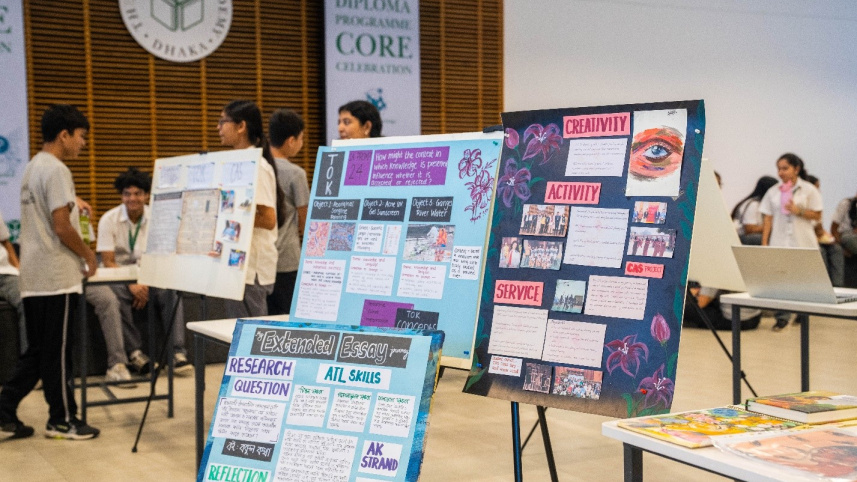
The DP is structured around a broad and balanced curriculum. Students study six subjects across languages, sciences, mathematics, humanities and the arts, while also completing a central “core” that develops skills beyond disciplinary boundaries. The core is made up of three components: the extended essay (EE), theory of knowledge (TOK) and creativity, activity, service (CAS). Each element contributes to shaping students as independent thinkers and responsible individuals.
This combination ensures both depth of knowledge and the ability to make connections across fields – an essential quality in addressing complex real-world issues.
Research rigour through the EE
The EE is a 4,000-word independent research project, completed over several months under teacher supervision. Students select a topic of personal interest, formulate a research question and engage in structured investigation and analysis. The assessment criteria focus on the clarity of the question, depth of research, use of evidence and reflection on the process.
Students choose their own topic and question and can explore issues closely connected to their local context through a wider range of disciplinary lenses. In the humanities and social sciences, students examine topics such as inflation and central bank policy, labour conditions in tea estates, the impact of the refugee movement on national sovereignty, and the role of exports in shaping the country’s economy.
In language and literature, students investigate how Bengali texts illuminate themes of rural life, social hierarchy, cultural identity and resilience. Others explore representations of the 1971 Liberation War through drama and literature, examining questions of national identity, memory and justice.
In the sciences, students investigate renewable energy, public health, environmental sustainability and scientific innovation, connecting scientific understanding with challenges relevant to local communities. Through these enquiries, students move beyond textbooks to engage with real-world questions, developing habits of evidence-based thinking, cultural understanding and ethical reflection that are essential for responsible decision-making.
Critical thinking through TOK
TOK invites students to reflect on how knowledge is constructed and evaluated across different areas. Students are assessed through an exhibition, where they connect real-world objects to questions about knowledge and write an essay that explores prescribed philosophical questions.
For example, within the unit on knowledge and religion, students participate in panel discussions that bring together individuals from different faith traditions and belief systems. These conversations move beyond abstract theory, creating space for students to engage directly with how belief, culture and lived experience shape perspectives on truth, ethics and knowledge.
In Bangladesh’s context, where diverse identities and traditions coexist, these dialogues become particularly meaningful. Students are challenged not only to ask questions, but also to listen with care, recognise bias and navigate differing viewpoints with respect.
Through such experiences, they begin to understand that ethical leadership is not about certainty, but about judgment – grounded in empathy, openness and the ability to engage constructively across difference.
Empathy and leadership through CAS
CAS extends learning beyond academics. CAS engagement is encouraged through sustained participation, reflection and evidence of involvement over time. Students engage in creative pursuits, physical activity and service initiatives, documenting their growth and learning.
Students demonstrate strong engagement with their communities. For example, they might support younger learners through teaching initiatives in science, language, debate and sports, contributing to educational access and peer development. Others might work with organisations such as the Bangladesh Rural Advancement Committee (BRAC), Bangladesh Cancer Aid Trust, and other student-led initiatives, gaining insight into issues of public health, policy and social development.
Research shows that such engagement strengthens collaboration, problem-solving and students’ sense of agency in real-world contexts (IBO, 2022). Environmental awareness also emerges as a key focus, with students participating in sustainability initiatives and climate-related dialogue. These experiences help them understand that leadership is grounded in responsibility and service, not simply achievement.
 For all latest news, follow The Daily Star's Google News channel.
 Learning beyond the classroom
Teachers create opportunities that help students connect classroom learning with real-world challenges, develop practical skills and reflect on the broader impact of their decisions.
The Collaborative Sciences Project (CSP), for instance, focuses on topics such as sustainability through the lens of building a more environmentally responsible and zero-waste campus. Students work across different areas of science to investigate waste patterns, explore solutions and propose actionable changes. Through this process, they engage in inquiry, collaboration and problem-solving, recognising how scientific understanding can contribute to addressing environmental challenges within their immediate context.
Student-led entrepreneurship programmes are also a key part of the learning experience. They provide students with opportunities to engage with entrepreneurship, economic decision-making and organisational thinking through simulations and collaborative challenges. Students analyse real-world scenarios, develop strategies and present their ideas, while also considering the ethical implications of business decisions. Such experiences help them understand that innovation must be balanced with responsibility and long-term sustainability.
Learning extends further through internships in sectors such as energy and finance, visits to climate centres, and engagement with alumni who share insights into professional pathways and real-world challenges. These experiences provide valuable exposure to industry practices and decision-making environments, helping students see the relevance of their learning beyond school.
Creative engagement also forms an important part of this process. Through performances, students explore themes of justice, authority and moral responsibility, reflecting on how these ideas continue to shape contemporary societies.
From knowledge to responsibility
Together, these experiences reflect a broader shift in education – from learning about the world to engaging with it. Students begin to recognise that knowledge carries responsibility: that scientific understanding must consider sustainability, economic decisions affect communities, and cultural awareness is essential for dialogue and cohesion.
In this way, the DP prepares students not only for university, but for life beyond it. They learn to move from asking, “What do I know?” to “Why does it matter?” and ultimately, “How can I use it to make a difference?”.
In a rapidly changing world, the most important skill is the ability to continue learning. The strength of the DP lies in nurturing this mindset – equipping young people with the curiosity, integrity and sense of responsibility needed to contribute thoughtfully to their communities and the world.
Comments