


Financial sector saved from edge of collapse: Finance adviser
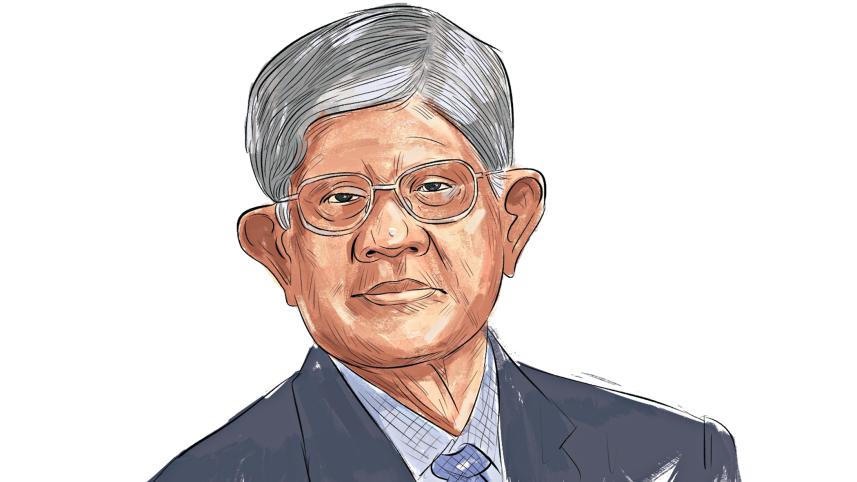
Steps taken over the past year helped steer the financial sector back towards stability from the edge of collapse, said Finance Adviser Salehuddin Ahmed yesterday.
He, however, acknowledged that a full transformation has not yet come about and that more time was needed.
 For all latest news, follow The Daily Star's Google News channel.
 The past Awami League-led government had pushed the country's financial sector into such a deep, almost unimaginable crisis, he told a discussion at the Bangladesh Bank (BB) headquarters marking last year's July uprising day.
Ahmed, also a former BB governor, said financial reforms take time and corruption and mismanagement were deeply rooted in institutions, processes, and individuals within the financial sector.
"However, there are some honest and capable people, and we are trying to carry out reforms through them," he said.
"It would not be wrong to say that we have already moved from the ICU to a cabin, and now from the cabin to home," he added.
Ahmed said the BB's role has been crucial in restoring stability in the financial sector.
"We are here only for a short time, to lay down a roadmap. The next government will follow that path and fully help the economy recover," he said.
"We will not forget the sacrifices of the July martyrs. The aspirations of August 5 will be realised in the financial sector," said BB Governor Ahsan H Mansur, urging the finance ministry to extend full cooperation.
"We seek the cooperation of every official in bringing qualitative change to the banking sector. Ensuring depositors' safety will be the first priority," he said.
He said a new bank company act was being drafted to restructure the financial sector.
The draft has already been sent to the finance ministry. Once the law is passed, the banking sector will return to a defined track and there will be no recurrence of fascism in the future, he said.
Earlier in the day, at a seminar at the National Board of Revenue headquarters in Dhaka, the finance adviser urged all, especially young economists, to develop the "inner sight" on how the government functions from within.
"Many junior economists nowadays apparently don't see anything (good). I know all of them. I've been teaching since the 1970s. They're all my students," he said.
"To see, one needs vision. One requires inner sight. If someone doesn't want to see, they won't be able to," he added.
The seminar was organised by the NBR to highlight recent changes brought about in income tax, VAT, and customs regulations through the current fiscal year's budget, as well as to inaugurate e-return submissions for the current tax year.
Speaking at the event, the adviser acknowledged that the government makes mistakes. "We make many mistakes, and that's okay. But it feels good when good initiatives are encouraged. Constructive criticism is always welcome."
Noting that everyone has the freedom to speak, the adviser called on to see the progress as well, instead of just the lackings. "Don't just look at the empty part of the glass, see that it is also half full."
The adviser also spoke stated that the NBR has made it mandatory for individual taxpayers to submit their income tax returns online.
However, this rule does not apply to those aged 65 or above, individuals who are physically unfit, or Bangladeshi taxpayers residing abroad.
"I'm over 65 years old, so maybe I'll get a bit of tax exemption," Ahmed said, calling for the online tax return process to be made more user-friendly.
Economic Reporters Forum President Doulot Akter Mala also spoke at the programme.


Comments