


GDP growth slows to 3% as industrial output shrinks


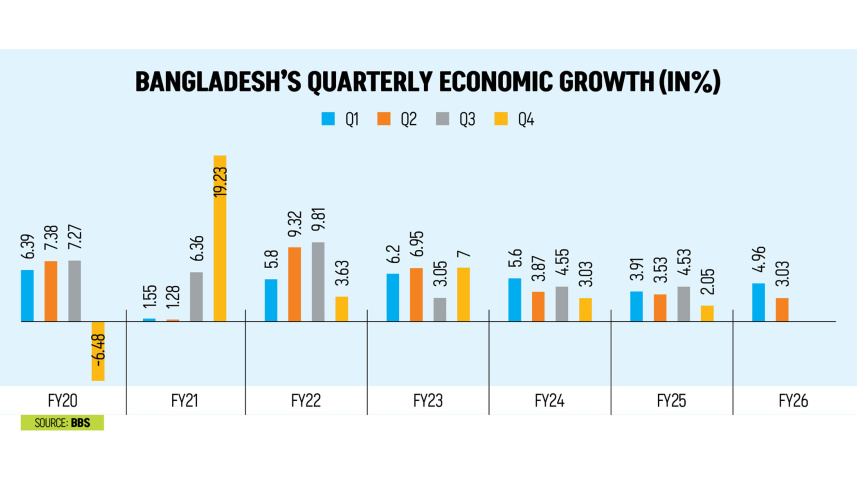
The country’s economic growth slowed in the second quarter of fiscal year 2025-26 as a sharp fall in industrial activity dragged down overall output, according to provisional data from the Bangladesh Bureau of Statistics (BBS).
The economy expanded 3.03 percent in the October-December quarter, down from 3.53 percent a year earlier, with industrial growth slipping to just 1.27 percent from 5.78 percent in the same period last year.

It was the slowest second-quarter expansion since FY21, when growth fell to 1.28 percent during the Covid-19 disruption.
Earlier in the fiscal year, the revised growth figure for the first quarter stood at 4.96 percent, compared with 3.91 percent in the corresponding quarter of FY25, showing that the slowdown has gathered pace as the year progressed.
At current prices, the size of the economy reached Tk 15,17,615 crore in the October-December quarter of FY26, up from Tk 13,90,147 crore in the same period a year earlier.
Zahid Hussain, former lead economist at the World Bank’s Dhaka office, said weak exports, energy constraints and political uncertainty weighed on production.
Besides, reciprocal tariffs imposed by the Trump administration affected global trade flows, hurting export-oriented manufacturing.
According to the economist, domestic disruptions like frequent street protests and demonstrations further dented output, especially in energy-intensive sectors such as ceramics.
“Manufacturing investment and production are usually slow in periods of political uncertainty,” Hussain added.
In the October-December quarter, agriculture grew 3.68 percent, up from 1.90 percent in the corresponding quarter a year earlier.
Favourable weather supported Aman rice production this year, compared to last year when flooding in parts of Noakhali region disrupted output, he said.
The services sector expanded 4.45 percent, compared with 3.48 percent in the same quarter of the previous fiscal year.
Although higher year-on-year, Hussain said that growth in the service sector usually remains above 5 percent.
According to the economist, poor law and order conditions weighed on service activities.
Mustafa K Mujeri, executive director of the Institute for Inclusive Finance and Development (InM) and former chief economist of the Bangladesh Bank, said growth has remained weak since the economic fallout from the Russia-Ukraine war.
He said the slowdown deepened in the latest quarter as both public and private spending tightened ahead of national elections in February.
Usually, the government scales back annual development programme (ADP) spending before elections, while private investors adopt a wait-and-see approach, he said.
Remittance earnings rose about 20 percent year-on-year to $8.67 billion in the second quarter, according to Bangladesh Bank data.
However, economists said the inflows have yet to translate into stronger overall growth.
Mujeri said the current quarter shows little sign of a strong rebound, citing the ongoing war in the Middle East and the risk of higher fuel prices disrupting production across sectors.
 For all latest news, follow The Daily Star's Google News channel.
 Multilateral lenders, however, expect some recovery over the full fiscal year.
The World Bank has projected the economy will expand by 4.6 percent in this fiscal year ending June 2026, despite persistent inflation, falling exports and sluggish investment.
The International Monetary Fund (IMF) expects growth to reach 4.9 percent in FY2025-26.
Comments