


Ecnec scraps one project, sends back another
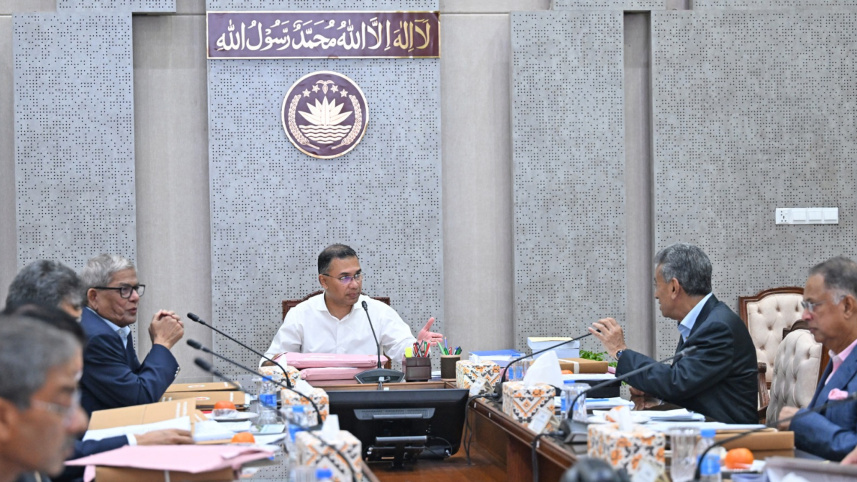
The new Executive Committee of the National Economic Council (Ecnec), chaired by Prime Minister Tarique Rahman, yesterday scrapped one development project and sent back another, which is located in the PM’s home district of Bogura, for cost review.
According to meeting sources, of a total 19 projects placed before the body, only seven were taken up for detailed discussion, with the remaining deemed too questionable for a cursory review. Five revised projects were approved.

At the meeting, a Tk 1,122 crore proposal to develop the Karatoya river system was sent back. The project had reportedly been placed at the top of the agenda partly because it falls within the prime minister’s home district, said sources.
Rahman questioned why land acquisition alone accounted for more than Tk 500 crore of the budget for a river excavation project, and made clear that geographic or political proximity to his office would carry no weight in approval decisions.
“No project will be approved simply because it is linked to a particular region,” he said, according to sources familiar with the meeting. The project was sent back for a full cost review.
A second project -- the Participatory Rural Development Project Phase-4 -- was scrapped outright, the committee having found no adequate justification for its implementation.
In addition to the two rejections, the meeting established a review committee, to be led by Rashed Al Mahmud Titumir, the prime minister’s finance and planning adviser, to assess all projects under the Annual Development Programme. The committee will examine the feasibility and economic rationale of each project, with authority to recommend cancellation, revision, or continuation.
Finance Minister Amir Khosru Mahmud Chowdhury, speaking at a post-meeting briefing, framed the session as the beginning of a systematic effort to clear a backlog of poorly justified public spending.
“We are currently going through what is effectively a backlog clearance process -- filtering out weaker proposals while advancing those deemed sound,” he said. “Once this clean-up phase is complete, the remaining legacy projects will be resolved in a phased manner.”
Meanwhile, Titumir, speaking about the review committee, said many projects had been approved without proper economic studies, with costs repeatedly inflated and returns consistently limited.
He called for a more accountable Annual Development Programme (ADP), noting that public capital expenditure had not kept pace with operating expenditure, with consequences for growth. “Projects will be evaluated on necessity, quality of surveys, cost control and long-term sustainability.”
The five approved projects saw a combined cost increase of Tk 483.43 crore in their revised estimates, of which Tk 390.84 crore will be financed from state funds and Tk 92.59 crore from project loans.
Among the schemes, the General Social Infrastructure Development Project-2 (GSIDP-2), being implemented by the Local Government Engineering Department, has been revised with its cost rising to Tk 1,450 crore and a new completion deadline set for June 2027.
The meeting also decided to increase the cost of the IT Training and Incubation Centre project to Tk 533.55 crore, with the timeline extended to June 2026. Besides, it revised a project to modernise diagnostic imaging facilities at eight divisional medical college hospitals, approving Tk 1,213.71 crore as cost and June 2028 as new deadline.
The meeting also approved the second revision of the Gopalganj Dental College and Hospital project, raising its cost to Tk 139.31 crore, with a target completion date of June 2026.
In contrast, the cost of the Char Development and Settlement Project-4 (CDSP-4) has been reduced to Tk 30.72 crore.
 For all latest news, follow The Daily Star's Google News channel.
Comments