


When reform becomes more power, less accountability

With the parliamentary politics once again becoming vibrant and engaging, a clear fault line is gradually emerging between the ruling party, BNP, and the opposition, Jamaat-e-Islami (JI). Not too long ago, these two parties were political allies—both in government and in opposition—jointly leading street movements against the rise of authoritarian rule under Sheikh Hasina and her Awami League. Their eventual split largely stemmed from a redrawing of the country’s political landscape following the uprising against Hasina’s dictatorial regime, which ultimately consigned her party to political irrelevance.
Both parties have been victims of egregious abuses of power, including the criminalisation of state institutions under Hasina’s rule. They endured severe persecution—enforced disappearances, extrajudicial killings, arbitrary arrests, fabricated charges, prolonged detention without trial, and brutal physical violence. At one point, their political futures appeared nearly extinguished due to the judiciary’s partisan alignment with the executive. In response, both parties championed sweeping reforms in governance and key state institutions, particularly the judiciary, security apparatus, and law enforcement, with a shared commitment to accountability and the rule of law.

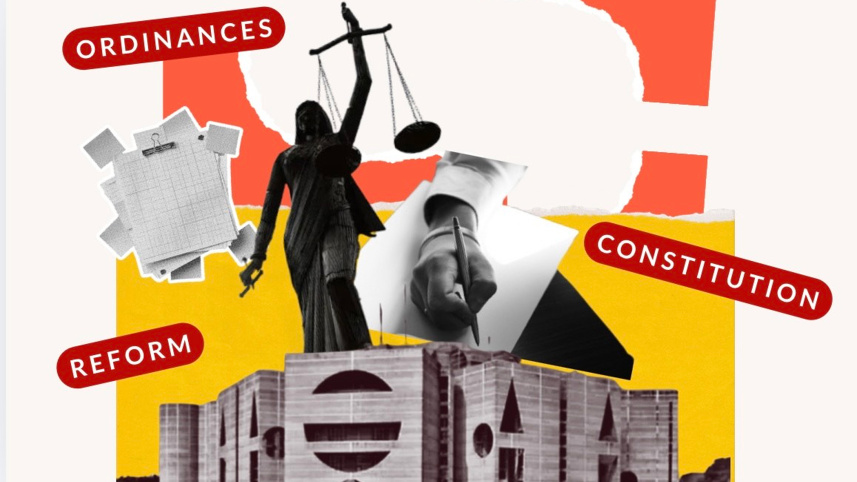
In the newly redrawn political landscape, both parties continue to profess support for fundamental reforms, though their interpretations diverge significantly. The reform process initiated by the interim government led by Professor Yunus—through 11 thematic commissions and a National Consensus Commission—resulted in the July National Charter as well as 133 ordinances aimed at overhauling governance and state institutions. Subsequently, the newly elected Jatiya Sangshad formed a parliamentary committee that recommended legal validation of 98 of these ordinances without amendment. At first glance, such broad agreement might suggest an impressive level of political consensus.
A closer examination, however, reveals a far more troubling picture. The 13-member parliamentary committee also proposed that 15 ordinances be introduced in amended form, while 16 others should be deferred for further revision rather than presented as bills now. Most strikingly, the committee recommended scrapping four ordinances outright, three of which relate to judicial reforms widely considered essential for ensuring judicial independence. Reactions from the opposition alliance led by JI, as well as from prominent non-partisan civil society actors and rights groups, suggest that these decisions represent a significant step backward.
The committee report includes notes of dissent from opposition members but none from those on the treasury bench. Three opposition MPs formally objected to 12 ordinances. These dynamics point to a disturbing pattern: rather than exercising independent judgment, many lawmakers appear to have adhered strictly to party directives. Notably, the report omits mention of a ruling party MP who submitted a detailed letter opposing the decision to let certain ordinances lapse or be discarded. This raises concerns that Article 70 of the constitution—which restricts MPs from voting against party lines—is already being enforced, despite prior commitments by all parliamentary parties to limit the application of Article 70 to confidence votes and finance bills.
A review of the ordinances slated for approval, revision, or rejection suggests that the ruling BNP may be prioritising consolidation of power over accountability, contradicting its own 31-point reform agenda. Among the 98 ordinances likely to pass unchanged are provisions that expand executive authority, including powers to remove elected local government officials and discipline civil servants. Given Bangladesh’s history of partisan interference in local governance, retaining such provisions risks replacing elected representatives with politically loyal administrators—an outcome that diverges sharply from BNP’s stated commitments and undermines recommendations from the Local Government Reform Commission. Many of the remaining ordinances are administrative in nature and carry limited political significance.
The most contentious recommendation, however, is the decision to scrap three ordinances related to judicial independence, particularly those concerning judicial appointments and the establishment of a separate secretariat for the Supreme Court. These moves effectively revive earlier practices that allowed significant executive influence over judicial appointments and the lower judiciary. This is especially striking given that many senior BNP leaders, including Tarique Rahman and Khaleda Zia, have themselves suffered from what many describe as the weaponisation of the judiciary under the previous regime. There are also suggestions that elements within the bureaucracy have resisted the creation of an independent judicial secretariat—claims that the government should address transparently to justify its position.
Equally concerning is the apparent retreat from efforts to strengthen institutional accountability. The parliamentary committee’s recommendation to defer (meaning allowing to lapse) 16 ordinances includes key legislation such as reforms to the National Human Rights Commission (NHRC). Allowing this ordinance to lapse could effectively dismantle the current NHRC, which has arguably the potential to be the most effective in the country’s history, as its members include experts who have investigated over 1,500 cases of enforced disappearance while leading a different probe commission. Reports indicate resistance from security agencies and bureaucratic actors to empowering the NHRC, particularly regarding its authority to investigate abuses and operate independently.
It is particularly troubling that a party with a significant number of victims of enforced disappearances now appears to accept national security justifications for limiting oversight. Such a position not only contradicts the spirit of the July mass uprising but also undermines fundamental human rights obligations. Mere pledges by the BNP to bring back these legislations with improved and stronger safeguards are least assuring, as such revisions could have been made during the ongoing process of validating other ordinances.
The opposition JI members of the committee are not without fault. Their revisionist proposals—particularly the suggestion to remove references to Jamaat-e-Islami, Muslim League, and Nezam-e-Islami as collaborators with Pakistani forces from the ordinance on Muktijoddha Council —are deeply problematic. This effort to sanitise historical wrongdoing avoids necessary accountability and reconciliation. A more responsible approach would involve acknowledging past actions and offering a formal apology. How JI’s allies, especially the NCP, a party born out of the uprising and led by its youth leaders, respond to such revisionist tendencies remains to be seen.
Kamal Ahmed is consulting editor at The Daily Star. He led the Media Reform Commission under the immediate past interim government. His X handle is @ahmedka1.
Views expressed in this article are the author's own.
Follow The Daily Star Opinion on Facebook for the latest opinions, commentaries, and analyses by experts and professionals. To contribute your article or letter to The Daily Star Opinion, see our guidelines for submission.
 For all latest news, follow The Daily Star's Google News channel.
Comments