


FDI growth masks slowdown in fresh capital inflow

Bangladesh’s net foreign direct investment witnessed a sharp 39 percent increase in 2025, reaching $1.77 billion, according to central bank data.
The growth, however, was driven almost entirely by existing foreign firms, not new investors entering the market.

Bangladesh Bank (BB) data shows that net FDI stood at $1.27 billion in 2024.
Meanwhile, net equity inflows, the most direct measure of new investment, stood at $554.63 million last year, barely changing from $544.63 million a year earlier.
The increase in overall FDI instead came from reinvested earnings, which rose to $781.67 million from $621.96 million, and from intra-company loans, which surged more than fourfold to $434.11 million. Both reflect existing companies financing their local operations rather than fresh capital coming in.
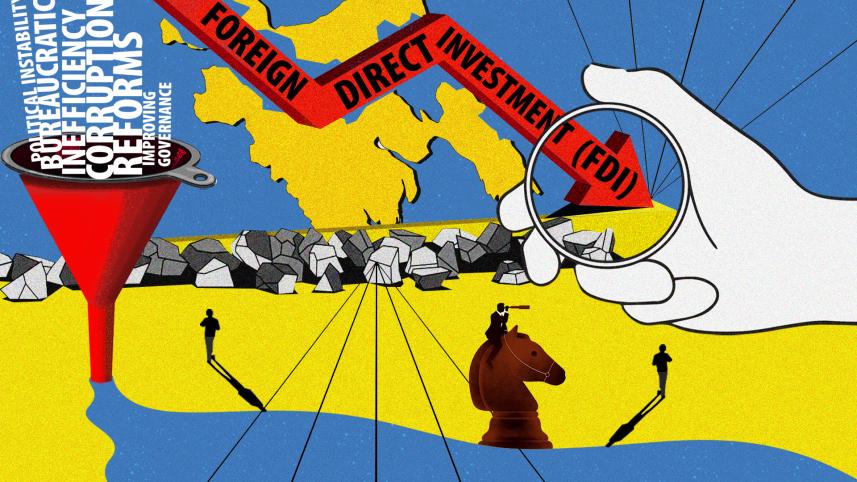
Economists say despite the growth in 2025, the net FDI inflow remains insignificant relative to the size of the economy, particularly in terms of fresh investment. Data indicates that the country is struggling to attract new investors or major expansion projects. In a healthy FDI environment, rising net inflows are typically accompanied by strong equity growth, signalling new projects, job creation, and technology transfer.
Mohammad Abdur Razzaque, chairman of the Research and Policy Integration for Development, said equity inflows have been persistently low for some time.
“Equity investment is very low, which suggests that new investors are not coming. What we are seeing is largely expansion by existing investors,” he said, attributing the weak equity inflows to broader macroeconomic vulnerabilities and an unfavourable investment climate.
The economist also questioned the gap between official claims and actual outcomes, saying that while the Bangladesh Investment Development Authority (Bida) continues to highlight investment prospects, the ground reality does not reflect strong or meaningful inflows.
Rupali Chowdhury, president of the Foreign Investors’ Chamber of Commerce & Industry, pointed to several factors behind the weak inflows.
According to her, the shift to an interim administration, from mid-2024 till February this year, has created uncertainty around long-term investment decisions. In addition, delays in government-backed projects have raised concerns about policy continuity and contract enforcement.
Furthermore, she said episodes of social unrest and “mob culture” have damaged Bangladesh’s image among foreign investors.
A broader global slowdown has also made investors more cautious, with capital flowing to more stable and predictable destinations.
To attract fresh FDI, she stressed the need for consistent policies, respect for contracts, improved infrastructure, and above all, political and social stability.
Khondker Golam Moazzem, research director at the Centre for Policy Dialogue, meanwhile, pointed out that Bangladesh’s FDI inflows remain subdued, with limited signs of strong growth compared with regional peers such as India.
He said a major concern is the composition of inflows. “Intra-company loans have risen sharply, but these largely reflect financing by parent companies to existing operations, not fresh investment.”
 For all latest news, follow The Daily Star's Google News channel.
 He added, “Greenfield investors continue to face hurdles, including complex licensing requirements, delays in opening bank accounts, land acquisition difficulties, and slow approvals.”
FDI also remains concentrated in traditional sectors, he said, while weak intellectual property enforcement and regulatory gaps have kept investment out of non-traditional, export-oriented industries.
In a similar tone, M Masrur Reaz, chairman and CEO of the Policy Exchange of Bangladesh, noted that equity accounts for only around a third of total FDI. “This composition is not encouraging for job creation or economic diversification, even though net FDI recorded strong growth in 2025.”
Comments