


Net FDI outflows soar as local firms eye global markets
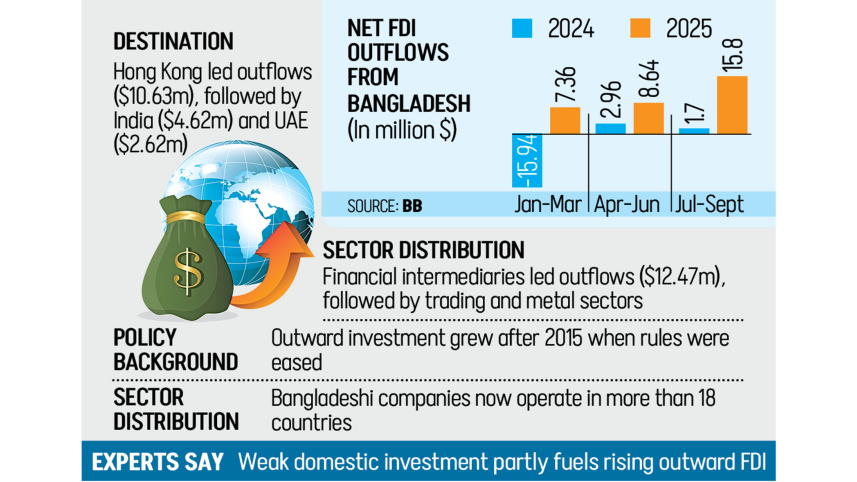
Bangladeshi companies are increasingly investing abroad, with net foreign direct investment (FDI) outflows soaring more than ninefold in the July-September quarter of 2025 compared with the same period the year before.
According to Bangladesh Bank data, net outflows reached $15.80 million during the quarter, up from $1.70 million a year earlier, reflecting a growing outward-looking investment trend.

Total outward flows (or gross outward flows) rose to $31.99 million in the quarter, compared with $17.11 million a year earlier.
Meanwhile, inflows increased slightly to $16.20 million from $15.41 million, widening the overall net outflow.
Between July and September 2025, Bangladeshi companies sent more money abroad than they received. Equity capital -- ownership stakes in foreign companies -- saw a net outflow of $2.23 million.
Reinvested profits also posted a net outflow of $4.12 million, while intra-company loans -- funds moved between parent firms and subsidiaries -- accounted for a net outflow of $9.45 million.
By contrast, the same period in 2024 saw only $1.19 million leave as equity, while $9.23 million in reinvested profits and $8.72 million in intra-company loans came into the country.
Country-wise, Hong Kong SAR of China received the largest share of net outflows at $10.63 million. India followed with $4.62 million, and the United Arab Emirates received $2.62 million.
Smaller amounts went to Singapore, Kenya, South Africa, Ireland, Italy, and the Maldives, while other countries recorded a net outflow of $3.68 million.
By sector, financial intermediaries sent the most money abroad with $12.47 million in net outflows, followed by trading ($3.53 million) and metal and machinery products ($0.21 million).
Mining and quarrying, and chemicals and pharmaceuticals each had tiny outflows of $0.01 million, textiles and clothing $0.11 million, and other manufacturing $0.27 million.
FIRMS SEEK OPPORTUNITIES ABROAD
The trend reflects companies’ growing interest in overseas markets through equity stakes and intra-company lending. The push began after 2015, when the government revised the Foreign Exchange Regulation Act, allowing firms to invest abroad under certain conditions, especially to promote exports. Since then, Bangladeshi companies have expanded into over 18 countries across Asia, Africa, and Europe.
Muhammad Zahangir Alam, chief financial officer of Square Pharmaceuticals Ltd, said the company invested $75 million in 2022 to build a manufacturing plant in Kenya.
The plant supplies medicines across East Africa, including Kenya, Tanzania, Rwanda, Burundi, Uganda, and South Sudan, where most medicines are still imported.
Currently, Square sells about $8 million worth of medicines each year from its Kenya plant, and it is expected to rise to $10 million soon, Alam said.
He added that investing abroad helps the company earn profits without relying solely on exports from Bangladesh.
Square Pharmaceuticals has also been approved by the US Food and Drug Administration, opening the door for further global investments.
“We are also aiming at the ASEAN market, where about 70 percent of medicines are imported,” Alam said, adding the company is considering investments in Malaysia and the Philippines.
Bangladesh Steel Re-Rolling Mills Ltd (BSRM) has also expanded abroad. The company got approval from the Bangladesh Bank to invest $500,000 to increase the capital of its existing subsidiary in Hong Kong.
 For all latest news, follow The Daily Star's Google News channel.
 Shekhar Ranjan Kar, company secretary of BSRM Steels Ltd, said the subsidiary mainly helps with sourcing raw materials, not manufacturing.
Set up two to three years ago, the trading office finds and buys quality scrap from countries like China and Hong Kong and supplies it to Bangladesh. The office runs with a small team of three to four staff members, he added.
Selim Raihan, executive director of the South Asian Network on Economic Modelling, said the rise in outward investment may partly be due to a weak domestic investment environment. Indicators like private sector credit growth show that local investment is still low.
He added that the total amount of outward FDI is still small and unlikely to affect the overall economy. Many investments are approved individually and are often driven by specific opportunities abroad.
Raihan said instead of worrying about money leaving the country, policymakers should focus on improving the local investment climate.
Boosting investor confidence, strengthening law and order, reducing business costs, and managing global uncertainties -- such as tensions in the Middle East and fluctuating oil prices -- will be key to encouraging investment in Bangladesh, he added.
Comments