


Prioritise energy security as war fallout weighs on economy
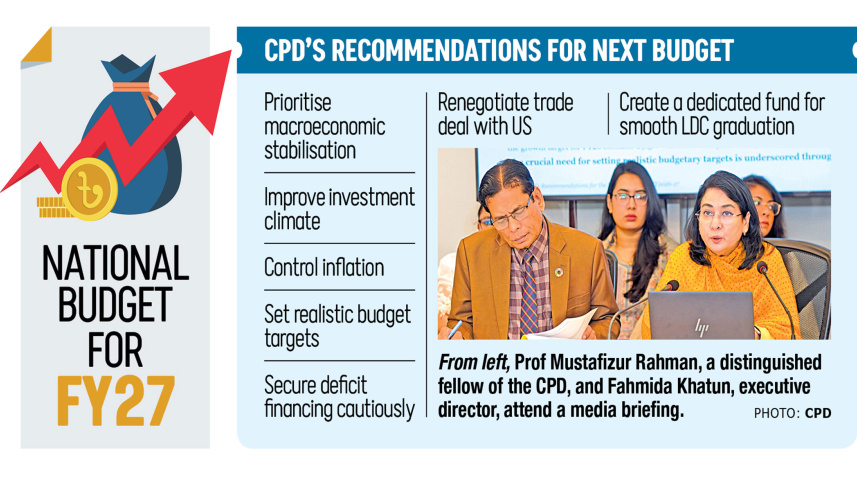
The country’s heavy reliance on imported energy from the Middle East, especially liquefied natural gas (LNG) and crude oil, has left the economy exposed to global price shocks and supply disruptions as the US-Israel’s war on Iran intensifies, according to the Centre for Policy Dialogue (CPD).
The think tank said the next national budget by the new government is being developed under these economic challenges. It urged the government to prioritise energy security in the new budget and gradually move towards greater domestic self-sufficiency.

Speaking at a media briefing at its Dhaka office on recommendations for the national budget for fiscal year 2026-2027, CPD urged policymakers to focus on restoring macroeconomic stability, stimulating investment and strengthening revenue mobilisation.
“The economy faces multiple pressures, including high inflation, low revenue collection, slow budget execution, a heavy debt burden, low investment, declining employment, a weak financial sector and declining export growth,” said Fahmida Khatun, executive director of CPD.
While presenting the paper, she said that rising global energy prices driven by instability in the Middle East are clouding Bangladesh’s inflation outlook further. Higher fuel costs are also pushing up prices of essential commodities such as edible oil, wheat and sugar.
Prof Mustafizur Rahman, a distinguished fellow of CPD, pointed to another vulnerability. He said Bangladesh does not have permanent strategic reserves of fuel oil, unlike several neighbouring countries.
Rahman urged the government to develop such reserves under a medium-term plan to reassure markets and prevent panic buying during periods of global volatility.
At the programme, CPD also highlighted deep financial strain in the energy sector, where mounting losses and heavy dependence on imported LNG are weakening fiscal stability.
Fahmida said the FY27 budget must combine targeted short-term measures while also laying the foundation for medium-term reforms to stabilise the economy.
REVENUE MOBILISATION REMAINS WEAK
CPD identified major shortcomings in revenue collection and said that the government is unlikely to meet its targets for the current fiscal year.
“In the case of tax collected by NBR [National Board of Revenue], revenue mobilisation growth remained at only 12.9 percent during July-January of FY26,” said Fahmida.
The annual growth target for FY26 was set at 34.5 percent. To reach that goal, tax collection would need to rise by 59.4 percent during the February-June period, a pace that appears highly unlikely given the current trend.
Professor Rahman said the government should focus on reducing revenue leakage. He called for greater digitalisation of tax administration and a strict stance against tax evasion.
To strengthen fiscal capacity, CPD proposed a series of reforms to increase domestic resource mobilisation.
The CPD paper said Bangladesh’s tax-to-GDP ratio remains among the lowest in comparable economies.
The Bangladesh Nationalist Party (BNP) has set a target of raising the ratio to 15 percent by 2035 from 6.8 percent in FY25. To achieve that target, the think tank suggested exploring new tax bases.
“Meaningful taxation of wealth and property and taxes on the expanding digital economy should be considered,” suggested Fahmida.
The think tank also advised the government to phase out ad-hoc tax incentives and improve mechanisms for resolving tax disputes.
BUDGET EXECUTION SLOWS SHARPLY
 For all latest news, follow The Daily Star's Google News channel.
 CPD also pointed to weaknesses in public spending, especially in the implementation of the annual development programme (ADP).
During the July-January period of FY26, the ADP implementation rate reached only 20.3 percent, the lowest level in fifteen years, it said.
CPD added the slowdown may reflect “poor project management, institutional inefficiency and the government’s deliberate attempt to curtail overcapitalised development projects.”
At the same time, the government has relied increasingly on bank borrowing to finance the fiscal deficit, a trend that could crowd out private sector credit.
CPD expressed concern about falling investment, saying that the trend threatens job creation and long-term economic growth.
Private investment dropped to 22.03 percent of GDP in the last fiscal year, the lowest level in a decade. Foreign direct investment has also remained very low.
The decline suggests that the economy is not creating enough jobs at a time when large numbers of young people enter the labour market each year.
INFLATION CONTINUES TO STRAIN HOUSEHOLDS
Inflation remains another pressing challenge for policymakers. During the first eight months of FY26, general inflation largely stayed between 8 percent and 9 percent across national, rural and urban levels.
Stubbornly high prices are placing additional pressure on middle-income households.
CPD said the upcoming budget will require more realistic fiscal targets. “The targets set for the macroeconomic framework in recent budgets appeared to be overly optimistic,” said Fahmida.
The think tank said the experience of the current fiscal year highlights the need for more credible projections and better alignment between targets and implementation capacity.
RETHINKING SPENDING PRIORITIES
CPD also urged the government to reassess spending priorities.
It recommended allocating greater resources to sectors that directly support vulnerable groups, including food production, social protection, agriculture subsidies, health and education.
At the same time, unproductive projects should continue to be removed from the development budget, it said.
The think tank called for reforms to improve the business climate and support employment. It also recommended building a digital platform that simplifies procedures for businesses.
“The government should establish an integrated digital one-stop service platform for business registration, licensing, taxation and regulatory compliance,” CPD said.
CPD also proposed tax relief for small and medium enterprises. It suggested abolishing Advance Income Tax and Advance VAT on imports of capital machinery and raw materials used by SMEs.
According to CPD, the FY27 budget offers the new government an opportunity to demonstrate leadership in fiscal management.
Restoring macroeconomic stability must remain the central objective, it added.
Khondaker Golam Moazzem, research director of CPD, was also present at the briefing.
Comments